The LLM is Not the Agent
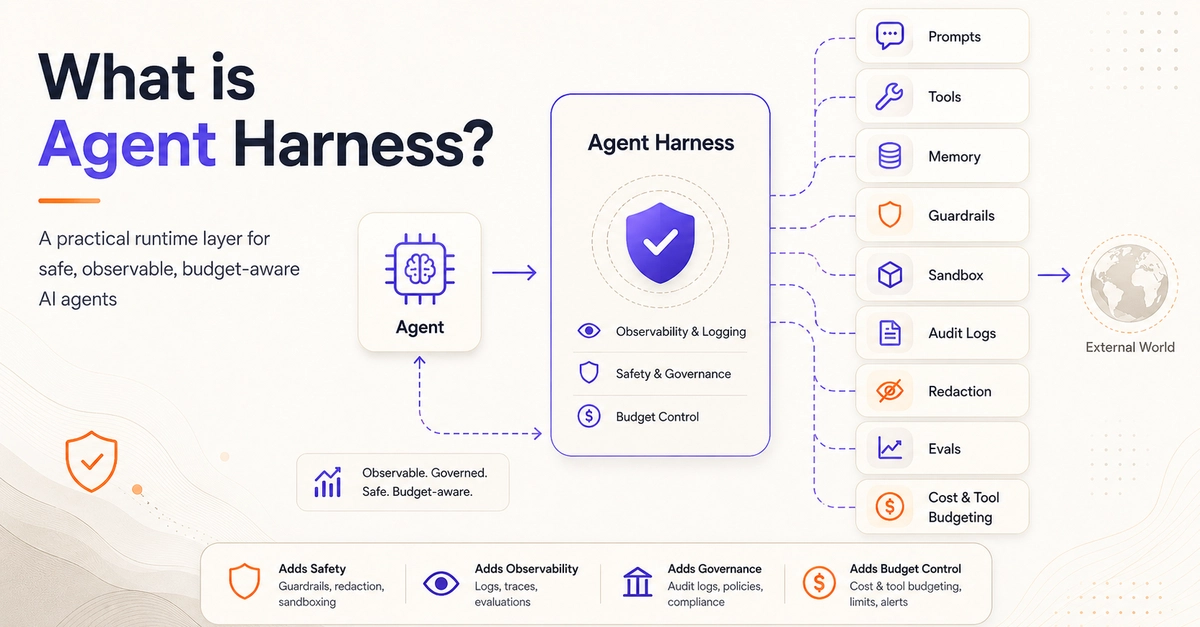
When building sophisticated AI systems, a common pitfall is treating the Large Language Model (LLM) as the entirety of an autonomous agent. This perspective is fundamentally flawed. The LLM itself is merely a reasoning engine; it provides the core intelligence for understanding, generating, and processing information. It does not inherently possess memory, the ability to interact with external systems, or the capacity for complex planning and execution. The true agent emerges from the comprehensive application layer built around this reasoning engine. This layer, known as the Agent Harness, is responsible for governing everything else that makes an AI system autonomous and functional.
Think of the LLM as the powerful engine of a car. It can generate immense power and perform complex computations. However, without the rest of the vehicle's components, it's just an engine sitting on a stand. The Agent Harness provides the steering wheel, the brakes, the transmission, the dashboard, and the chassis. It's the collection of components that allow the engine's power to be directed, controlled, and utilized safely and effectively to achieve a goal. This includes managing the agent's memory, enabling the execution of tools, defining its operational boundaries, and enforcing deterministic policies.
Key Components of an Agent Harness
The Agent Harness is a multifaceted system designed to provide an LLM with the capabilities required for autonomous operation. Its primary functions include:
Memory Management
Autonomous agents need to recall past interactions, learned information, and context to make informed decisions. The Agent Harness implements memory systems that can range from simple short-term context windows to complex long-term memory stores. This allows the agent to maintain a consistent understanding of its environment and objectives over extended periods, much like a human recalling previous conversations or experiences. Without robust memory, an agent would be perpetually starting from scratch, unable to learn or adapt.
Tool Execution
LLMs are confined to the information they were trained on. To interact with the real world or access dynamic data, agents require the ability to use tools. The Agent Harness provides the framework for defining, discovering, and executing these tools. This could involve calling APIs, running code, accessing databases, or interacting with other software services. The harness ensures that tool execution is secure, that inputs are validated, and that outputs are correctly interpreted and fed back to the LLM for further reasoning. For instance, an agent might use a search engine tool to fetch current news or a calculator tool to perform complex arithmetic.
Execution Boundaries and Security
Granting an LLM access to tools and memory introduces significant security risks. The Agent Harness establishes critical security boundaries and execution policies to prevent unintended or malicious actions. This includes sandboxing code execution, validating tool inputs and outputs, limiting access to sensitive data, and implementing rate limiting to prevent abuse. The harness acts as a security guard and a set of rules, ensuring the agent operates within safe and defined parameters. This is paramount when an agent is given access to production data or critical systems, as demonstrated by the potential risks when such access is mishandled.
Deterministic Policy Enforcement
While LLMs are inherently probabilistic, many agent applications require deterministic behavior for critical tasks. The Agent Harness can enforce policies that ensure consistency and predictability. This might involve ensuring that certain actions are always taken under specific conditions, or that the agent adheres to predefined ethical guidelines and operational protocols. This layer of control transforms the LLM's probabilistic output into reliable agent behavior.
The Evolution from Chatbots to Autonomous Agents
The transition from building simple chatbots to developing fully autonomous AI agents necessitates a shift in architectural thinking. Chatbots typically operate in a reactive mode, responding to direct user prompts within a limited context. Autonomous agents, on the other hand, are proactive. They can set their own goals, plan sequences of actions, and execute those actions over time without constant human supervision. This leap in capability is enabled by the Agent Harness. It provides the agent with the agency—the ability to act independently—by equipping the LLM with the necessary infrastructure for memory, tool use, and goal-directed execution.
Without an Agent Harness, an LLM given broad access to systems would be like a powerful but untamed force, prone to errors, security breaches, and unpredictable behavior. The harness structures this power, channeling it towards specific objectives in a controlled and secure manner. It’s the difference between a raw computational engine and a functional, reliable AI system capable of performing complex tasks in the real world.