
The Unsold Slack: A Divergent Path
The question of what might have been for Slack, had it not been acquired by Salesforce for $27.7 billion in 2020, is a compelling thought experiment for anyone tracking the enterprise software landscape. Julian Lehr’s recent inquiry on X sparked a debate about an alternate reality: an independent Slack, doubling down on its core communication platform while aggressively integrating artificial intelligence. This hypothetical scenario offers a unique lens through which to examine Slack’s product trajectory, its market position, and its potential valuation today.
In this alternate timeline, Slack likely would have continued its rapid ascent, not as a component of a larger CRM behemoth, but as a standalone communications powerhouse. The core product, the digital headquarters for millions, would have evolved with a singular focus on enhancing team collaboration and productivity. Instead of being integrated into the Salesforce ecosystem, its development would have been driven solely by the demands of its massive user base and the competitive pressures of a rapidly evolving communication tools market.
The most significant divergence would undoubtedly be Slack’s approach to AI. While Salesforce has integrated Slack into its Einstein AI strategy, an independent Slack would have had the freedom to pursue its own AI-first roadmap. This could have meant deeper, more intuitive integrations with generative AI models, enabling features like automated meeting summaries, intelligent task delegation, proactive information retrieval, and even AI-powered workflow automation directly within conversations. Imagine a Slack bot that doesn't just answer questions, but anticipates needs based on ongoing discussions and project context, drawing from a vast, self-curated knowledge base unique to each organization.

Product Evolution: AI as the Core, Not an Add-on
An independent Slack’s product strategy would likely mirror the industry’s broader shift towards AI-native applications. Rather than viewing AI as a set of features to be bolted onto an existing platform, Slack would have positioned AI as the fundamental layer of its service. This would manifest in several key areas:
- Intelligent Information Synthesis: Beyond simple search, AI could analyze entire conversation histories, project threads, and shared documents to provide context-aware summaries. This would dramatically reduce the time spent catching up on missed discussions or searching for critical information scattered across channels. Think of it less like a search engine and more like a hyper-efficient team assistant who has read and understood everything relevant.
- Proactive Assistance and Automation: AI could identify action items, potential bottlenecks, or knowledge gaps within conversations and proactively suggest solutions or assign tasks. Automated workflows, triggered by specific keywords or events in channels, could become far more sophisticated, handling routine requests and freeing up human bandwidth for more complex work.
- Personalized Collaboration Experience: An AI layer could tailor the Slack experience to individual users, prioritizing messages, surfacing relevant files, and suggesting relevant channels or colleagues based on their role, current projects, and communication patterns. This moves beyond simple notifications to a truly adaptive communication environment.
- Enhanced Developer Ecosystem: With its own AI roadmap, Slack could foster a new generation of AI-powered apps and integrations within its App Directory. Developers could build tools that leverage Slack’s conversational data and AI capabilities to create highly specialized productivity solutions, further cementing Slack’s role as a central hub for work.
This AI-centric approach would differentiate Slack from competitors that might be slower to adopt such deep integrations or that are constrained by broader corporate strategies. The focus would remain squarely on making communication more intelligent, efficient, and valuable, reinforcing Slack’s position as the indispensable digital headquarters.
Financial Projections: A $2.5 Billion ARR Reality?
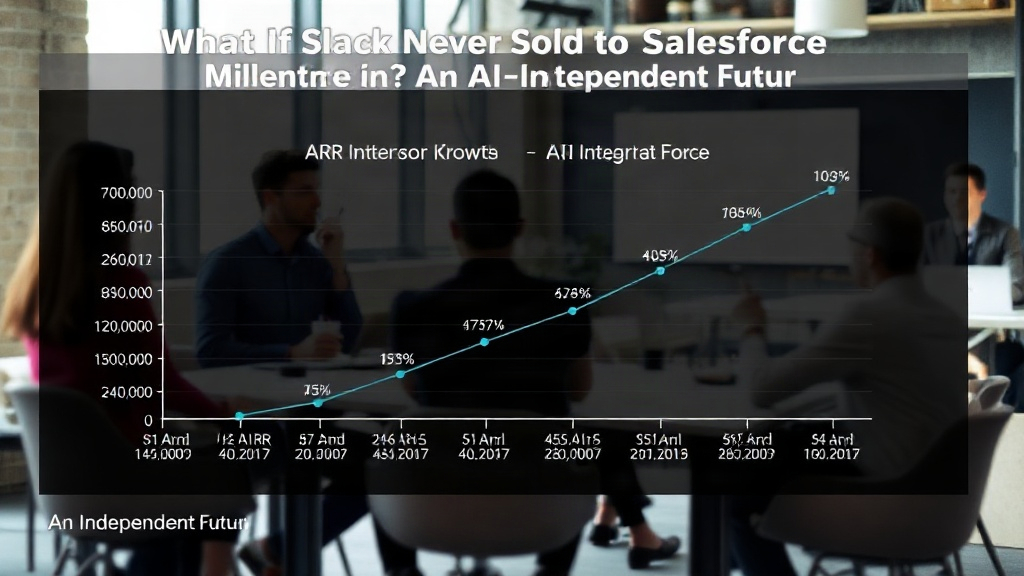
The question of valuation is complex, but the projections suggest a robust, albeit perhaps not $27 billion, independent future. Analysts like Lehr suggest an independent Slack could be achieving around $2.5 billion in Annual Recurring Revenue (ARR) with a healthy 25% year-over-year growth rate. This figure is based on Slack’s trajectory prior to the acquisition and its continued market penetration.
At a 25% growth rate, Slack would be demonstrating sustained momentum in the enterprise collaboration space. This level of growth, combined with its strong brand recognition and massive user base, would certainly make it an attractive acquisition target or a strong candidate for an independent public offering. However, the market’s current appetite for high-growth, unprofitable tech companies has shifted. While $2.5 billion in ARR is substantial, the multiples applied to SaaS companies have fluctuated significantly since 2020.
If Slack had remained independent and executed an AI-first strategy, its valuation would be heavily influenced by its ability to monetize these new AI capabilities. The premium Salesforce paid was not just for Slack’s existing ARR but for its strategic position within the enterprise, its user base, and the potential for integration. An independent Slack would need to demonstrate a clear path to increased revenue and profitability driven by its AI innovations to command a valuation anywhere near the Salesforce acquisition price.
Market Context and Competitive Landscape
In the absence of the Salesforce acquisition, Slack would have faced an increasingly competitive landscape. Microsoft Teams, already a formidable rival, would likely have continued its aggressive push, leveraging its bundled Office 365 ecosystem. Other players, such as Zoom, Google Workspace, and a host of specialized collaboration tools, would also continue to vie for market share.
However, Slack's hypothetical AI-first strategy could have provided a significant competitive moat. By deeply embedding AI into its core communication functions, it could have created a stickier product that offered distinct advantages over less integrated or less intelligent alternatives. The ability to offer truly transformative AI-driven productivity gains would be a powerful differentiator.
The broader trend towards hybrid and remote work would continue to fuel demand for robust collaboration platforms. An independent Slack, unburdened by the need to align with Salesforce’s broader CRM strategy, could have focused entirely on optimizing the remote and hybrid work experience. This singular focus, coupled with a forward-thinking AI strategy, might have allowed it to maintain a leading position, even against giants like Microsoft.
The Unanswered Question: Monetization of AI
The critical unknown in this hypothetical scenario is how effectively an independent Slack could monetize its advanced AI features. While the *potential* for AI-driven productivity gains is clear, translating that into tangible revenue growth that justifies a $27 billion valuation is a significant challenge. Would users pay a substantial premium for AI-enhanced communication, or would these features become expected, commoditized elements of the platform? The success of an independent Slack would hinge on its ability to prove that its AI investments translate into a clear, defensible revenue stream, a feat that many companies are still grappling with today.