The Core Challenge: Real-Time Resilience
Building real-time systems that are not only fast but also resilient and highly available is a critical challenge in modern software architecture. From collaborative applications and live dashboards to gaming and IoT, the demand for instant, uninterrupted data flow is pervasive. The inherent difficulty lies in managing state, ensuring message delivery, and maintaining connections under varying loads and potential failures. A single point of failure can cripple an entire application, leading to user frustration and lost business. Achieving true resilience requires careful consideration of communication protocols, data handling, and architectural patterns that can distribute load and recover from disruptions.
This deep dive explores how WebSockets, for persistent bidirectional communication, and Redis, for high-performance data storage and messaging, can be combined to create robust real-time solutions capable of withstanding failures and scaling gracefully. By understanding the mechanics of each technology and how they interact, developers can architect systems that deliver seamless, real-time experiences even in demanding environments.
WebSockets: The Foundation of Real-Time Communication
WebSockets provide a persistent, full-duplex communication channel over a single TCP connection. Unlike traditional HTTP, which requires a new request for each piece of data, WebSockets allow the server to push data to the client and the client to send data to the server at any time, without the overhead of establishing new connections. This makes them ideal for applications requiring low latency and real-time updates.
Understanding WebSocket Mechanics
The WebSocket protocol begins with an HTTP handshake. A client sends an HTTP request with an 'Upgrade' header to the server. If the server supports WebSockets, it responds with an HTTP 101 Switching Protocols status, effectively upgrading the connection from HTTP to the WebSocket protocol. Once established, the connection remains open until explicitly closed by either the client or the server. Data is then exchanged in frames, which can be text or binary, allowing for efficient transmission of various types of information.
Scaling WebSocket Servers
Scaling WebSocket servers presents unique challenges. Traditional load balancing methods, which often rely on sticky sessions or round-robin distribution, can be problematic. Sticky sessions ensure a client always connects to the same server instance, which can lead to uneven load distribution and make it difficult to handle server failures. Round-robin might not account for the stateful nature of WebSocket connections, where a client is tied to a specific server. To overcome this, architectures often employ a reverse proxy or load balancer that can manage connections and distribute them across a pool of WebSocket servers. Techniques like connection multiplexing and efficient state management are crucial. Furthermore, managing millions of persistent connections requires significant server resources and careful optimization of network I/O. A common approach is to use a message broker or a distributed pub/sub system to decouple clients from specific server instances, allowing any server to handle messages for any client.
Redis: The High-Performance Backbone
Redis, an in-memory data structure store, serves as an excellent choice for real-time applications due to its speed, versatility, and built-in features for messaging and caching. Its low latency and support for various data structures like lists, sets, and sorted sets make it suitable for managing real-time data and facilitating inter-service communication.
Redis as a Message Broker
Redis Pub/Sub is a powerful pattern for building real-time communication systems. A publisher sends messages to named channels, and any clients subscribed to those channels receive the messages. This decouples senders from receivers, enabling a scalable architecture where multiple clients can receive the same message without the server needing to track each individual client connection explicitly. This is particularly useful when scaling WebSocket servers, as a single Redis channel can broadcast messages to all connected WebSocket clients, regardless of which server instance they are connected to.
Caching and State Management with Redis
Beyond messaging, Redis excels at caching frequently accessed data, reducing the load on primary databases. In real-time systems, this can include user presence information, session data, or frequently updated metrics. By keeping this data in memory, Redis provides sub-millisecond access times, which is critical for responsive real-time UIs. Managing user sessions or tracking the online status of users can be efficiently handled using Redis. For instance, when a WebSocket connection is established, the server can update a Redis key indicating the user is online. When the connection closes, the key can be removed or updated.
Architecting for High Availability
Building a truly resilient real-time system means designing for failure. This involves eliminating single points of failure and ensuring that the system can continue operating even if components fail.
Redundancy and Failover
High availability is achieved through redundancy. This means having multiple instances of each critical component – WebSocket servers, Redis instances, and any other services. For Redis, this often involves setting up master-replica configurations or Redis Sentinel for automatic failover. If a master Redis instance fails, a replica can be promoted to master with minimal downtime. Similarly, multiple WebSocket server instances behind a load balancer ensure that if one server goes down, traffic is automatically rerouted to healthy instances.
Graceful Degradation and Recovery
Even with redundancy, failures can occur. A resilient system should be able to degrade gracefully. For example, if a Redis cache becomes temporarily unavailable, the application might continue to function using stale data from its own memory or by fetching data directly from a slower data source, rather than crashing. Mechanisms for automatic recovery are also essential. When a failed component comes back online, the system should be able to reintegrate it seamlessly. This might involve re-establishing connections, resynchronizing data, or rejoining a cluster. The use of Redis Pub/Sub simplifies recovery for messaging, as new subscribers simply start listening to messages published after they join the channel.
Putting It All Together: A Resilient Architecture
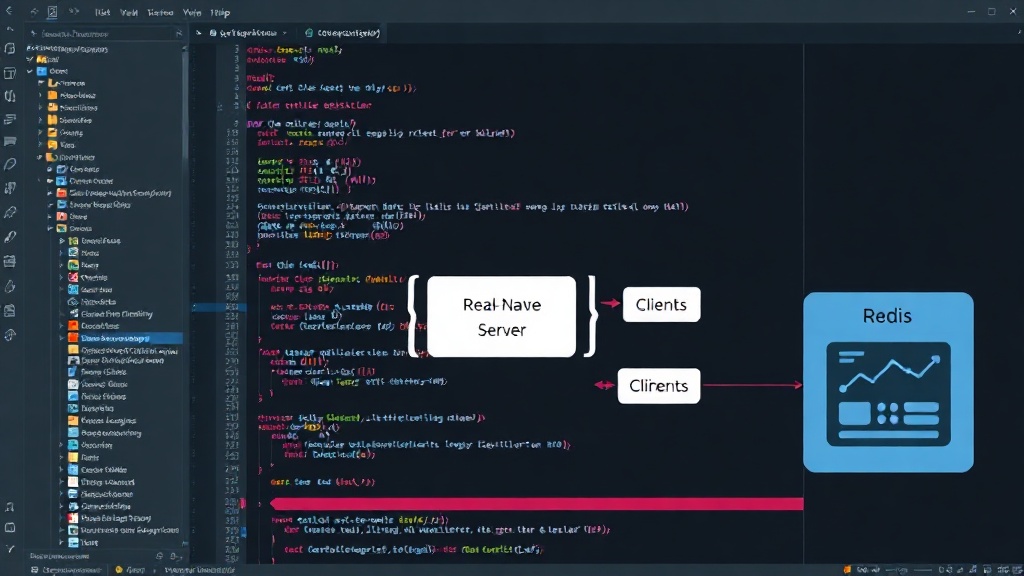
A typical resilient real-time architecture might look like this: Clients connect to a fleet of WebSocket servers managed by a load balancer. These WebSocket servers, in turn, communicate with a Redis cluster for message broadcasting and data caching. When a client sends a message, the WebSocket server might publish it to a Redis channel. Other WebSocket servers subscribed to this channel receive the message and push it to their respective connected clients. User presence, session data, and other ephemeral state are managed in Redis. For Redis high availability, a master-replica setup with Sentinel ensures that data is not lost and service remains available during failovers. This layered approach, combining the persistent connection capabilities of WebSockets with the speed and pub/sub features of Redis, creates a system that is both responsive and robust against failures.
The surprising detail here is not the inherent complexity of real-time systems, but how seemingly simple tools like WebSockets and Redis, when combined with thoughtful architectural patterns, can address these challenges effectively. The key is understanding their strengths and weaknesses and orchestrating them to create a fault-tolerant whole.
The Unanswered Question: Evolving Standards
What nobody has fully addressed yet is how evolving browser standards and network conditions might impact the long-term viability and performance of these established patterns. As new protocols emerge and network infrastructure changes, continuous adaptation will be key to maintaining resilience.