The Shifting Landscape of AI Terminals
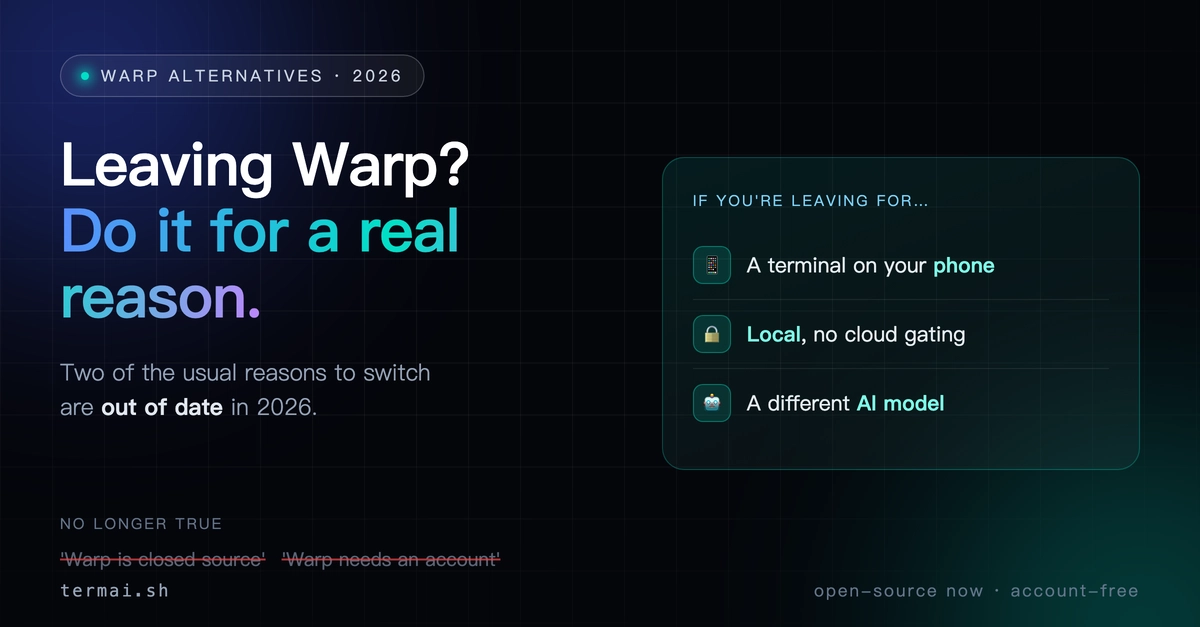
The conversation around Warp terminal alternatives in 2026 is fundamentally different than it was even a year ago. Two significant shifts have neutralized common migration drivers: Warp's mandatory login requirement was removed in November 2024, and the terminal client itself became open-source (AGPL-3.0) in April 2026. These changes mean that if you're considering alternatives, you should base your decision on current needs, not outdated complaints.
This article examines the current landscape of terminal emulators and AI-enhanced shells, focusing on why developers and power users might choose an alternative to Warp today, and which options best fit specific use cases. The core value proposition of Warp—its AI-powered features, streamlined workflow, and collaborative capabilities—is now being matched or complemented by other tools, but the reasons for switching are more nuanced than before.
When to Look Beyond Warp
The original friction points that drove users away from Warp are largely resolved. The forced login, a significant privacy concern for many, is a relic of the past. Similarly, the formerly closed-source nature of the client, which raised questions about transparency and customizability, has been addressed by its open-sourcing under the AGPL-3.0 license. This means the decision to seek an alternative is now driven by specific feature gaps or preferences rather than fundamental platform issues.
Here are the primary scenarios where an alternative terminal or shell might be a better fit for your workflow in 2026:
Mobile AI Access: The Unfilled Gap
Warp has not yet released a mobile application for iOS or Android. For developers who need AI-assisted terminal capabilities on the go, this represents a significant gap. The most direct alternative in this niche is TermAI. While TermAI may not replicate all of Warp's desktop features, it aims to provide AI-powered command suggestions, explanations, and code generation directly on mobile devices, allowing for productivity without a laptop.
The challenge for mobile terminal solutions is often balancing power with usability on smaller screens and touch interfaces. TermAI's success hinges on its ability to deliver a genuinely useful AI experience that doesn't feel shoehorned into a mobile environment. For many, the ability to quickly look up a command or get a shell prompt explanation from their phone could be invaluable, making TermAI the go-to for this specific need.
Open-Source Flexibility and BYO-Model
For users who prioritize a fully open-source ecosystem and granular control over their AI models, Wave Terminal stands out. Licensed under Apache-2.0, Wave Terminal offers a compelling alternative. It provides AI features without the subscription or credit-based system often associated with commercial products like Warp. Instead, users are empowered to bring their own models and API keys, offering significant cost savings and greater privacy for those with existing AI infrastructure or a preference for specific open-source models.
This approach is particularly attractive to organizations with strict data governance policies or research teams experimenting with various large language models. The ability to integrate Wave Terminal with proprietary or fine-tuned models, without being tied to a vendor's roadmap or pricing structure, offers a level of freedom that Warp, despite its open-source client, does not match. The freedom to use any compatible LLM backend is a powerful differentiator for Wave Terminal.
Lean, Fast, and Native Mac Experience
For Mac users who prioritize raw performance, minimal resource usage, and a native feel, without necessarily needing integrated AI features, there are excellent, established alternatives. Ghostty, licensed under MIT, is a modern, native terminal emulator built for macOS. It's known for its speed, lack of telemetry, and clean interface. Similarly, iTerm2 remains a perennial favorite among Mac developers. It offers a vast array of customization options, robust features like split panes and triggers, and a highly responsive experience.
These terminals focus on the core functionality of a terminal emulator—speed, reliability, and extensibility—without the added complexity or resource overhead that AI features can introduce. If your workflow doesn't heavily rely on AI assistance within the terminal itself, or if you prefer to pipe your terminal output to separate AI tools, Ghostty and iTerm2 offer a lean, highly performant alternative that respects system resources.
The Evolution of AI in Terminals
Warp's journey from a closed-source, login-required application to an open-source project highlights a broader trend in developer tools: the integration of AI and the increasing demand for transparency. While Warp has addressed its most criticized aspects, the emergence of specialized alternatives demonstrates that a one-size-fits-all solution is unlikely. TermAI caters to mobile users, Wave Terminal appeals to the open-source purist and cost-conscious AI user, and Ghostty/iTerm2 serve those prioritizing native performance.
The question for developers in 2026 is no longer *if* they should switch from Warp due to outdated reasons, but *which* tool best aligns with their current technical requirements, budget, and philosophical preferences regarding open-source software and AI integration. The terminal landscape is diversifying, offering more tailored solutions than ever before.