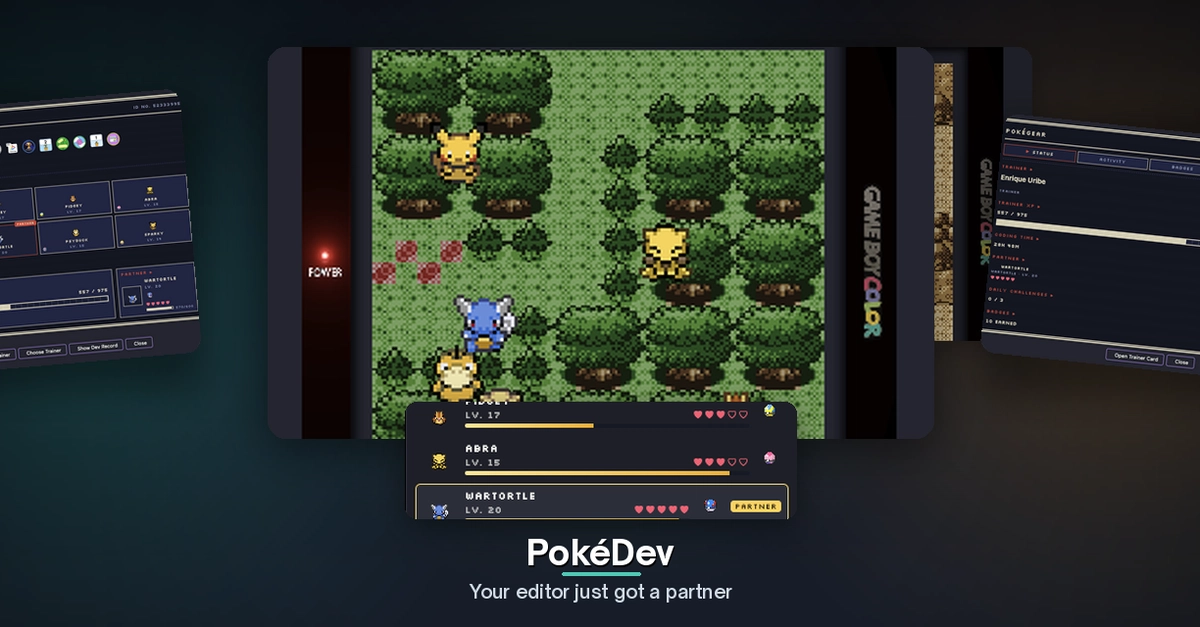
Beyond Static Companions: The Rise of Interactive Editor Pets
Many developers adorn their coding environments with digital companions. These virtual pets, often found in IDE extensions, typically serve as static decorations. They might change expression or offer a fleeting animation, but their existence is largely divorced from the actual work a developer performs. This disconnect inspired developer UribeJr to build PokéDev, a VS Code and Cursor extension that bridges this gap by directly tying a virtual pet’s growth to tangible development milestones.
PokéDev transforms your editor into a nostalgic 2D overworld or a classic floor-pet environment. Your virtual partner, a Pokémon in this case, gains experience points (XP) not from arbitrary clicks, but from the core actions that define a developer’s workflow: saving files, committing code, and achieving successful builds or tests. For those working with Shopify themes and apps, PokéDev even integrates outcomes from those specific development environments into the leveling system.

Gamifying the Grind: How PokéDev Rewards Core Development Actions
The fundamental premise of PokéDev is to make the often-monotonous aspects of software development more engaging. Instead of abstract progress bars or generic productivity metrics, the extension offers a visual and interactive representation of achievement through a familiar gaming mechanic: leveling up.
The system is designed to reward the actions that directly contribute to shipping code. Each time a developer saves a file, it contributes a small amount of XP to their partner. Committing code, a more significant step in the development lifecycle, grants a larger XP boost. The ultimate validation of work – a successful build or test run – provides the most substantial XP reward. This tiered approach encourages consistent progress and celebrates successful outcomes, reinforcing positive development habits.
For developers specializing in e-commerce platforms like Shopify, PokéDev offers tailored integration. Successfully deploying a theme update or passing tests for a Shopify app, for example, is recognized by the extension, translating real-world project success into virtual pet progression. This specific integration acknowledges the diverse workflows within the developer community and aims to make the tool relevant across different specializations.
The Technical Implementation: Connecting Editor Activity to Game Logic
Under the hood, PokéDev leverages VS Code’s extension API to monitor user activity. It hooks into events such as file saves, Git commit operations, and the output of build and test commands. For more specialized integrations, like Shopify, it likely involves parsing specific output logs or monitoring project file changes associated with those platforms.
The choice of a Pokémon theme is strategic. The franchise is globally recognized for its core loop of training and evolving creatures, making the concept of leveling up and evolving a virtual pet immediately understandable and appealing to a broad audience. The nostalgic appeal of 2D overworlds or simpler floor-pet aesthetics further enhances the user experience, evoking a sense of comfort and familiarity.
The extension’s repository, available on GitHub, indicates a project built with a clear vision for developer experience enhancement. While the current iteration focuses on VS Code and Cursor, the underlying principles could theoretically be adapted to other IDEs or even different gamification themes. The success of such an extension hinges on its ability to remain unobtrusive while providing meaningful, motivating feedback. It's less about adding a distraction and more about reframing existing work into a more rewarding context.
What’s Next for Editor Gamification?
PokéDev’s approach raises an interesting question: what happens when these gamified elements become integral to a developer’s workflow, and what if the underlying platform changes? If a developer builds a significant portion of their motivation around their digital pet’s progression, a major IDE update or a shift to a new tool could feel like losing a progress bar they’ve invested weeks or months into. This isn't just about aesthetics; it’s about the psychological anchor these tools can provide.
The surprising detail here is not the creation of another “editor pet,” but the direct and meaningful connection to tangible development outputs. Many similar tools remain superficial, offering little more than cosmetic flair. PokéDev, by contrast, ties itself directly to the definition of “shipping” – saving, committing, building, and testing successfully. This makes it more than just a cute addition; it becomes a subtle, ongoing reward system for the core activities of software development.
For founders and product managers, this highlights an untapped area in developer tooling: intrinsic motivation through gamification. Tools that can genuinely tap into the desire for progress and achievement, by aligning with the developer’s actual work, could see significant adoption. The challenge lies in creating systems that are robust, unobtrusive, and genuinely rewarding without becoming a source of anxiety or a distraction from the primary task of building software.