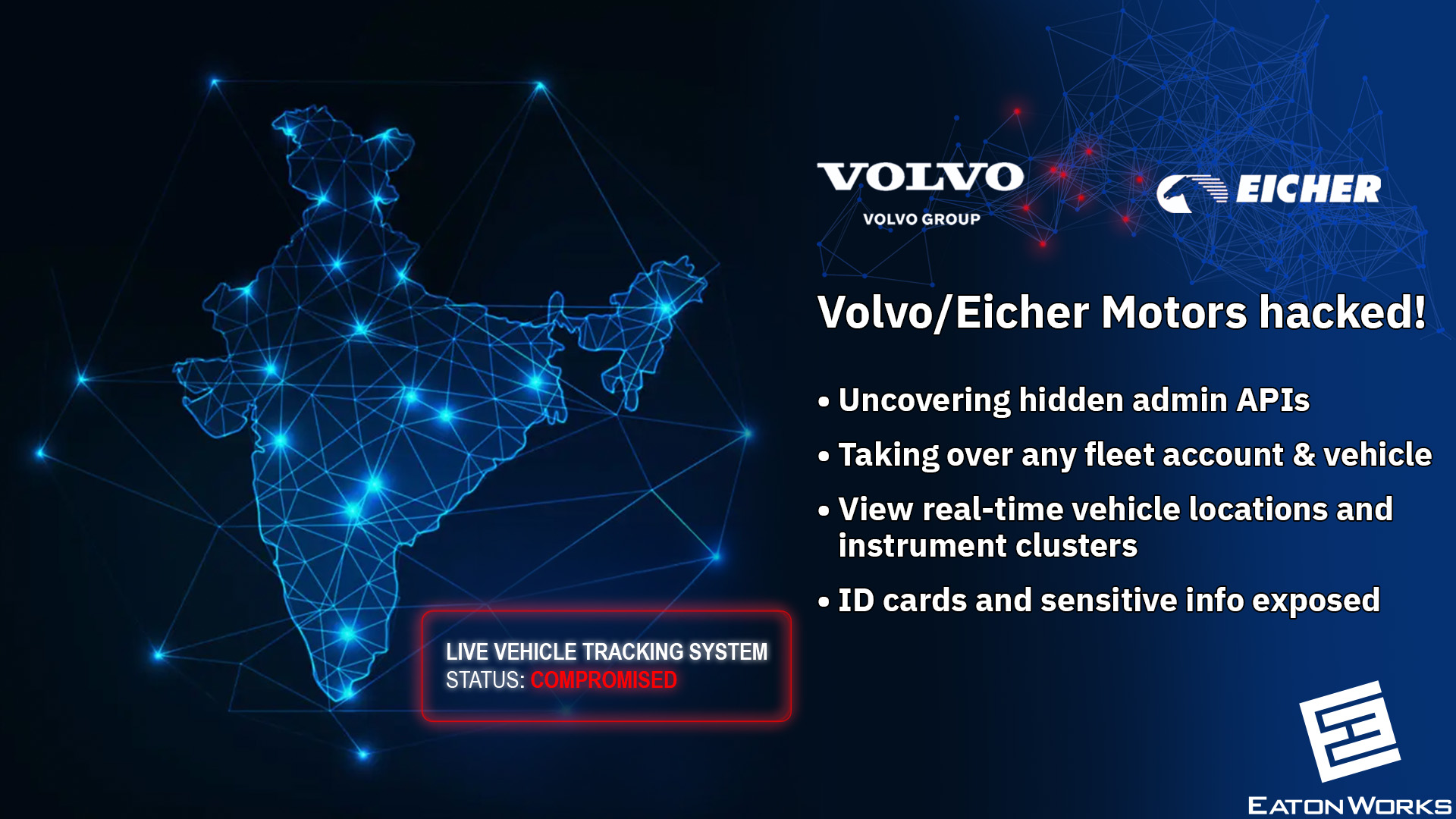
The Vulnerability Uncovered
A significant security vulnerability has been identified within the fleet management platform used by Volvo and Eicher, potentially allowing attackers to gain unauthorized control over all connected users and vehicles. This flaw, if exploited, could have widespread implications for logistics, transportation, and the safety of drivers and the public.
The vulnerability stems from a fundamental oversight in how the platform authenticates and authorizes access to sensitive fleet data and control functions. While the specifics are being withheld to prevent immediate exploitation, the core issue lies in a susceptibility that bypasses standard security protocols. This isn't a subtle bug; it's a gaping hole that could allow a malicious actor to act as a super-administrator across the entire network.
Think of the platform like a central command center for a fleet of trucks. Each driver has a key card (authentication) to access their specific truck, and the dispatcher has a master key (authorization) to manage the whole fleet. This vulnerability is akin to finding a way to forge master key cards that also grant you dispatcher-level access, allowing you to not only start any truck but also reroute it, disable it, or monitor its every move without proper authorization.
Technical Deep Dive: Authentication and Authorization Flaws
At the heart of the exploit is a weakness in the platform's authentication mechanism. Sources suggest that the system may rely on predictable or easily guessable tokens, or worse, fails to adequately validate session integrity after initial login. This could allow an attacker to hijack legitimate user sessions or impersonate authorized personnel. For instance, if a user's session token is transmitted insecurely or can be brute-forced, an attacker could intercept it or generate a valid one without needing the user's credentials.
Furthermore, the authorization model appears to lack granular control and robust checks. Once an attacker gains a foothold, even with limited privileges, the vulnerability reportedly allows for privilege escalation. This means a low-level access token could be leveraged to obtain administrative rights, granting control over vehicle telematics, ignition, speed limiters, and potentially even navigation systems. The potential for remotely disabling vehicles or manipulating their operational parameters is a critical concern.
The scale of the potential compromise is what makes this vulnerability particularly alarming. Unlike typical exploits that might affect a single user or a small group, this flaw appears to grant access to the entire user base and all vehicles registered on the platform. This could include thousands of commercial trucks, buses, and other heavy-duty vehicles operating under the Volvo and Eicher brands globally.
Implications for Fleet Operators and Safety
For fleet operators, the implications are severe. Unauthorized access could lead to:
- Theft of Sensitive Data: Route information, delivery schedules, driver logs, and customer data could be compromised.
- Operational Disruption: Vehicles could be remotely disabled, rerouted, or prevented from operating, causing significant delays and financial losses.
- Sabotage: Malicious actors could intentionally cause accidents by manipulating vehicle controls, posing a direct threat to driver and public safety.
- Ransomware Attacks: Attackers could hold fleets hostage, demanding payment to restore control or prevent data leaks.
The lack of immediate, widespread patching and the complexity of securing large fleets mean that even after the vulnerability is disclosed, many vehicles could remain exposed for an extended period. This scenario highlights the increasing cybersecurity risks inherent in connected vehicle technology and the critical need for robust, end-to-end security architectures.
The Unanswered Question: What About Legacy Systems?
What nobody has addressed yet is the fate of older vehicles or those operating on less frequently updated versions of the fleet platform. Are they equally susceptible? And if so, what is the remediation strategy for hardware that cannot easily receive software patches? The complexity of maintaining security across a diverse and evolving fleet, some of which may be in service for over a decade, presents a formidable challenge that extends far beyond a simple software update.
Mitigation and Disclosure
Details regarding the disclosure timeline and any official mitigation strategies from Volvo or Eicher have not yet been widely publicized. However, best practices for such vulnerabilities typically involve immediate patching of the core platform, followed by mandatory updates for all connected vehicles. Users are strongly advised to monitor official communications from Volvo and Eicher for security advisories and to implement any recommended security enhancements without delay. For companies operating large fleets, a comprehensive security audit of their connected vehicle infrastructure is now a critical imperative.
The discovery of this vulnerability underscores a broader trend: as vehicles become more connected and reliant on sophisticated software platforms, their attack surface expands dramatically. This incident serves as a stark reminder that cybersecurity must be a foundational element in the design, deployment, and ongoing management of automotive and transportation technologies.