
The Flaw in Streaming ASR's Speed Obsession
The core assumption underpinning most Automatic Speech Recognition (ASR) systems, particularly those designed for streaming, is that the output transcript will eventually be read by a human. This assumption, deeply ingrained in decades of captioning and dictation technology, fundamentally misunderstands the needs of modern voice agents and AI systems. When a human reads subtitles, a millisecond correction from "fifteen" to "fifty" is inconsequential. The human brain can easily bridge the gap, and the error is effectively invisible. But for a voice agent, a translation engine, or a large language model (LLM) receiving this transcript as input, such rapid, mid-stream corrections can be catastrophic.
Imagine an agent that initiates a complex API call based on the word "fifteen." Moments later, the ASR corrects itself to "fifty." By then, the agent has already acted on incomplete or incorrect information. This creates a thorny dilemma: accept occasional flawed decisions, buffer all audio until a final, stable transcript is available (introducing significant latency), or engineer increasingly complex systems to reconcile these conflicting signals. This is not an interface problem; it's a fundamental mismatch between ASR's historical design and its emergent role as an input mechanism for autonomous AI.
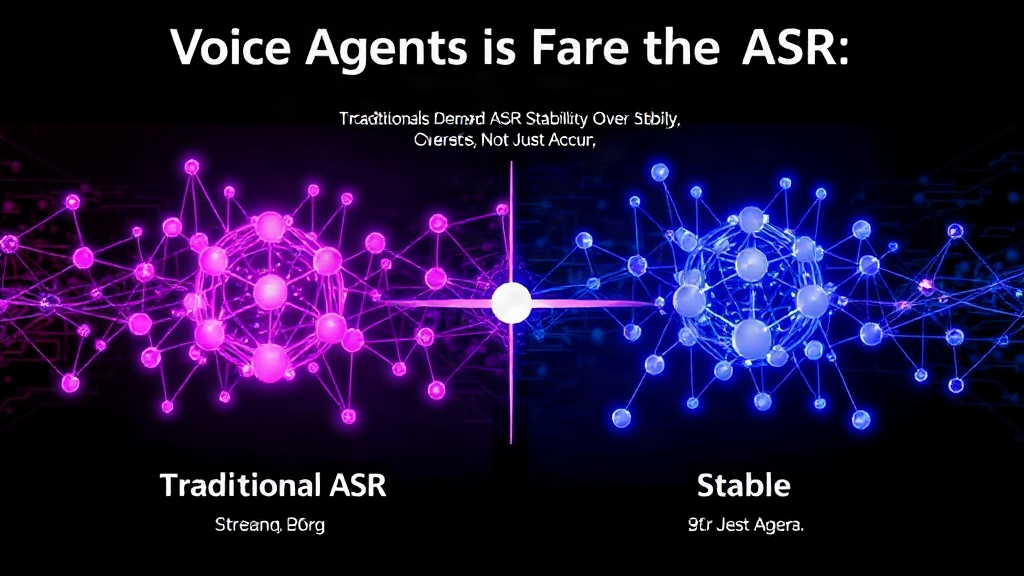
The realization is stark: the critical metric for ASR in the age of voice agents isn't raw speed or even absolute accuracy in isolation. It's stability. What voice agents need is a transcript that is reliable and predictable, rather than one that constantly rewrites itself. This suggests a paradigm shift from a system that prioritizes rapid, tentative predictions to one that aims for a definitive, immutable output. The goal should be to "never edit; only append." If there's doubt about a word or phrase, the ASR system should be able to pause, wait for more context, or signal uncertainty, rather than commit to a potentially incorrect prediction that triggers downstream actions.
The "Never Edit; Only Append" Mandate
Consider the implications of a stable ASR system. Instead of a dynamic, flickering transcript that might say "add one hundred dollars to the cart," then "add one thousand dollars to the cart," a stable system would hold off. It might output "add [uncertain: one hundred/one thousand] dollars to the cart" or simply wait until it has higher confidence, perhaps after the user finishes speaking or provides further clarification. The output would then definitively become "add one thousand dollars to the cart," and this append-only nature ensures that downstream systems receive a single, authoritative record of what was intended.
This approach mirrors how humans often process information when certainty is low. We might pause, ask for clarification, or wait for more data before committing to an action or statement. Applying this principle to ASR means building systems that are less about the immediate word-for-word transcription and more about understanding the user's intent with sufficient confidence to allow other systems to act. This involves a more sophisticated internal state management within the ASR, potentially incorporating confidence scores, contextual awareness, and explicit mechanisms for handling ambiguity.
The challenge lies in recalibrating the ASR architecture and its training data. Current models are often optimized for metrics like Word Error Rate (WER) on specific datasets, implicitly rewarding faster, albeit less certain, predictions. Shifting to stability as a primary objective requires rethinking loss functions, decoding strategies, and potentially introducing new evaluation metrics that specifically measure the stability and immutability of the transcript over time. It might also involve exploring techniques like confidence-weighted outputs or explicit uncertainty signaling, which are currently underdeveloped in mainstream ASR pipelines.
Redefining Performance Metrics for Voice Agents
The traditional ASR performance metrics – speed (latency) and accuracy (WER) – are insufficient for voice agents. Latency is still important, but not at the expense of stability. A voice agent that responds instantly with the wrong command is worse than one that takes a second longer but gets it right. Similarly, while accuracy is crucial, a system that rapidly corrects itself introduces a different kind of error: a logical inconsistency in the data stream that downstream systems must handle. This leads to a more complex user experience and increased engineering overhead.
The real goal for voice agents is task completion. This hinges on receiving a reliable, coherent representation of the user's intent. Stability in the ASR output directly contributes to this by providing a cleaner, more predictable input for the agent's natural language understanding (NLU) and execution modules. If the ASR can guarantee that once a segment of speech is transcribed and finalized, it will not change, then the agent can process it with much greater confidence and efficiency. This "finalized" state is key; it means the ASR has reached a high enough confidence level that further changes are unlikely.
This shift necessitates a re-evaluation of how we benchmark and deploy ASR systems. Instead of focusing solely on how quickly a system can produce *any* transcript, we must measure how quickly it can produce a stable and accurate transcript. This might involve metrics like "time to stable transcript," "rate of transcript revision," or "confidence-weighted accuracy." Developers building voice agents will need to understand these new performance characteristics to select and integrate ASR technologies effectively. If your ASR is constantly revising itself, it's not just a minor annoyance; it's a fundamental bottleneck to building reliable AI agents.
The Path Forward: Stability-First ASR
The age of voice agents is here, and it demands a new breed of ASR. The old model, optimized for human readers of captions, is breaking under the strain of feeding autonomous AI systems. The path forward requires a radical rethinking of ASR design principles, moving from a speed-and-accuracy-at-all-costs mentality to one that prioritizes stability and reliability. The "never edit; only append" philosophy offers a compelling blueprint.
This means ASR systems must become more judicious, willing to pause and gather more evidence rather than making premature, potentially incorrect, predictions. It means developing new metrics that reflect the needs of AI agents, focusing on the finality and trustworthiness of the transcript. For engineers and researchers, this presents a significant opportunity to innovate in ASR decoding, confidence estimation, and uncertainty handling. The future of voice interaction with AI hinges on our ability to build ASR systems that don't just hear, but reliably understand and commit.