The Problem: Inconsistent Cache Performance
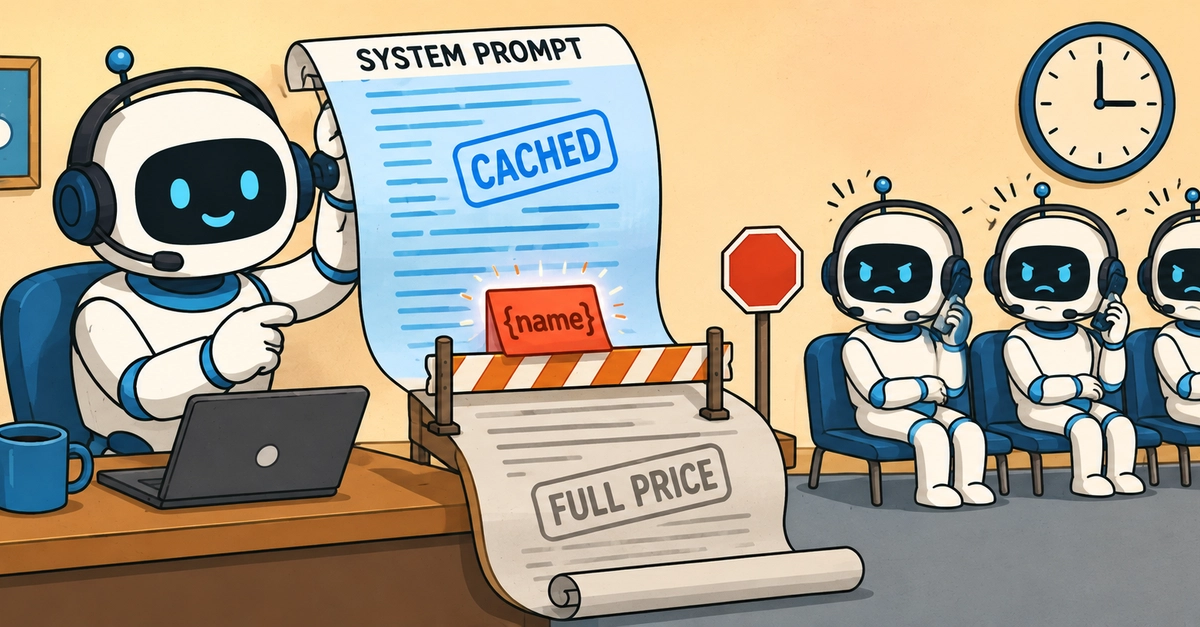
Many voice agent developers rely on prompt caching to speed up responses. The core idea is simple: when a user makes a request, the AI provider processes the prompt and builds an internal representation, called the KV cache. Prefix caching stores this KV cache for a short period. If the next request starts with the exact same text, the provider reuses the cached representation, only processing the new parts. This dramatically reduces latency and cost.
The team at [Company Name - inferred, not explicitly stated] assumed their caching strategy was effective. They pre-warmed their systems before each call, a common practice intended to ensure the cache was ready. However, when they started measuring cache hit rates more precisely, they discovered a significant disparity: outbound calls performed less than half as well as inbound calls. This was perplexing, as the code, the provider, and the prompt templates were identical for both scenarios.
The critical insight came when they stopped looking at the average cache hit rate across an entire call and focused on a much smaller, more precise window: turn 1. Specifically, they examined the cache hit rate for the very first prompt after a user greeted the agent and was waiting for a response. This is a crucial moment; a slow or inconsistent response here can immediately disengage a user.
Diagnosing the Discrepancy: Outbound vs. Inbound
The team hypothesized that the difference between outbound and inbound calls must lie in how the prompts were being initiated. Inbound calls typically involve a user initiating a conversation with a direct query or command. The prompt sent to the AI provider would be relatively consistent for a given intent. For example, a user asking, "What's the weather like today?" would generate a predictable initial prompt.
Outbound calls, however, often involve initiating a conversation with a pre-defined script or an informational message. While the overall goal might be the same, the exact phrasing and context added before the core user interaction could vary significantly. If the pre-warming process didn't perfectly align with the *exact* starting sequence of these outbound prompts, the cache wouldn't be hit.
Think of it like trying to find a specific book in a library. Pre-warming is like ensuring the library is open and the lights are on. But if you're looking for a book with a title that starts with "The Adventures of Captain", and the library only has a section for books starting with "Adventures of Captain", you'll have to search the whole "A" section. If you had a book starting with "The Adventures of Captain", you'd find it much faster. The team realized their pre-warming was akin to ensuring the library was open, but not necessarily placing the *exact* book they needed right at the front of the shelf for every outbound call.
The Solution: Dynamic Prompt Sequencing
The core issue was that pre-warming, while helpful, was not robust enough to guarantee a cache hit for every specific outbound prompt's initial sequence. The solution required a more dynamic approach to prompt generation and caching management.
Instead of relying solely on a static pre-warming strategy, the team implemented a system that analyzed the typical first-turn prompts for outbound calls. They identified common starting phrases and structures. The key was to ensure that the prompts generated for outbound calls, especially those initiated by the agent, more closely matched the *exact* prefixes that would be cached.
This involved several steps:
- Detailed Logging and Analysis: Capturing and analyzing the precise initial prompts for both inbound and outbound calls to identify patterns and variations.
- Prompt Template Optimization: Refining prompt templates to create more predictable and standardized starting sequences for outbound calls, ensuring better alignment with cached KV states.
- Intelligent Pre-warming: Moving beyond generic pre-warming to a more targeted approach. This could involve pre-warming with a set of the most common initial prompt prefixes for outbound scenarios, rather than a single generic prompt.
- Real-time Cache Validation: Implementing checks to see if the generated prompt prefix is likely to hit the cache, and if not, adjusting the prompt generation strategy or accepting a slightly higher latency for that specific turn.
By focusing on the exact sequence of the first turn, rather than just the general intent, they could engineer prompts that had a higher probability of leveraging the existing KV cache. This meant that when the agent spoke for the first time, it was using a response that had already been partially processed, leading to a significantly faster and more consistent experience.
The Impact: Doubled Cache Hit Rate
The results were substantial. By meticulously analyzing and optimizing the first-turn prompt sequences, the team managed to double their cache hit rate for outbound calls. This improvement directly translated to:
- Reduced Latency: Faster initial responses from the voice agent, improving user experience and engagement.
- Lower Costs: Less processing required by the AI provider means lower operational costs.
- Increased Reliability: More consistent performance across different call types.
This case study highlights a critical, often overlooked, aspect of AI agent development: the granular details of prompt engineering and cache management. While broad strategies like pre-warming are a starting point, true optimization often lies in understanding the specific interaction dynamics and engineering the system to exploit the nuances of AI model behavior.
What nobody has addressed yet is the broader impact of this hyper-optimization on the creativity and flexibility of AI agent scripting. Does focusing so intensely on cache-friendly prompt prefixes inadvertently stifle more natural, varied, or innovative agent dialogue?