Introducing the VModal Flutter SDK
Flutter developers are accustomed to SDKs for common tasks like authentication, analytics, cloud storage, and database interactions. The VModal Flutter SDK offers a different proposition: a client library designed to interface with an AI-powered video platform. Instead of performing complex AI inference directly on a user's device, this SDK acts as a sophisticated conduit. It manages the essential connections between a Flutter application and the VModal cloud infrastructure, streamlining processes like user authentication, uploading video media, indexing content for retrieval, and executing semantic searches.
The core value of the VModal SDK lies in its abstraction of the underlying AI complexities. Developers can integrate powerful video search and management capabilities into their applications without needing to build or manage the AI models themselves. This approach allows for faster development cycles and leverages the specialized expertise and resources of the VModal platform.
Project Architecture and Modularity
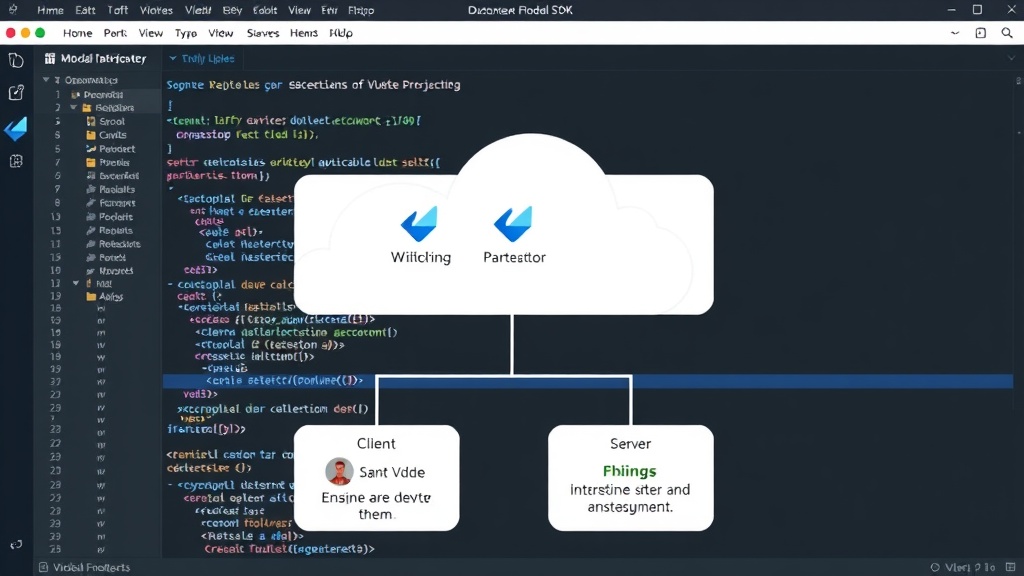
The SDK is built around a clean, modular architecture, centered on a single VmodalClient instance. This client serves as the primary entry point for all interactions with the VModal cloud platform. From this central point, developers can access distinct modules for various functionalities:
- Authentication: Handles secure user login and session management with the VModal platform.
- Search: Enables semantic search queries against indexed video content.
- Collections: Allows for the organization and management of video assets into logical groups.
- Images: Provides capabilities for interacting with image data related to videos, potentially for thumbnails or frame extraction.
- Admin: Offers administrative functions for managing the VModal platform resources.
These modules communicate through an HTTP Transport layer, which in turn interfaces with the VModal Cloud Platform. This layered design promotes maintainability and allows for easier expansion of features in the future. The emphasis on a single client instance simplifies integration, as developers only need to manage one connection object to access the full suite of VModal's AI video capabilities.
Key Functionalities and Use Cases
The VModal Flutter SDK unlocks several powerful AI-driven video functionalities for mobile applications. For developers building content platforms, educational apps, or any application dealing with video libraries, the SDK provides a robust set of tools.
Semantic Search: This is perhaps the most compelling feature. Unlike traditional keyword-based search, semantic search understands the context and meaning behind a query. For example, a user could search for "people enjoying a picnic in a park" and the SDK, via the VModal cloud, would return videos matching that description, even if the words "picnic" or "enjoying" are not explicitly in the video's metadata or transcript. This is achieved through advanced natural language processing (NLP) and computer vision models running on the VModal platform.
Media Upload and Indexing: The SDK simplifies the process of uploading video files from a Flutter application to the VModal cloud. Once uploaded, the platform automatically processes and indexes the video content. This indexing can include generating transcripts from audio, identifying objects and scenes within the video frames, and creating embeddings for semantic understanding. Developers don't need to worry about the heavy lifting of video processing; the SDK and platform handle it.
Collection Management: Organizing large video libraries is crucial. The SDK allows developers to create, manage, and associate videos with collections. This could be used to group videos by topic, event, user, or any custom categorization scheme. This feature is essential for building user-friendly interfaces that allow viewers to easily navigate and discover relevant content.
Authentication and Administration: Secure access is paramount. The SDK integrates with VModal's authentication system, ensuring that only authorized users can upload, manage, or search content. The administrative functions, while less detailed in the provided information, likely offer control over API keys, user permissions, and platform settings.
Developer Experience and Integration
The VModal SDK aims to provide a smooth developer experience within the Flutter ecosystem. By offering a Dart-based client library, it integrates naturally into existing Flutter projects. The modular design means developers can adopt only the functionalities they need, reducing the overall footprint and complexity of their integration. The reliance on a cloud-based AI backend means that the performance of search and analysis is not constrained by the user's device capabilities, offering a consistent experience across a wide range of hardware.
For developers looking to embed advanced video search and management without the prohibitive cost and complexity of building their own AI infrastructure, the VModal Flutter SDK presents a compelling solution. It democratizes access to powerful AI video capabilities, allowing mobile app creators to focus on user experience and core application logic rather than the intricacies of machine learning pipelines.
The Road Ahead
While the VModal Flutter SDK offers a robust set of features for AI-powered video search, the evolving nature of AI and video analysis suggests continuous development. Future iterations could potentially include real-time video analysis capabilities, more granular control over AI model parameters, or enhanced collaboration features for teams managing video content. The success of such SDKs often hinges on the breadth of their integration capabilities and the ongoing support and updates provided by the platform.