
The Enduring Power of Vim

Vim, a modal text editor that has been a staple for developers for decades, is not succumbing to the AI revolution. Instead, its users are actively adapting it, integrating AI capabilities to enhance its already powerful editing features. The core philosophy of Vim—efficiency, speed, and keyboard-centric control—remains highly relevant. However, the emergence of AI assistants like GitHub Copilot, Tabnine, and other code generation tools presents an opportunity to augment these strengths. The question isn't whether Vim can survive AI, but how it can evolve to leverage AI. The Hacker News discussion reveals a community keenly interested in this evolution, sharing strategies for making Vim an even more potent tool in an AI-assisted development landscape. This isn't about replacing Vim's modal editing with AI-generated code; it's about using AI to supercharge the Vim experience.

Integrating AI Code Assistants

The most significant integration point for AI in Vim is through code completion and generation. Tools like GitHub Copilot, powered by large language models, can suggest lines or entire functions of code based on context. For Vim users, this means leveraging plugins that bridge the gap between these AI services and their editor. Plugins such as `copilot.vim` or `vim-copilot` allow developers to access Copilot's suggestions directly within Vim. These plugins typically work by sending the current file's context and cursor position to the AI service and then displaying the suggestions inline or in a separate window. The Vim user can then accept, reject, or cycle through suggestions using familiar Vim keybindings. This preserves the flow state that Vim users cherish, avoiding the need to switch to a separate IDE or application. Beyond direct code generation, AI assistants can also be used for code refactoring, explaining code snippets, and even debugging. Imagine highlighting a block of code and invoking an AI command to suggest refactorings, or asking an AI to explain a complex function without leaving your Vim session. This is the direction many Vim users are exploring.
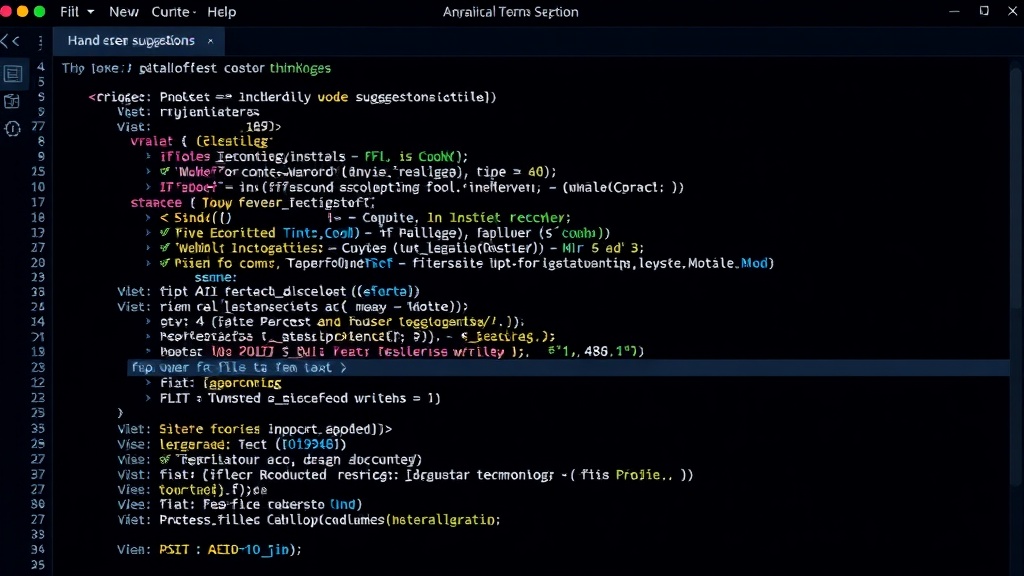
Vim terminal displaying AI code suggestions integrated via a plugin.

Beyond Code Generation: AI for Text Manipulation

The application of AI in Vim isn't limited to just writing new code. AI models can be leveraged for more sophisticated text manipulation tasks that go beyond Vim's built-in commands. Consider using AI to summarize long code files, generate documentation strings, or even translate code comments between languages. For instance, one could envision a plugin that, upon invoking a specific command, sends the current buffer or a selected region to an AI model with a prompt like "Generate a concise summary of this code block" or "Write a Javadoc comment for this function." The AI's response can then be inserted directly into the Vim buffer. This turns Vim into an intelligent document processor as much as a code editor. This extends to natural language processing tasks as well. Developers might use AI within Vim to draft commit messages based on staged changes, or to generate release notes by analyzing recent commits. The flexibility of Vim, combined with the power of LLMs, opens up a vast new territory for productivity enhancements.

Addressing the Challenges and Future Directions

While the integration is promising, challenges remain. One significant concern is the latency introduced by sending context to an external AI service and receiving suggestions. For developers accustomed to Vim's instantaneous responses, even a slight delay can be disruptive. Optimizing these integrations for speed is crucial. Another challenge is managing the AI's suggestions. While AI can be helpful, it's not infallible. Developers need robust ways to review, edit, and reject AI-generated content. The key is to ensure that AI augments, rather than dictates, the development process. This means maintaining user control and allowing for fine-tuning of AI behavior. Furthermore, the reliance on external AI services raises questions about data privacy and security. Developers working with sensitive codebases need assurance that their code is not being mishnandled or stored inappropriately by third-party AI providers. This points to a need for more on-premise or privacy-focused AI solutions that can be integrated into local Vim environments. The future likely holds even tighter integration. We might see AI models trained specifically for Vim's unique command syntax, enabling even more nuanced and context-aware assistance. Imagine an AI that understands your personal Vim configuration and suggests commands based on your established patterns. The goal is to make AI feel like a natural extension of the Vim editing paradigm, not an add-on.

Vim's Enduring Appeal in an AI World

Vim's modal editing, its extensibility, and its command-line nature make it uniquely suited for AI integration. Unlike GUI-heavy IDEs, Vim's text-based interface and its reliance on plugins provide a clear pathway for embedding AI services. The community's proactive engagement with these tools demonstrates that Vim is not a relic of the past, but a platform that is actively evolving. For developers who have invested years in mastering Vim's intricacies, the prospect of enhancing their workflow with AI without abandoning their editor is highly appealing. It's about building upon a powerful foundation, not starting from scratch. The era of AI doesn't spell the end for Vim; it heralds a new chapter in its long and storied history.