The Rise of "Vibe Coding"
The act of writing code has transformed. Five years ago, typing syntax line-by-line was the primary bottleneck. Now, AI-powered tools like GitHub Copilot have evolved from glorified autocomplete into sophisticated agents that can draft entire features and push pull requests before your morning coffee is ready. This shift, dubbed "Vibe Coding," allows developers to express intent in natural language, direct agents within their editors, and prompt terminal workflows. Code manifests at conversational speed, making the developer experience feel magical, fluid, and incredibly fast.
This new paradigm allows developers to focus on higher-level architectural decisions and problem-solving rather than the minutiae of syntax. The speed at which features can be prototyped and implemented is unprecedented. However, this rapid acceleration comes with a significant, often overlooked, cost: the erosion of fundamental debugging skills.
The Debugging Deficit
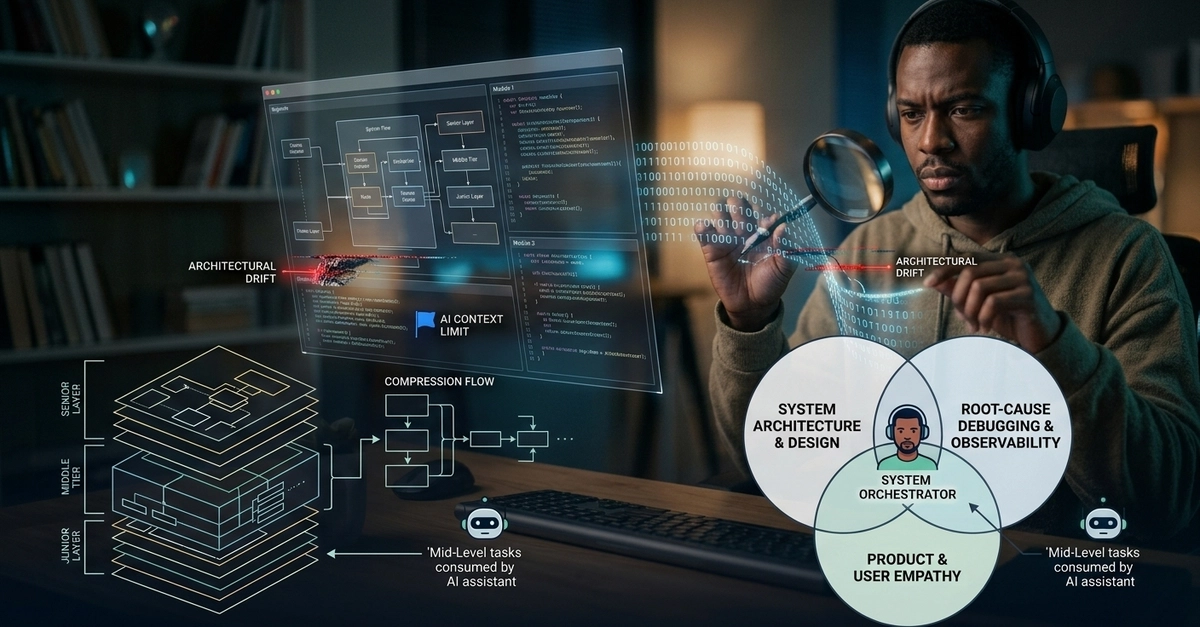
When code is generated almost instantaneously, the developer's role shifts from author to conductor. Instead of meticulously crafting each line and understanding its implications, developers increasingly rely on AI to produce functional code. This reliance has a direct impact on their ability to diagnose and fix problems when they inevitably arise. Debugging is not just about finding errors; it's a deep dive into the code's logic, control flow, and underlying assumptions. It requires an intimate understanding of how different components interact and how data propagates through a system.
Without the daily grind of writing and troubleshooting code from scratch, developers may lack the foundational knowledge and muscle memory required for effective debugging. They might be adept at prompting an AI to generate a solution, but struggle when faced with a bug that the AI cannot immediately resolve or that stems from a subtle logical flaw in the generated code. This is akin to a chef who can follow a recipe perfectly but cannot improvise when an ingredient is missing or a dish goes wrong. The ability to read, understand, and trace complex execution paths becomes a lost art.
Systemic Risks of Undebuggable Code
The consequences of a generation of developers unable to effectively debug their own systems are profound and far-reaching. Software systems, especially complex ones, are never static. They require continuous maintenance, updates, and bug fixes. If developers cannot reliably diagnose and resolve issues, the stability and reliability of these systems will inevitably degrade. This can lead to:
- Increased Downtime: Unresolved bugs can cause applications and services to crash, leading to significant downtime and lost productivity for users.
- Security Vulnerabilities: Debugging is crucial for identifying and patching security flaws. A weakened debugging capability means vulnerabilities may linger undetected, leaving systems exposed to malicious attacks.
- Technical Debt Accumulation: When bugs are patched with quick, superficial fixes rather than thorough diagnoses, technical debt grows. This makes future development slower, more expensive, and more prone to errors.
- Stifled Innovation: If teams spend an inordinate amount of time fighting fires caused by unaddressed bugs, they have less capacity for innovation and developing new features.
The current trend suggests a potential future where critical systems are maintained by developers who understand how to prompt an AI, but not necessarily how to dissect the complex emergent behavior of the code the AI produces. This creates a dependency on AI tools that, while powerful, are not infallible and cannot replicate the deep, intuitive understanding of a seasoned debugger.
The Path Forward: Rebalancing Velocity and Depth
The challenge is not to abandon AI coding assistants, which offer undeniable productivity gains. Instead, the industry must find a way to integrate these tools without sacrificing essential skills. This requires a conscious effort from both educational institutions and development teams:
- Curriculum Reform: Computer science programs need to adapt. While introducing AI tools, they must place renewed emphasis on fundamental programming principles, algorithms, data structures, and, critically, debugging methodologies. Students must be taught how to analyze code, trace execution, and use debugging tools effectively, even when AI assists in code generation.
- Training and Mentorship: Companies should implement robust training programs that explicitly focus on debugging skills, even for experienced developers. Mentorship is key, pairing junior developers who may be overly reliant on AI with senior engineers who can guide them through complex problem-solving scenarios.
- Tooling Evolution: The development of AI coding tools themselves could evolve. Future iterations might include more sophisticated built-in debugging assistance, prompting developers to explain the logic and trace execution paths rather than just generating code.
- Cultural Shift: Development teams need to foster a culture that values deep understanding and problem-solving alongside rapid development. Recognizing and rewarding the ability to troubleshoot complex issues is as important as the speed of feature delivery.
Ultimately, the goal is to leverage AI to augment, not replace, human ingenuity and critical thinking. The magic of "Vibe Coding" should be a force multiplier, enabling developers to build more sophisticated and reliable systems, not creating a generation that can only orchestrate but not repair.