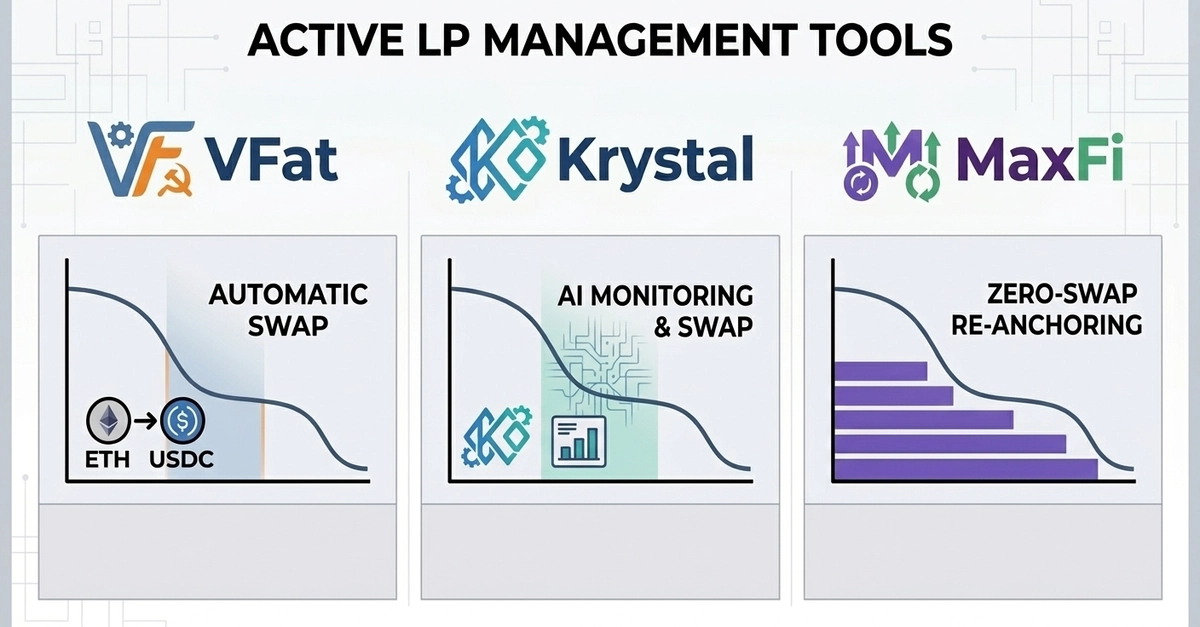
Automating Concentrated Liquidity: VFat, Krystal, and MaxFi
Active management of concentrated liquidity positions in decentralized finance (DeFi) has become a critical task for yield farmers seeking to maximize returns while minimizing impermanent loss. Three prominent tools have emerged to automate this complex process: VFat, Krystal, and the newer entrant, MaxFi. While all aim to keep liquidity positions within the active price range, their underlying rebalancing mechanisms differ fundamentally, leading to vastly different outcomes for users, especially during volatile market conditions.
Understanding these differences is crucial for anyone managing liquidity on platforms like Uniswap V3, where capital efficiency hinges on precise range management. The choice of automation tool can mean the difference between compounding gains and suffering substantial losses.
How Each Tool Rebalances
The core functionality of these tools revolves around rebalancing a liquidity position when the asset price moves outside the predefined range. This typically involves closing the current position and opening a new one at a different price range, often aiming to capture a new spread or adjust for impermanent loss.
VFat: The Established Self-Custodial Manager
VFat is a self-custodial yield aggregator and concentrated liquidity manager. It utilizes its proprietary Sickle contracts for managing positions. VFat’s approach is characterized by its flexibility and user control, as users retain custody of their assets. Its rebalancing logic is designed to adapt to market conditions, aiming to maintain optimal liquidity depth without excessive fee generation from frequent, unnecessary trades.
VFat charges a fee, typically a percentage of the profits generated. The exact fee structure can vary, but it aligns with industry standards for yield aggregators. Its strategy focuses on intelligent rebalancing, ensuring that trades are executed only when necessary to preserve capital efficiency and capture yields effectively. This often means a more conservative approach to rebalancing compared to newer, more aggressive strategies.
Krystal: The Integrated DeFi Super App
Krystal positions itself as a comprehensive DeFi super app, offering a suite of services including a wallet, swap functionality, and importantly, concentrated liquidity management. Unlike VFat’s self-custodial model, Krystal integrates these functions within its platform. Its liquidity management tools are designed to be user-friendly, appealing to a broader audience that may not be deeply technical.
Krystal's rebalancing strategy is integrated into its broader ecosystem. When an LP position drifts out of range, Krystal’s system can automatically adjust it. The specifics of its rebalancing logic are less transparent than VFat’s, but it aims to optimize for yield and minimize impermanent loss within its integrated framework. Krystal also employs a fee structure, often tied to the overall services offered within the app, which can include a percentage of trading fees or a subscription model for advanced features. Its strength lies in its accessibility and the convenience of managing multiple DeFi activities from a single interface.
MaxFi: The Aggressive Newcomer
MaxFi enters the market with a distinct and aggressive rebalancing strategy: zero-swap rebalancing logic. This means MaxFi aims to rebalance positions with minimal or no slippage cost, a significant differentiator. Its primary mechanic is designed to capitalize on market fluctuations, particularly in volatile or sideways markets.
The aggressive nature of MaxFi’s rebalancing is its main selling point, especially in a bounce-back market where quick adjustments can capture significant gains. However, this same mechanic poses a substantial risk in a continued downturn. If the market trends downwards sharply, MaxFi’s rapid rebalancing could lead to amplified losses as it continuously adjusts to capture a falling price. Its fee structure is competitive, aiming to attract users with its novel approach to rebalancing. The zero-swap logic is particularly appealing to traders who want to avoid the typical costs associated with frequent rebalancing actions.
Referenced Sources
- verified