VEQRA AI: Bridging the Gap in Enterprise Incident Management
Existing enterprise incident management platforms often excel at detection and routing, but falter when answering the crucial 'why,' 'what's the cost,' and 'what next' questions. Nabil Fattouch’s VEQRA AI addresses this critical gap. Built as an intelligence layer for his existing Microsoft 365 automation platform, VEQRA AI leverages the power of Qwen3-235B to transform incident resolution from a multi-hour, human-intensive process into a near-instantaneous, automated workflow.
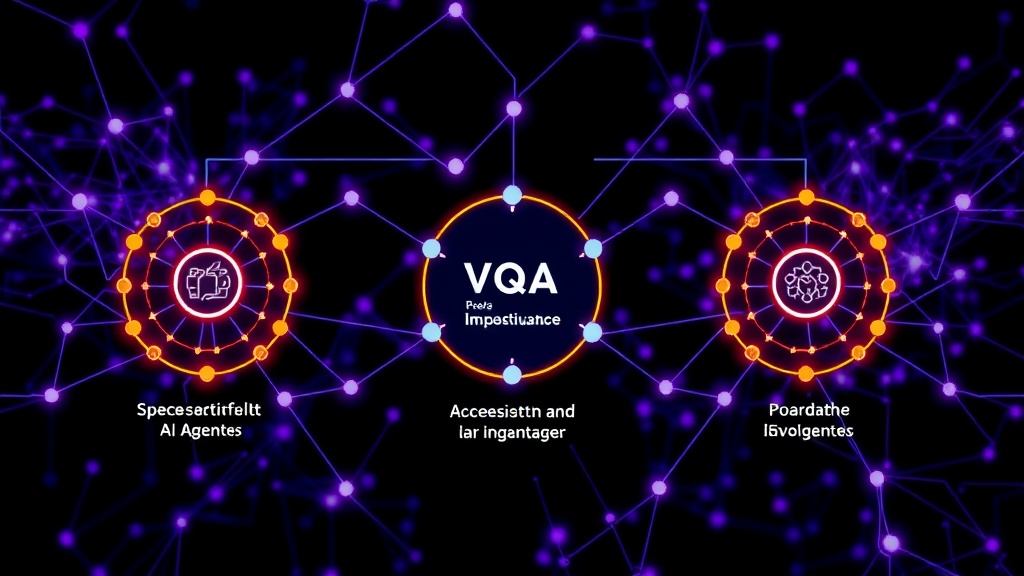
The Qwen Cloud Global AI Hackathon provided the impetus and platform to develop this sophisticated AI orchestration. VEQRA AI isn't a single monolithic model; instead, it deploys three specialized agents, each with a distinct function, working in concert to achieve unprecedented resolution speed.
Orchestrating Resolution with Specialized AI Agents
The core innovation of VEQRA AI lies in its agent-based architecture. This approach allows for modularity, specialization, and a clear division of labor, leading to highly efficient processing. The three agents are:
Memory Agent: The Historical Analyst
This agent is responsible for digging into the past. It queries the historical incident database, searching for similar past events. By identifying patterns and drawing parallels, it determines the most probable root cause of the current incident. Crucially, it assigns a confidence score to its findings, providing transparency into the certainty of the identified cause. This is vital for preventing the AI from making critical decisions based on weak evidence.
BI Agent: The Financial and Risk Assessor
Once the root cause is established, the BI Agent steps in to quantify the impact. It calculates the immediate and projected financial loss associated with the incident. Furthermore, it assesses the risk of Service Level Agreement (SLA) breaches, a critical metric for many enterprises. Based on these financial and operational risks, it assigns a criticality score, allowing for dynamic prioritization of incidents that might otherwise be overlooked.
Action Agent: The Decisive Executor
The final agent is the orchestrator of the solution. It translates the findings from the Memory and BI Agents into a concrete, structured action plan. This plan is designed for immediate execution within the Microsoft 365 ecosystem. Actions can include automatically creating a Microsoft Teams task for relevant personnel, sending a detailed email notification to the designated Data Owner, or updating a Power BI dashboard with the latest incident status and impact. This ensures that the resolution process doesn't end with analysis but culminates in tangible, automated remediation steps.
Demo Scenario: A Real-World Test Case
To demonstrate VEQRA AI's capabilities, a scenario involving a critical Leasing VIP contract was simulated. The contract was flagged as having an overdue status, representing a significant financial risk of €120,000. Without VEQRA AI, such an incident could trigger lengthy investigations, manual communication chains, and delayed financial adjustments, potentially exacerbating the loss.
In the VEQRA AI demonstration, the entire resolution process—from detection and root cause analysis to financial impact assessment and the generation of a structured action plan—was completed in an astonishing 13 seconds. This was achieved with zero human intervention, showcasing the platform's potential to drastically reduce response times and minimize financial and operational damage for enterprises. The system automatically identified the contract issue, calculated the potential €120,000 loss, and initiated a predefined action, likely involving notifying the relevant leasing department or finance team via a Teams task or email.
The Power of Qwen3-235B
The underlying engine driving VEQRA AI's intelligence is Qwen3-235B, a powerful large language model. Its extensive knowledge base and sophisticated natural language understanding capabilities are essential for the Memory Agent's ability to interpret historical data and identify nuanced similarities between incidents. The BI Agent relies on the model's analytical prowess to parse financial data and project risk scenarios. The Action Agent benefits from the model's capacity to generate structured, contextually relevant commands and communications. The choice of Qwen3-235B underscores the trend towards leveraging state-of-the-art foundation models to build highly specialized and effective AI solutions.
Implications for Enterprise AI and Automation
VEQRA AI represents a significant leap forward in practical enterprise AI applications. By focusing on a critical pain point—incident resolution—and delivering a measurable, dramatic improvement in speed and efficiency, it sets a new benchmark. The platform’s ability to integrate seamlessly with Microsoft 365 makes it immediately accessible to a vast number of organizations. This success highlights the potential for agent-based AI architectures, powered by advanced LLMs, to automate complex, multi-step business processes. The surprising speed of resolution—13 seconds—challenges the long-held assumption that complex enterprise problem-solving inherently requires significant human time and involvement. Organizations that adopt such intelligent automation will gain a substantial competitive advantage through reduced downtime, minimized financial losses, and more agile operational responses.