The Challenge of AI Agent Tooling
As artificial intelligence agents become more sophisticated, their ability to interact with the real world and perform complex tasks hinges on their access to a diverse set of tools and functions. These tools can range from simple API calls to complex external services. However, managing, deploying, and scaling these tools for AI agents presents a significant engineering challenge. Developers often face issues with version control, dependency management, security, and ensuring high availability for the functions their agents rely on. This is where Velane enters the picture, aiming to provide a dedicated cloud infrastructure specifically for AI agent tooling.
Velane positions itself as a cloud platform designed to abstract away the complexities of managing the functions and tools that AI agents utilize. Instead of developers needing to build and maintain their own infrastructure for hosting and serving these tools, Velane offers a managed solution. This allows development teams to focus on the AI agent's core logic and the functionality of the tools themselves, rather than the underlying operational overhead.
Velane's Core Offering
At its heart, Velane provides a managed environment for deploying and executing functions that AI agents can call upon. This means developers can define their tools as code, upload them to Velane, and then grant their AI agents permission to access and invoke these functions. The platform handles the necessary infrastructure, including server provisioning, scaling, and monitoring, ensuring that the tools are available when the agent needs them.
Think of Velane less like a general-purpose cloud provider and more like a highly specialized backstage crew for an AI agent's performance. The agent is the star performer, but it needs a reliable system to quickly access props, change costumes, or adjust the stage lighting on command. Velane is that system, ensuring the tools (props, costumes, lighting cues) are ready and accessible without the agent needing to worry about how they got there or if they're in working order.

Key aspects of Velane's offering likely include:
- Function Deployment: A streamlined process for uploading and registering custom functions or tools. This could involve support for various programming languages and frameworks.
- API Gateway: A secure and scalable API layer that exposes the deployed functions to AI agents. This gateway would manage authentication, authorization, and request routing.
- Scalability and Reliability: Automatic scaling of the underlying infrastructure to handle varying loads, ensuring low latency and high availability for agent tool invocations.
- Monitoring and Observability: Tools to track function usage, performance metrics, and error rates, providing insights into the health and efficiency of the AI agent's tool ecosystem.
- Security: Robust security measures to protect deployed functions and the data they process, including access control and potentially secrets management.
Simplifying the AI Agent Development Lifecycle
The development of AI agents, particularly those intended for complex, real-world applications, often involves an iterative process of defining agent behavior, integrating external services, and refining the agent's ability to select and use the appropriate tools. Without a dedicated platform like Velane, developers might resort to building custom microservices, managing serverless functions across different cloud providers, or using generic orchestration tools. Each of these approaches introduces significant development and operational overhead.
Velane aims to simplify this lifecycle by providing a unified and specialized environment. This reduces the cognitive load on developers, allowing them to concentrate on the agent's intelligence and the value proposition of its tools. The platform's abstraction layers handle much of the boilerplate infrastructure code, speeding up development cycles and reducing the potential for common deployment errors.
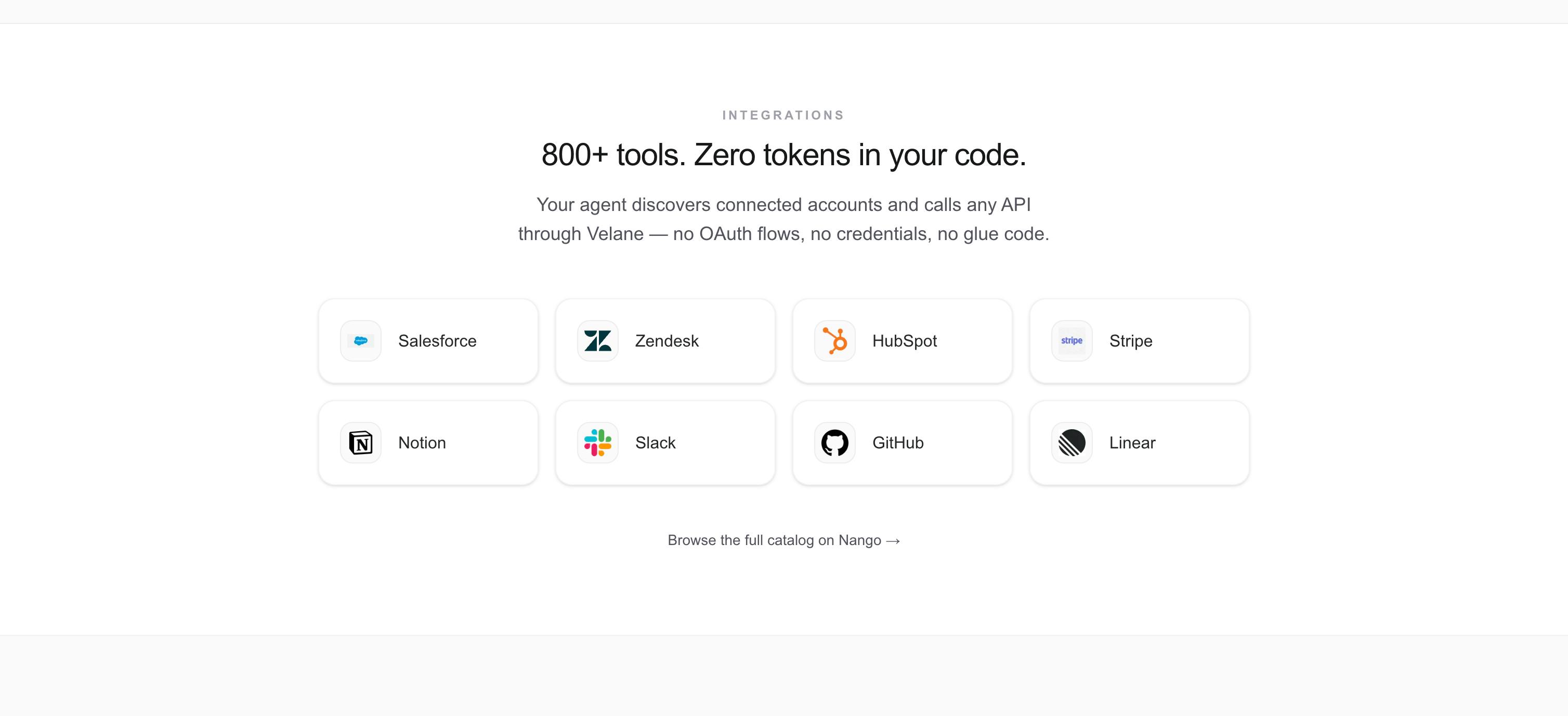
For instance, an AI agent designed to manage personal finances might need tools to access banking APIs, stock market data, or budgeting software. Velane would allow developers to package these specific API integrations as functions within its platform. When the AI agent decides it needs to check a stock price, it makes a request to Velane, which then securely invokes the relevant stock data function and returns the result. This is far more manageable than the agent needing to directly interact with the complexities of multiple, disparate APIs and their associated infrastructure.
Market Context and Future Implications
The emergence of platforms like Velane signals a growing trend towards specialized infrastructure for AI development. As AI agents move beyond simple chatbots and into more complex operational roles, the need for robust, scalable, and secure tooling management will only increase. Competitors might include general-purpose serverless platforms that could be adapted for this purpose, or other emerging startups focusing on specific aspects of AI agent infrastructure.
What remains to be seen is how Velane will integrate with the rapidly evolving landscape of AI agent frameworks and large language models (LLMs). The ability to seamlessly connect with popular agent development kits and to handle the dynamic nature of LLM-driven tool selection will be crucial for its adoption. Furthermore, the economics of such a specialized platform will be a key factor for founders considering its long-term viability and scalability.
For developers building the next generation of AI agents, Velane offers a compelling proposition: offload the heavy lifting of tool infrastructure management to a specialized service. This allows for faster iteration, potentially more robust agent capabilities, and a clearer path to production for AI applications that require sophisticated external interactions.