The RAM Tax on Vector Search
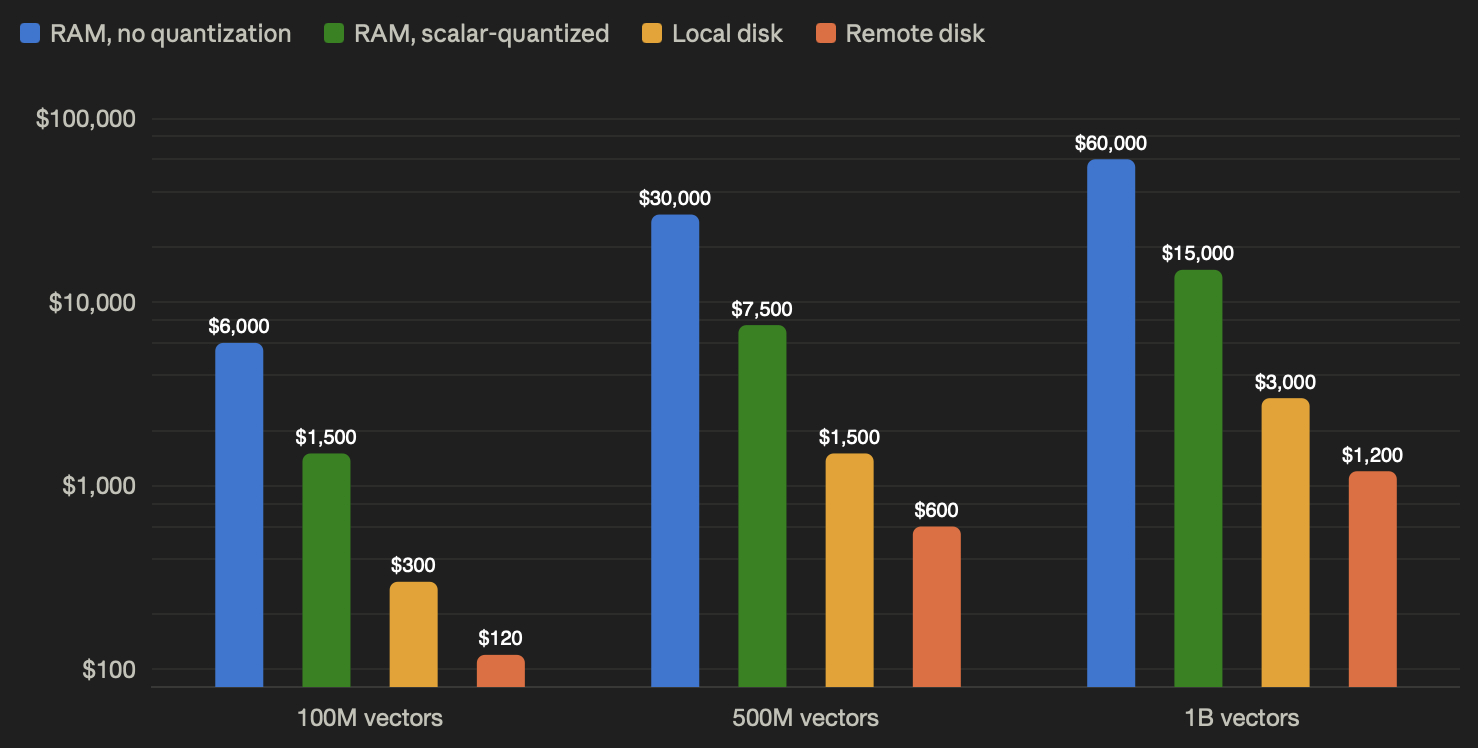
The explosion of AI and machine learning applications has driven a surge in demand for vector search. Storing and querying massive datasets of high-dimensional vectors, however, comes with a significant infrastructure cost, primarily dictated by Random Access Memory (RAM). In-memory Approximate Nearest Neighbor (ANN) indexes, while offering low latency, become prohibitively expensive as datasets grow. This forces a critical re-evaluation of architecture: how do we balance performance with the escalating cost of RAM?
The core challenge lies in the trade-off between index size, query latency, and cost. Traditional in-memory ANN indexes, such as Hierarchical Navigable Small Worlds (HNSW), store the entire index structure in RAM. This allows for extremely fast lookups, often measured in milliseconds. However, as the number of vectors and their dimensionality increase, the RAM footprint of these indexes balloons. For datasets containing billions of vectors, the required RAM can easily run into terabytes, translating to hundreds of thousands or even millions of dollars in hardware costs per deployment. This is a hard limit for many startups and even established companies looking to scale their AI-powered features cost-effectively.
Consider a recommendation engine serving millions of users. Each user profile might be represented by a vector, and the system needs to find similar vectors for product recommendations. If the catalog grows to hundreds of millions of items, each with a 128-dimensional vector, the in-memory index alone could require tens of terabytes of RAM. This is akin to trying to store an entire library in your pocket – possible, but only if the library is small or your pocket is impossibly large and expensive.
This economic pressure is driving innovation towards hybrid or purely on-disk solutions. The goal is to leverage cheaper, higher-capacity storage (like SSDs) while minimizing the performance penalty. The question is no longer *if* we can afford to keep everything in RAM, but *how* we can smartly move parts of the index off RAM without crippling the search experience.
The Rise of On-Disk ANN
The most prominent on-disk ANN index is DiskANN, developed by Microsoft. DiskANN is designed to perform ANN searches directly from SSDs. Unlike earlier attempts that simply loaded parts of an in-memory index to disk, DiskANN rethinks the data structures and algorithms to be SSD-native. It achieves this by optimizing for the sequential read patterns that SSDs excel at, while mitigating the latency associated with random disk I/O. DiskANN partitions the graph into blocks that can be efficiently loaded and processed.
Another approach, often seen as a hybrid, is SPANN (Sparsely-Packed ANN). SPANN combines an in-memory index with an on-disk inverted file index. The in-memory component stores frequently accessed vectors or centroids, while the disk-based component handles the bulk of the data. This allows for a balance: common queries hit the fast in-memory part, while less frequent or more exhaustive searches can leverage the disk component. The sparsity aspect refers to how it handles the vector dimensions, allowing for more efficient storage and retrieval.
HNSW (Hierarchical Navigable Small Worlds) remains a popular in-memory choice. Its strength lies in its relatively simple implementation and good performance for its memory footprint. However, when memory becomes the bottleneck, HNSW’s all-in-RAM nature is its Achilles’ heel. The decision to use HNSW often implies a willingness to pay a premium for speed, or a dataset size that is still manageable within RAM budgets.
Navigating the Trade-offs
Choosing between these approaches involves a careful calibration of several factors:
- Dataset Size: For truly massive datasets (billions of vectors), on-disk solutions like DiskANN become almost a necessity to avoid astronomical RAM costs. For smaller to medium datasets (millions to tens of millions of vectors), in-memory HNSW might still be viable and offer superior latency.
- Query Latency Requirements: If sub-10-millisecond latency is non-negotiable for every query, then in-memory indexes like HNSW are likely the only option. On-disk indexes introduce I/O latency, pushing query times into tens or even hundreds of milliseconds, depending on the configuration and hardware. SPANN attempts to bridge this gap by keeping hot data in RAM.
- Cost Constraints: This is the primary driver for exploring on-disk solutions. SSDs are significantly cheaper per gigabyte than RAM. A system designed around DiskANN can potentially store many times the number of vectors for the same hardware budget compared to an all-in-memory HNSW system.
- Indexing Time: Building large ANN indexes, especially for in-memory structures, can be computationally intensive and time-consuming. On-disk indexes may also have significant build times, but the ability to update or rebuild parts of the index without reloading the entire structure can be an advantage.
- Update Frequency: Systems that require frequent updates to vectors or the index structure might find in-memory indexes easier to manage. On-disk indexes, particularly those with complex partitioning, can be more challenging to update atomically and efficiently.
What nobody has fully addressed yet is the long-term operational complexity of managing sophisticated on-disk ANN systems. While they solve the immediate RAM cost problem, the tuning and maintenance required to extract optimal performance from SSDs can be significantly more intricate than for RAM-based systems. This includes understanding SSD wear leveling, caching strategies, and the nuances of block-based I/O.
Beyond HNSW, SPANN, and DiskANN
The field is not static. Researchers and engineers are continuously exploring new ways to optimize ANN indexing. This includes:
- Quantization Techniques: Methods like Product Quantization (PQ) and Scalar Quantization (SQ) reduce the memory footprint of vectors by compressing them. This can make larger datasets fit into RAM, or allow for more efficient disk storage.
- Graph Compression: Techniques to reduce the number of edges in HNSW graphs without significantly degrading search quality.
- Hybrid Architectures: More sophisticated combinations of in-memory and on-disk storage, potentially leveraging different types of storage (e.g., NVMe SSDs for speed, traditional SSDs for capacity).
- Specialized Hardware: While currently niche, custom hardware accelerators for vector operations could eventually change the economic landscape.
For developers building AI applications, understanding these architectural choices is paramount. The decision between on-disk and in-memory ANN indexes is not merely a technical detail; it directly impacts the scalability, cost-effectiveness, and ultimately, the viability of a product. As RAM prices continue their upward trend, the clever engineering behind on-disk solutions will become increasingly crucial for keeping vector search accessible and affordable.