The Problem: Payment Without Proof of Data Integrity
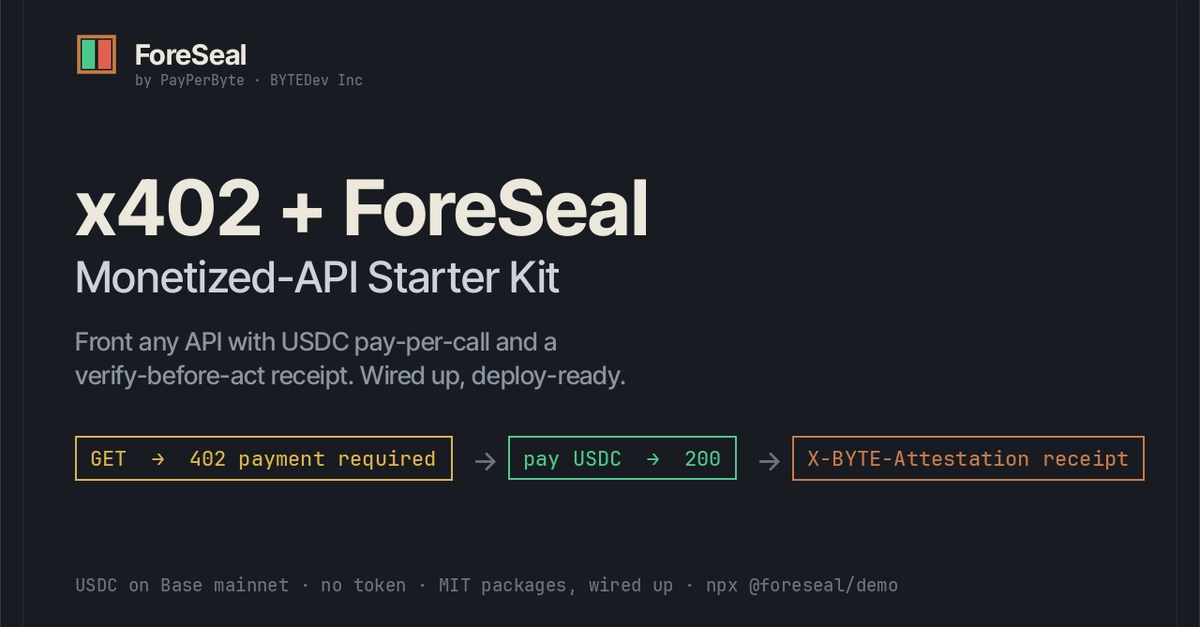
The advent of AI agents capable of autonomous action introduces novel payment paradigms. The x402 protocol, by reusing HTTP 402 Payment Required, offers a compelling primitive for clients—human or AI—to pay for API calls directly in USDC. This eliminates the overhead of traditional API keys, accounts, and subscriptions, creating a frictionless transaction model. A client can query an API, receive a 402 response indicating payment is due, and then remit USDC for the service. The payment rail confirms the financial transaction has occurred.
However, a critical gap emerges when an AI agent must act upon the data received from a paid API call. While the payment rail validates that money has moved, it provides no assurance about the integrity of the data itself. An agent, having paid for a service, could still receive tampered, spoofed, or otherwise compromised data. This could lead to erroneous decision-making, security vulnerabilities, or failed operations, undermining the trust and reliability essential for autonomous agents.

The Solution: Verified Receipts via Signed Responses
To bridge this integrity gap, a novel approach combines per-call USDC payments with cryptographically verifiable receipts. The core innovation is to equip the API server not only with the ability to charge for requests but also to sign the response data. This signed response serves as a receipt, proving that the data originated from the authenticated server and has not been altered since it was signed.
The architecture involves an Express endpoint acting as the API gateway. When a client (an AI agent, for instance) makes a request, the server first determines if payment is required. If so, it returns an HTTP 402 Payment Required status, potentially including details about the USDC amount and the payment address. The client then remits the specified USDC. Upon successful confirmation of the payment, the server processes the original request and, crucially, returns the response data cryptographically signed using a private key. The client can then verify this signature using the server's corresponding public key. This verification step confirms both the origin of the data and its immutability since the signature was applied.
Technical Implementation: Signing and Verification
Implementing this system requires careful consideration of cryptographic primitives and server-side logic. The server needs a private key to sign responses and a mechanism to securely distribute its corresponding public key to clients. Standard asymmetric encryption algorithms, such as RSA or ECDSA, are suitable for this purpose.
On the server-side (e.g., an Express.js application), the process would look like this:
- Receive client request.
- Determine if payment is required based on the endpoint or request parameters.
- If payment is required, return a
402 Payment Requiredresponse, specifying the USDC amount and recipient address. - Upon confirmation of payment (this would typically involve a webhook or polling mechanism checking a payment processor or blockchain explorer for the transaction), process the original request.
- Generate the response data.
- Sign the response data using the server's private key. This could involve serializing the response payload (e.g., to JSON) and then signing the resulting string.
- Return the signed response data to the client, potentially including the signature as a separate header or within the response body.
On the client-side (the AI agent or its controller), the verification process is equally critical:
- Receive the response data and the accompanying signature.
- Obtain the server's public key. This could be pre-shared, fetched from a well-known endpoint, or included in the initial payment negotiation.
- Verify the signature against the received response data using the server's public key. If the verification fails, the data is considered untrustworthy and should not be acted upon.
- If verification succeeds, the client can confidently process the response data.
Benefits and Implications
This combined payment and verification system offers several advantages:
- Enhanced Trust for AI Agents: AI agents can operate with greater confidence, knowing that the data they receive is authentic and has not been tampered with. This is crucial for autonomous decision-making in critical applications.
- Reduced Fraud: By providing verifiable receipts, the system makes it harder for malicious actors to spoof API responses or claim non-existent payments.
- Frictionless Commerce: Building on the x402 protocol, it maintains the ease of use without API keys or complex account setups, enabling microtransactions for API usage.
- Decentralized Potential: The use of USDC and blockchain-based payment confirmation aligns with decentralized principles, potentially enabling peer-to-peer API marketplaces.
The implementation is presented as a straightforward assembly of existing tools and protocols, emphasizing that the core cryptographic and payment primitives are freely available. This accessibility lowers the barrier to adoption for developers looking to secure their API interactions and monetize them effectively, particularly in the burgeoning field of AI agent services.
The Unanswered Question: Scalability and Key Management
While this approach solves the immediate problem of data integrity for paid API calls, a significant question remains: how will this scale, particularly regarding public key management? For a widely used API, distributing and managing public keys securely and efficiently for potentially millions of clients presents a non-trivial challenge. Will clients need to constantly fetch updated keys? How will revocation be handled if a server's private key is compromised? These operational aspects will be critical for widespread adoption beyond niche applications.