The Problem with Legacy Code
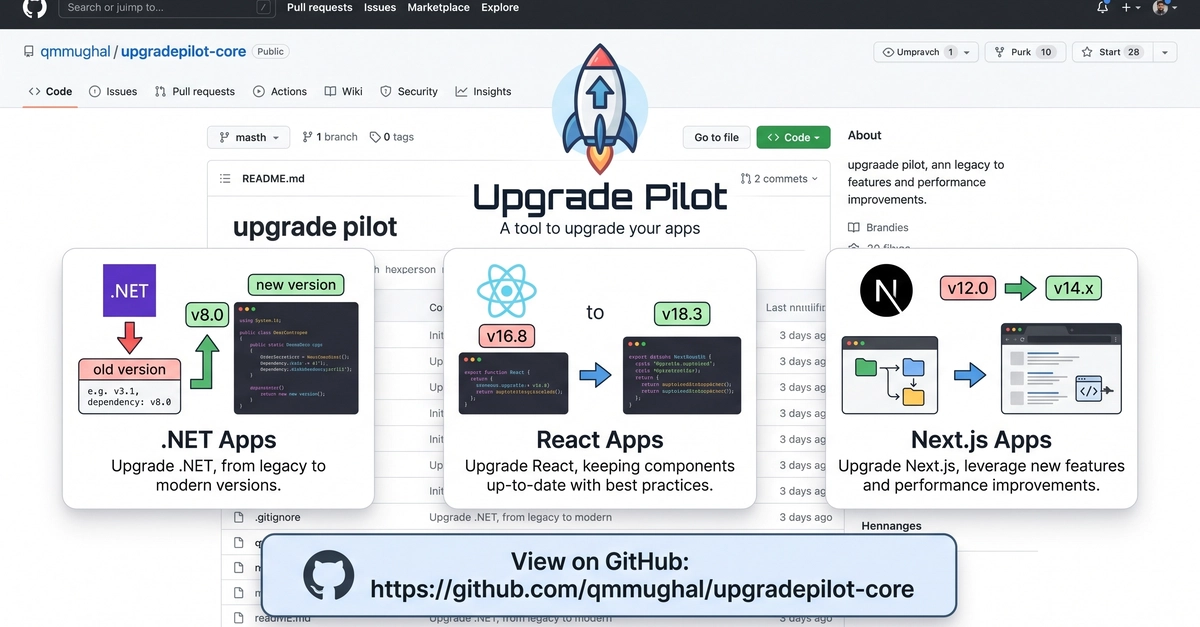
Every engineering team grapples with the forgotten repository. It’s the one languishing on framework versions from three or four years ago. The need for an upgrade is universally acknowledged, yet the fear of breaking production paralyzes action. This is the precise challenge UpgradePilot, an open-source, multi-agent upgrade pipeline, aims to solve. This week, the project shipped a critical update enabling stack-agnostic, real-world upgrade automation for .NET, React, and Next.js applications. This includes complex codebases that feature a .NET backend alongside a React or Next.js frontend within the same repository.
The claim “AI upgrades your code” often meets skepticism, and rightfully so. Many existing solutions rely on LLMs that simply read configuration files and suggest version bumps, a superficial approach that fails to address the intricate interdependencies and potential breaking changes inherent in software updates.
Design Principle: Shell Out to the Real Tool
UpgradePilot’s core design philosophy is to avoid faking the upgrade process. Instead of relying on an LLM to *guess* new version numbers or *simulate* code changes, UpgradePilot’s agents are designed to interact directly with the actual development tools and package managers. This means for .NET, it uses the .NET CLI (`dotnet add package`, `dotnet restore`, `dotnet build`). For React and Next.js, it leverages npm or yarn (`npm install`, `yarn add`, `npm update`, `yarn upgrade`).
This approach ensures that the upgrade process is grounded in reality. When a new version of a dependency is identified, the agent doesn't just write a new line into a manifest file. It executes the command that a human developer would use. This command is run within a sandboxed environment, preventing any unintended side effects on the main development branch.
The Multi-Agent Pipeline Explained
UpgradePilot employs a pipeline of specialized AI agents, each with a distinct role:
- Discovery Agent: This agent scans the codebase to identify all relevant dependencies across different languages and frameworks. It maps out the project structure, including backend (e.g., .NET) and frontend (e.g., React, Next.js) components, and their respective package management files (e.g., `.csproj`, `package.json`).
- Version Identification Agent: Once dependencies are identified, this agent queries package registries (like NuGet for .NET, npm registry for Node.js) to find the latest stable versions. It also considers compatibility information, if available, to flag potential issues early.
- Upgrade Execution Agent: This is where the core action happens. This agent takes the identified dependencies and their target versions and executes the appropriate CLI commands. For a mixed .NET/React app, it might first run `dotnet add package` commands for .NET dependencies, followed by `npm install` or `yarn add` for frontend dependencies. All these operations occur within isolated environments to ensure safety.
- Testing Agent: Crucially, after dependencies are updated, this agent triggers the project’s existing test suite. This could include unit tests, integration tests, or end-to-end tests defined in the project. The goal is to verify that the application still functions as expected after the upgrades.
- Code Fixer Agent (Experimental): For breaking changes that cause tests to fail, a more advanced agent can attempt to automatically refactor the code. This agent, powered by LLMs trained on code transformation patterns, analyzes the test failures and suggests or applies code modifications to resolve them. This is an area of ongoing development, with the focus being on common breaking changes and patterns.
- Pull Request Agent: Once all automated checks pass, this agent creates a pull request (PR) with the proposed changes. This PR includes detailed notes about the upgrade process, the dependencies updated, and the results of automated tests. This allows human developers to review the changes before merging, providing a crucial layer of oversight.
Handling Mixed Codebases
The ability to handle repositories containing both .NET backends and React/Next.js frontends in the same codebase is a significant advancement. Traditionally, tools are framework-specific. A .NET upgrade tool wouldn't touch `package.json`, and a Node.js tool wouldn't look at `.csproj` files. UpgradePilot's multi-agent system allows it to orchestrate updates across these disparate environments. It understands the project structure, identifies which parts need which tools, and executes them in a logical sequence. For instance, it might upgrade backend dependencies first, run backend tests, then proceed to frontend dependencies and tests.
Beyond Simple Version Bumps
The real value lies in UpgradePilot’s commitment to performing actual operations and validations. It doesn't just suggest; it *does*. This involves:
- Dependency Resolution: Handling complex dependency graphs where updating one package might require updating others to maintain compatibility.
- Build Verification: Ensuring that the application still compiles or builds successfully after dependency changes.
- Test Execution: Running the project’s own test suites to catch regressions that static analysis might miss.
- Automated Refactoring: Attempting to fix common breaking API changes through intelligent code modification.
This comprehensive approach transforms the upgrade process from a dreaded manual task into a manageable, automated workflow. It significantly reduces the risk associated with updating legacy systems, making it more feasible for teams to keep their technology stacks modern and secure.
The Skepticism and The Solution
Much of the skepticism around AI code modification stems from LLMs hallucinating fixes or generating code that, while syntactically correct, is functionally flawed or insecure. UpgradePilot sidesteps this by using AI agents primarily for orchestration and decision-making, while the actual code manipulation is performed by the proven, native tooling of each ecosystem. The AI’s role is to intelligently guide these tools, analyze their output, and manage the overall process. This hybrid approach—AI for intelligence, native tools for execution—is key to its effectiveness. The automated PR creation ensures human oversight remains paramount, providing a safety net for critical production systems.