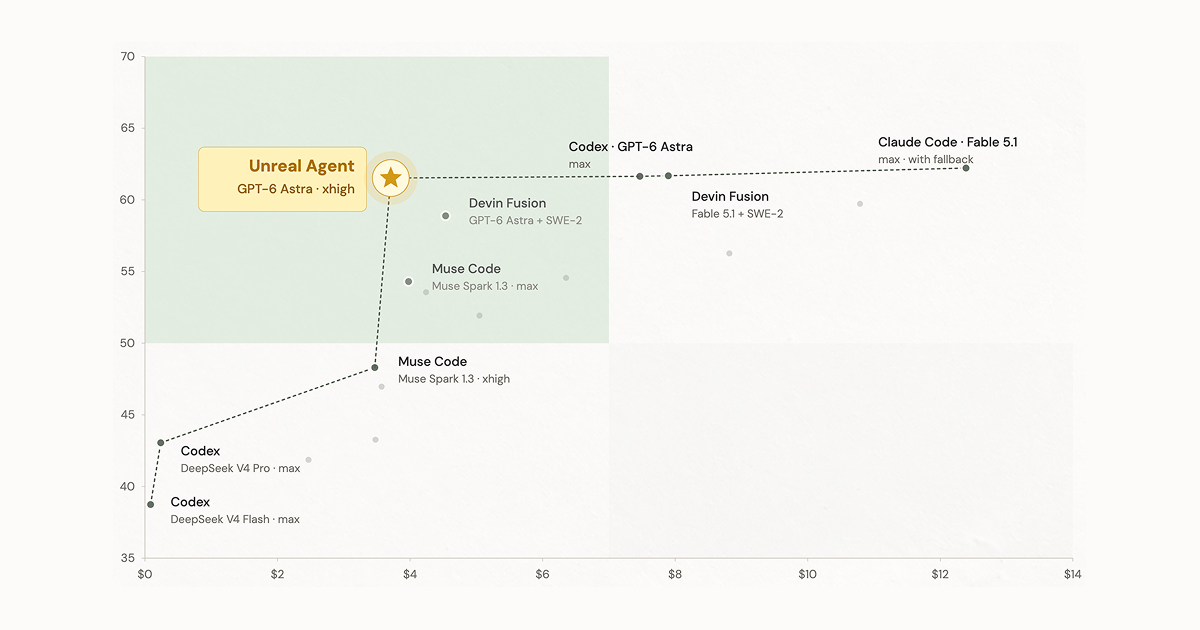
Unreal Agent: Automating the AI Development Lifecycle
Unreal Labs has introduced Unreal Agent, a new platform designed to automate significant portions of the artificial intelligence development pipeline. The ambitious goal is to enable developers and researchers to build, train, and deploy AI models with significantly reduced manual intervention. This move signals a broader industry trend toward autonomous AI systems, aiming to democratize AI development and accelerate innovation by abstracting away much of the complexity.
Traditionally, developing a robust AI model involves a multi-stage, labor-intensive process. This includes data collection and preprocessing, feature engineering, model selection, hyperparameter tuning, training, validation, and finally, deployment. Each step requires specialized expertise and considerable time. Unreal Agent seeks to streamline this by acting as an intelligent orchestrator, capable of making decisions and executing tasks across these stages autonomously.
The platform reportedly handles tasks such as data augmentation, automated feature selection, and even algorithm selection based on the problem domain and available data. This is akin to having a senior AI engineer on call 24/7, capable of performing routine tasks and making informed decisions without constant human oversight. The implications for research labs and startups, where resources are often constrained, could be substantial.
Key Capabilities and Technical Underpinnings
At its core, Unreal Agent leverages a sophisticated orchestration engine that manages the workflow. It integrates with various data sources and existing AI libraries. The system is designed to be flexible, allowing users to define high-level objectives rather than granular implementation details. For instance, a user might specify the desired outcome (e.g., "classify images with 95% accuracy") and the type of data available, and Unreal Agent would then attempt to construct the optimal model.
One of the standout features is its automated hyperparameter optimization. Instead of manually running grid searches or random searches, Unreal Agent employs advanced techniques to find optimal parameters more efficiently. This is crucial because hyperparameter tuning can be one of the most time-consuming aspects of AI development, often requiring extensive computational resources and experimentation.
Furthermore, the platform aims to simplify model deployment. It can automatically package trained models into deployable formats compatible with various cloud environments or edge devices. This addresses another common bottleneck: the gap between a successfully trained model in a research environment and a production-ready application.

Addressing the AI Talent Gap and Accelerating Research
The introduction of Unreal Agent comes at a time when the demand for AI talent far outstrips supply. By automating many of the routine and complex tasks, the platform aims to empower a broader range of professionals to engage in AI development. This could significantly lower the barrier to entry for businesses looking to adopt AI solutions without needing to hire large teams of highly specialized engineers.
For researchers, Unreal Agent offers the potential to accelerate the pace of discovery. Imagine a scenario where a researcher can iterate through dozens of model architectures and training strategies in the time it previously took to set up a single experiment. This rapid iteration cycle is critical for pushing the boundaries of AI research, particularly in areas like deep learning where empirical exploration plays a significant role.
The platform's ability to handle data preprocessing and augmentation is also noteworthy. Data quality and quantity are often the primary determinants of AI model performance. By automating these steps, Unreal Agent ensures that models are trained on well-prepared, diverse datasets, leading to more robust and generalizable results. This is particularly important for applications in sensitive domains like healthcare or finance, where data biases can have severe consequences.
Challenges and Future Outlook
While the promise of Unreal Agent is significant, several challenges remain. The effectiveness of any automated system is heavily dependent on the quality and nature of the input data. Complex, unstructured, or highly specialized datasets may still require significant human intervention and domain expertise to prepare adequately. Moreover, the interpretability of models generated by fully automated systems can be a concern, especially in regulated industries where understanding model decisions is paramount.
Another question is the level of control users will have over the automated process. While abstraction is beneficial, developers often need fine-grained control to debug issues, incorporate specific domain knowledge, or optimize for unique constraints. The success of Unreal Agent will likely hinge on striking the right balance between automation and user control.
Looking ahead, platforms like Unreal Agent could fundamentally alter the AI development landscape. They may shift the focus from manual model building to defining problems, curating data, and evaluating the outputs of autonomous systems. This could lead to a new class of AI professionals who are adept at orchestrating and managing AI workflows rather than coding every component from scratch. The race is on to see how effectively these tools can deliver on their promise of democratizing and accelerating AI creation.