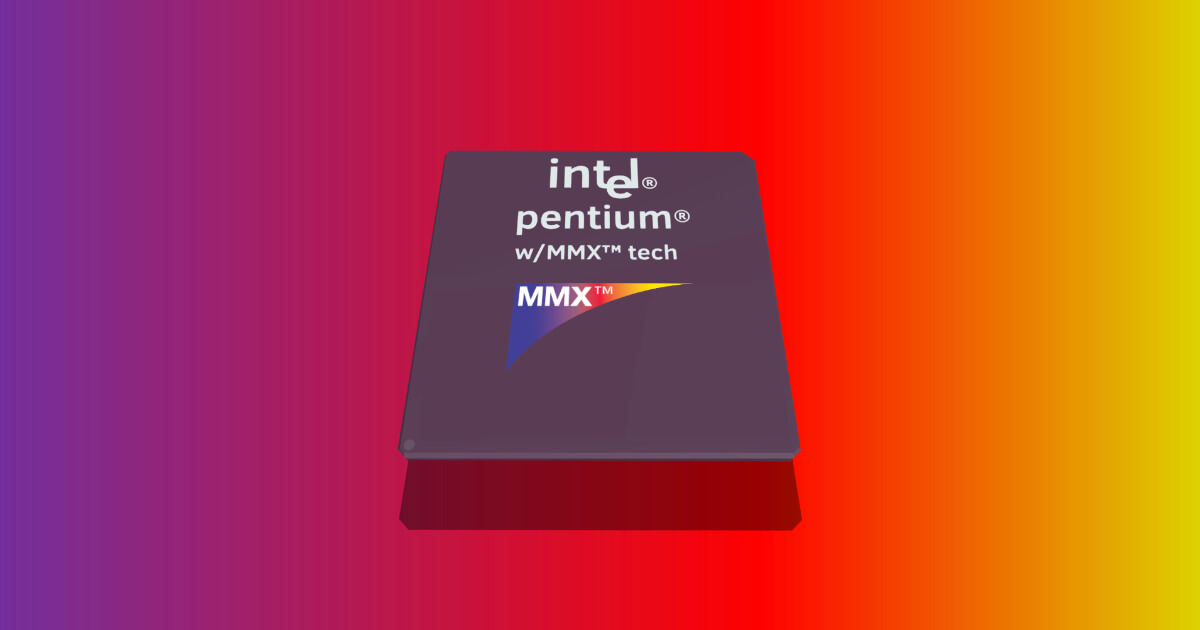
The Dawn of SIMD: Intel's Pentium MMX
In the mid-1990s, the computing landscape was rapidly evolving. Processors were becoming more powerful, but the demands of emerging applications like 3D graphics, video encoding, and complex scientific simulations outpaced traditional scalar processing. Intel recognized this need and introduced the MMX (MultiMedia eXtensions) instruction set with the Pentium P55C processor in 1997. This was a significant step towards Single Instruction, Multiple Data (SIMD) parallelism, enabling a single instruction to operate on multiple data elements simultaneously. For developers, this opened up a new frontier for optimizing performance, particularly in multimedia and signal processing tasks.
MMX was designed to accelerate common operations found in multimedia applications. It introduced eight new 64-bit registers, aliased to the existing x87 FPU registers (MM0-MM7). These registers could hold multiple smaller data types, such as four 16-bit integers, two 32-bit integers, or eight 8-bit integers. The core idea was to pack multiple data elements into these registers and then execute a single instruction that performed the same operation on all of them in parallel. This was a paradigm shift from the traditional one-instruction-one-data model.
The MMX instruction set included operations for arithmetic (addition, subtraction, multiplication), comparison, logical operations, and data movement. A key feature was the use of saturating arithmetic. Unlike standard arithmetic where overflow might wrap around, saturating arithmetic clamps the result to the maximum or minimum representable value. For example, if adding two 8-bit unsigned integers resulted in a value greater than 255, it would simply be capped at 255. This was crucial for multimedia processing where precise overflow handling could be complex and unnecessary, and clamping often produced visually acceptable results.
Programming MMX directly involved using assembly language. Developers had to carefully pack data into the 64-bit MMX registers and then select the appropriate MMX instructions to operate on this packed data. This required a deep understanding of the data types, register usage, and the specific MMX instruction set. The aliasing of MMX registers with FPU registers also introduced a potential pitfall: using MMX instructions could clear the FPU state, and vice-versa. Developers had to manage this carefully to avoid performance penalties or incorrect results.
Consider the common task of adding two arrays of 8-bit unsigned integers. A scalar approach would involve a loop, fetching one byte from each array, adding them, and storing the result, repeating 256 times for a 256-byte array. With MMX, you could load eight 8-bit integers into a 64-bit register from each array, then use a single `PADDB` (Packed Add Byte) instruction to add all eight pairs simultaneously. This instruction would perform eight additions in the time it would take a scalar processor to perform one. The performance gains could be substantial, often several times faster for suitable workloads.

Challenges and Optimizations
Despite its potential, programming MMX wasn't straightforward. The need for assembly language was a significant barrier for many developers. Compilers in the 90s had limited capabilities in automatically vectorizing code for MMX, meaning manual optimization was often necessary for achieving maximum performance. This involved intricate knowledge of instruction scheduling, register allocation, and data alignment. Misaligned data could lead to performance penalties, as the processor might need multiple memory accesses to fetch a single 64-bit register's worth of data.
Another challenge was the limited size of the MMX registers. While 64 bits allowed for packing multiple data elements, it was still constrained for larger data types or more complex operations. For instance, packing 32-bit integers meant only two could fit into a 64-bit register, offering less parallelism than with 8-bit or 16-bit integers. This meant that the effectiveness of MMX was highly dependent on the specific data types and operations being performed.
The MMX instruction set also introduced new operations like `PMULHW` (Packed Multiply High Word) and `PMADDWD` (Packed Multiply and Add Doubleword). `PMULHW` multiplied two pairs of 16-bit integers and stored the high 16 bits of each 32-bit product. `PMADDWD` was particularly powerful: it multiplied pairs of 16-bit integers, summed the results into 32-bit integers, and stored them. This single instruction could replace several scalar multiply and add operations, significantly boosting performance in applications like digital signal processing filters.
The introduction of MMX was not without its controversy. The aliasing of MMX registers with the floating-point registers caused issues for applications that mixed floating-point and MMX code. A common workaround was to save and restore the FPU state, but this incurred performance overhead. Later Intel architectures, starting with the Pentium III, introduced SSE (Streaming SIMD Extensions), which provided a separate set of registers (XMM registers) and addressed many of MMX's limitations, including register aliasing and data type support.
Legacy and Impact
Although MMX was eventually superseded by SSE and its successors (SSE2, SSE3, AVX, AVX-512), its introduction was a critical milestone. It demonstrated the viability and performance benefits of SIMD processing for mainstream applications. It forced developers to think about data parallelism and optimized their code for specific hardware capabilities. The concepts pioneered with MMX laid the groundwork for the more advanced SIMD instruction sets that followed, which are now fundamental to high-performance computing, machine learning, scientific research, and modern multimedia processing.
For developers of the era, mastering MMX was about understanding the nuances of the hardware and carefully crafting assembly code. It was a time when low-level optimization could yield dramatic performance improvements, making the difference between a choppy video playback and a smooth experience, or a slow rendering process and a responsive application. The MMX instruction set, while primitive by today's standards, was an essential evolutionary step, proving that parallel execution on the CPU could deliver substantial gains for specific workloads.
The lessons learned from MMX — the importance of data packing, saturating arithmetic, register management, and the challenges of compiler auto-vectorization — informed the design and adoption of subsequent SIMD technologies. While few developers today write explicit MMX assembly, the underlying principles remain relevant. Modern compilers and libraries abstract away much of this complexity, but the fundamental architectural shift towards parallel data processing that MMX represented continues to shape the performance of software across the board.