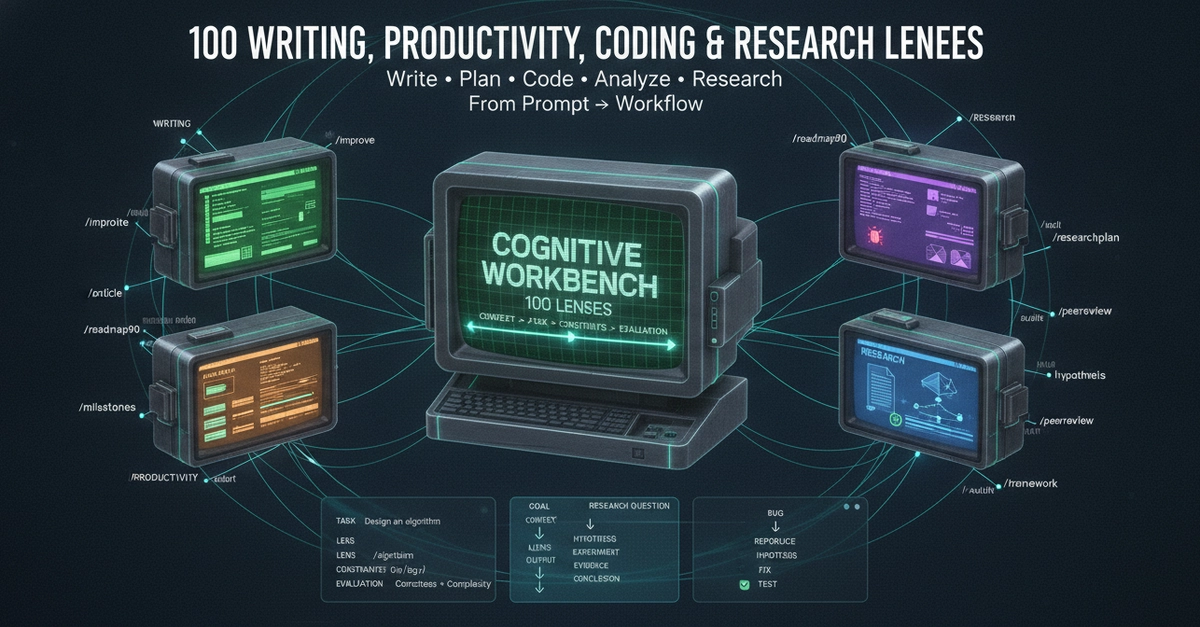
Beyond the Chatbot: Introducing Specialized AI Lenses
The common interaction with AI models like ChatGPT often resembles a simple question-and-answer session. You ask, it replies. This approach, however, vastly underutilizes the potential of advanced AI. The underlying idea is to stop treating AI as a single-purpose chatbot and instead, conceptualize it as a collection of specialized working modes, or 'lenses'. By adopting this perspective, users can unlock significantly more utility, moving from fixing a single sentence to designing complex algorithms.
Consider the difference between asking ChatGPT to 'write an email' versus instructing it to adopt a '/salespitch' lens. The latter primes the AI with a specific context, objective, and expected output format. This isn't merely about crafting better prompts; it's about fundamentally shifting how we engage with AI, guiding it towards specific cognitive functions.
This paradigm shift turns a linear interaction into a structured workflow.
User
  ↓
Question
  ↓
AI
  ↓
Answer
Becomes:
User
  ↓
Select Lens (/debug, /researchplan, /roadmap90)
  ↓
Contextual Prompt
  ↓
AI (in specialized mode)
  ↓
Targeted, structured output
Applying Lenses Across Disciplines
The concept of 'lenses' provides a powerful framework for leveraging AI across various domains. For writers, this means moving beyond simple text generation. A '/proofread' lens could focus on grammatical accuracy and style consistency. A '/summarize' lens would distill lengthy documents into concise summaries, while a '/brainstorm' lens could generate creative ideas for articles or marketing copy. The '/critic' lens is particularly valuable, prompting the AI to challenge assumptions and identify weaknesses in an argument, forcing a more robust and well-considered output.
In the realm of productivity, lenses can streamline project management and planning. A '/roadmap90' lens, for instance, could break down a large project into manageable 90-day goals, complete with milestones and potential roadblocks. This transforms an overwhelming task into a series of actionable steps. Similarly, a '/meetingprep' lens could gather relevant background information and suggest talking points for an upcoming discussion.
Developers can benefit immensely from specialized coding lenses. A '/debug' lens instructs the AI to analyze code for errors, offering specific solutions and explanations. For algorithm design, a '/algorithm' lens guides the AI to generate or optimize algorithms based on specified parameters and constraints. A '/codeexplain' lens can demystify complex code snippets, making them accessible to less experienced developers or for documentation purposes. This structured approach to coding tasks ensures greater efficiency and accuracy.
Researchers can leverage lenses to accelerate their work. A '/researchplan' lens can help outline a study, suggesting methodologies, potential hypotheses, and key literature to review. A '/dataviz' lens could assist in identifying appropriate visualization techniques for a given dataset and even suggest code snippets for generating charts. For literature reviews, a '/litreview' lens can help identify key themes, seminal works, and gaps in existing research, providing a structured foundation for further investigation.
The Mechanics of Lens Implementation
Implementing these lenses doesn't necessarily require complex new technology. For many AI platforms, it's a matter of sophisticated prompt engineering. The key is to clearly define the AI's role and objective before presenting the core task. This often involves a preamble that sets the context. For example, before asking the AI to write a marketing email, one might preface it with:
"You are a senior marketing copywriter. Your goal is to craft persuasive and engaging copy that drives conversions. Focus on benefit-driven language and a clear call to action. Now, write a marketing email for product X."
The specific commands like '/debug' or '/roadmap90' serve as shorthand for these complex contextual instructions. They act as triggers, signaling to the AI to adopt a predefined set of parameters and behaviors. Think of it less like a rigid command-line interface and more like selecting a specialized tool from a comprehensive toolbox. Each lens is pre-loaded with the necessary context and constraints for its specific function.

The underlying principle is to provide the AI with a 'mode of thinking' rather than just a task. This allows for more nuanced and accurate outputs. For instance, a '/debate' lens would prompt the AI to adopt a contrarian viewpoint and construct arguments, whereas a '/negotiate' lens would focus on finding common ground and proposing solutions. The diversity of potential lenses is limited only by the user's imagination and the AI's capabilities.
Building Your Own Lens Library
Creating a personal library of lenses can significantly boost productivity. Start by identifying recurring tasks where AI can be helpful. For each task, define the desired outcome, the necessary context, and any constraints. Then, craft a detailed prompt that encapsulates these elements. Save these prompts for easy reuse. Over time, this collection will evolve into a powerful, customized toolkit.
For example, if you frequently need to extract key information from meeting transcripts, you might develop a '/extractactionitems' lens. This lens would instruct the AI to identify decisions made, assigned tasks, deadlines, and responsible individuals. The prompt might look something like:
"Act as a meticulous meeting scribe. Your task is to review the following transcript and extract all action items. For each action item, clearly state the task, the person responsible, and the deadline. If no deadline is specified, note it as 'TBD'. Format the output as a bulleted list."
This approach transforms AI from a passive respondent into an active, specialized assistant. The benefit is not just in the quality of the output, but in the efficiency gained by pre-defining the AI's operational mode, reducing the need for iterative refinement and clarification.
The potential applications are vast, encompassing everything from drafting legal documents with a '/legaldraft' lens to generating creative story plots with a '/storyoutline' lens. As AI models become more sophisticated, the ability to direct their focus through these specialized lenses will become an increasingly critical skill for maximizing their utility.