%22%20%2F%3E%0A%20%20%3C%2Fsvg%3E)
Unitree As2-W: A Leap in Quadruped Robotics
Unitree Robotics, a company known for pushing the boundaries of quadrupedal robot design, has unveiled its latest offering: the As2-W. This new iteration represents a significant advancement over its predecessors, integrating more sophisticated AI capabilities and enhanced mechanical dexterity, signaling a clear push towards more demanding industrial and research applications.
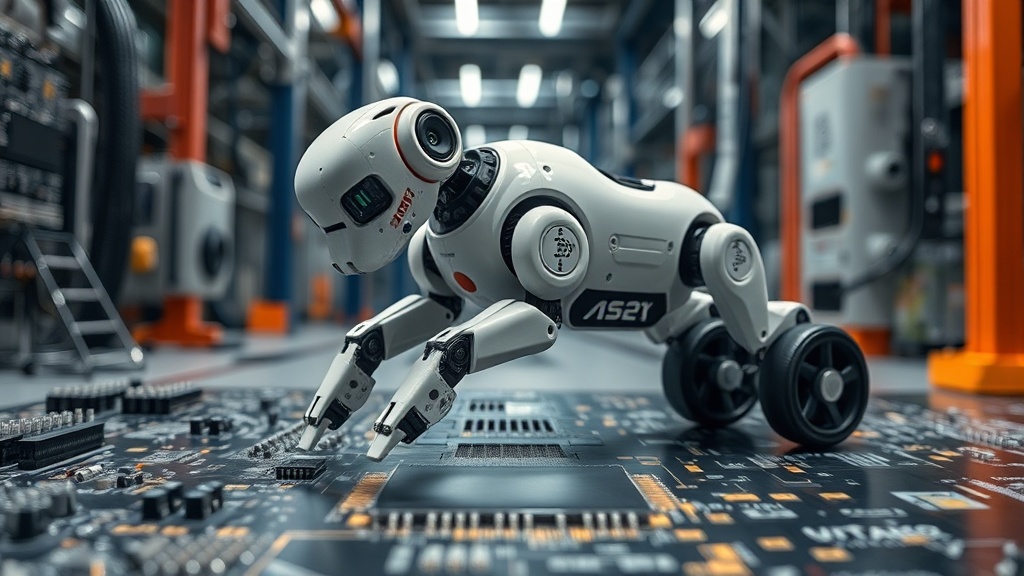
The As2-W is designed to navigate complex environments with a level of agility previously unseen in commercial quadruped robots. Its advanced kinematic design allows for dynamic movements, including rapid changes in direction, stair climbing, and obstacle avoidance. This enhanced mobility is crucial for tasks such as inspection in hazardous areas, complex logistics in warehouses, and even advanced scientific research in unpredictable terrains.
Enhanced Dexterity and AI Integration
At the core of the As2-W's capabilities lies its improved dexterity. The robot features a redesigned leg structure and more powerful actuators, enabling finer motor control. This allows the As2-W to perform tasks requiring delicate manipulation, a significant departure from earlier models that were primarily focused on locomotion. While specific details on manipulation end-effectors are scarce, the underlying mechanical design suggests a platform ready for integration with robotic arms or specialized grippers.
The integration of advanced AI is another key differentiator. The As2-W is equipped with enhanced onboard processing power, allowing for real-time decision-making and adaptation to its surroundings. This moves beyond simple pre-programmed routines, enabling the robot to learn from its environment, optimize its movements for efficiency, and potentially collaborate with other robots or human operators. Unitree has emphasized the AI's role in improving autonomy, reducing the need for constant human supervision in long-duration missions.
Target Applications and Market Positioning
Unitree has clearly positioned the As2-W for professional use cases. The robot's robust construction and advanced features make it suitable for a range of industries:
- Industrial Inspection: The As2-W can access hard-to-reach areas in factories, power plants, or construction sites, transmitting real-time data and imagery. Its AI can potentially identify anomalies or potential issues autonomously.
- Logistics and Warehousing: In dynamic warehouse environments, the robot can assist with inventory management, package sorting, and delivery of goods, especially in areas not easily accessible by traditional automated systems.
- Public Safety and Emergency Response: Its ability to traverse difficult terrain and potentially carry sensor payloads makes it valuable for search and rescue operations, hazardous material detection, or reconnaissance in disaster zones.
- Research and Development: For academic institutions and R&D labs, the As2-W offers a powerful platform for developing new AI algorithms, robotic control strategies, and human-robot interaction models.
The company's focus on a professional-grade product suggests a strategy to capture market share in the growing enterprise robotics sector, moving beyond its earlier consumer-oriented models. The As2-W aims to provide a versatile and intelligent solution that can be customized for specific industry needs.
Comparison to Existing Models and Future Outlook
While Unitree has a strong track record with models like the Go1 and the earlier Go2, the As2-W signifies a maturation of their technology. It competes in a space increasingly populated by companies like Boston Dynamics with its Spot robot, but Unitree appears to be targeting a more accessible price point and a broader range of AI-driven functionalities. The emphasis on enhanced dexterity and AI suggests a roadmap towards robots that are not just mobile but also capable of performing complex tasks with a degree of autonomy.
The Hacker News discussion around the As2-W highlights the community's interest in the practical applications and the underlying technological advancements. Developers and engineers are keen to understand the specifics of its AI, the extensibility of its platform, and its performance benchmarks in real-world scenarios. What remains to be seen is how Unitree will support the developer ecosystem around the As2-W, particularly concerning custom AI model integration and advanced manipulation task programming.
Unitree's As2-W is more than just an incremental upgrade; it’s a statement of intent. By blending advanced locomotion with sophisticated AI and a focus on practical industrial use, Unitree is positioning itself as a serious contender in the professional robotics market. The coming months will likely reveal more about its performance capabilities and the specific partnerships it aims to forge across various sectors.