The Challenge of Realistic Space Physics in UE5
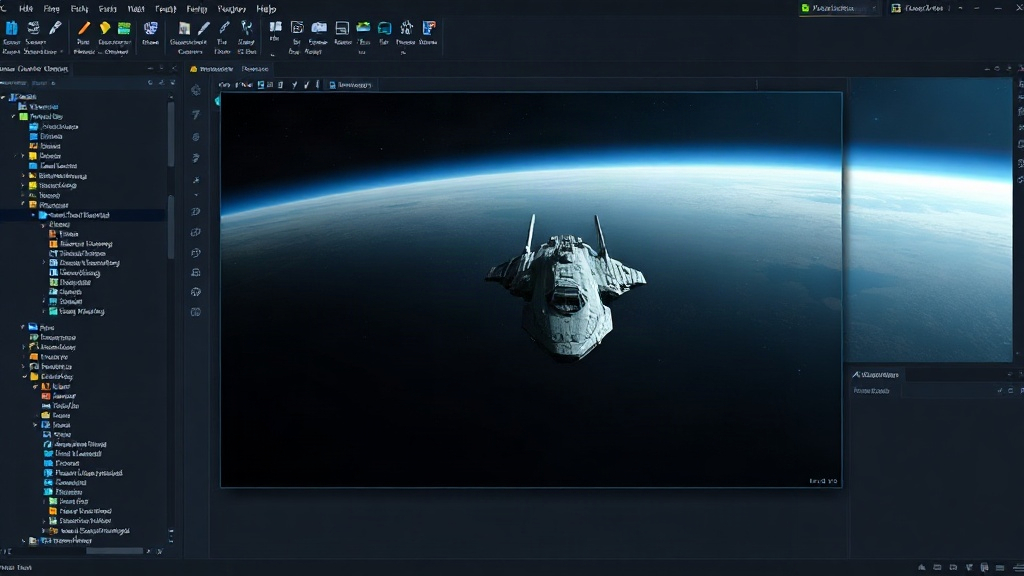
Developing a convincing open-world space simulator in Unreal Engine 5 presents unique challenges, particularly when dealing with 6DOF (six degrees of freedom) physics and network synchronization. The developer behind the Sirius space sim, using a custom-built Aether Framework, tackled critical issues related to relative docking and physics drift. This framework integrates UE5's Network Prediction Plugin (NPP) and Large World Coordinates (LWC) to manage complex physics simulations across vast distances. The core problem lies in replicating the sensation of precise control when docking smaller, agile craft onto massive, fast-moving capital ships, a process prone to physics jitter and desynchronization between clients and the server.
The developer identified four specific physics bugs that plagued the docking experience. These issues were not minor visual glitches; they fundamentally broke the player's immersion and control, making complex maneuvers impossible. The solutions, implemented in C++, focused on refining how physics interactions are calculated and synchronized, especially when objects are in relative motion.
Fixing Jittery Rotation on Moving Carriers
The first major hurdle was jittery rotation when a player's ship entered a relative movement zone. Normally, rotational smoothing algorithms help create a fluid experience. However, in this specific scenario, the rotational smoothing was bypassed entirely. This meant every micro-rotation of the carrier, no matter how small, was directly and jarringly applied to the player's ship. This created a nauseating and uncontrollable experience, making it impossible to align a fighter with a docking port on a moving carrier.
The solution involved ensuring that the relative movement calculations did not interfere with the established rotational smoothing pipeline. By re-evaluating how the carrier's transform was applied to the docked ship's physics state, the developer was able to maintain smooth rotation while still accounting for the carrier's own movement. This required careful management of physics substeps and ensuring that the relative velocity and rotation were correctly integrated into the player ship's physics simulation without causing abrupt changes.
Addressing Physics Drift and Unpredictable Movement
Another significant issue was physics drift, where ships would slowly but surely deviate from their intended trajectories, especially when under thruster control or interacting with gravitational forces. This drift is particularly problematic in space sims where precise navigation is paramount. If a ship's physics state is not perfectly synchronized and calculated, even small errors can accumulate over time, leading to significant deviations. This makes long-distance travel unreliable and combat maneuvers unpredictable.
The fix for physics drift involved a multi-pronged approach. Firstly, it required a more robust implementation of deterministic physics. This means that given the same inputs and initial conditions, the physics simulation must produce identical results on all clients and the server. This often involves careful handling of floating-point arithmetic and ensuring consistent physics engine settings. Secondly, the Aether Framework likely implemented stricter checks on physics state replication, ensuring that any discrepancies detected were immediately corrected rather than allowed to propagate. The use of LWC is critical here, as it extends the precision of coordinates, reducing inherent drift issues in large-scale environments.
Netcode Desync During Docking Maneuvers
The most complex problem was netcode desync specifically during docking. When a player initiates a docking sequence, their ship's physics are often influenced by the target object (the carrier). If the network prediction and reconciliation logic doesn't perfectly mirror the physics simulation, desync occurs. This can manifest as the player seeing their ship successfully dock on their screen, while the server registers it as having missed or collided. This leads to frustrating experiences where players lose their ship or fail to dock despite appearing to succeed locally.
The developer addressed this by refining the Network Prediction Plugin's integration with the custom physics system. This likely involved developing custom prediction and reconciliation logic that more accurately reflects the deterministic 6DOF physics. A key aspect is ensuring that the physics state of the docked ship is correctly updated based on the carrier's movement and rotation *before* the next network update is sent or processed. This might involve custom RPCs (Remote Procedure Calls) or a more sophisticated state synchronization mechanism that prioritizes the physics state during critical maneuvers like docking. The goal is to make the physics simulation on the client and server as close as possible, minimizing the window for desync.
The Importance of Deterministic 6DOF Physics
Ultimately, the success of the Aether Framework in solving these problems hinges on its ability to manage deterministic 6DOF physics. Unlike simpler 3DOF physics common in ground-based games, 6DOF accounts for movement along all three axes (X, Y, Z) and rotation around all three axes (pitch, yaw, roll). Achieving determinism in 6DOF physics, especially in a networked environment with floating-point precision challenges and varying frame rates, is exceptionally difficult. It requires meticulous C++ implementation, careful management of physics parameters, and robust network code.
The Aether Framework's approach, leveraging UE5's NPP and LWC, provides a strong foundation. However, the specific bug fixes—ensuring rotational smoothing isn't bypassed, mitigating drift through precise state management, and refining netcode for docking—demonstrate that even advanced engine features require custom solutions for highly specialized use cases like realistic space simulation. The developer's work offers a valuable blueprint for other developers tackling similar challenges in Unreal Engine 5.