
Accelerating Code Integration with Speculative Merging
In the fast-paced world of software development, the time it takes to integrate new code changes into a main branch can become a significant bottleneck. Traditional merge processes, while robust, often involve sequential checks and can lead to lengthy queues, delaying the delivery of new features and bug fixes. Uber has open-sourced SubmitQueue, a high-performance speculative merge queue designed to tackle this challenge head-on.
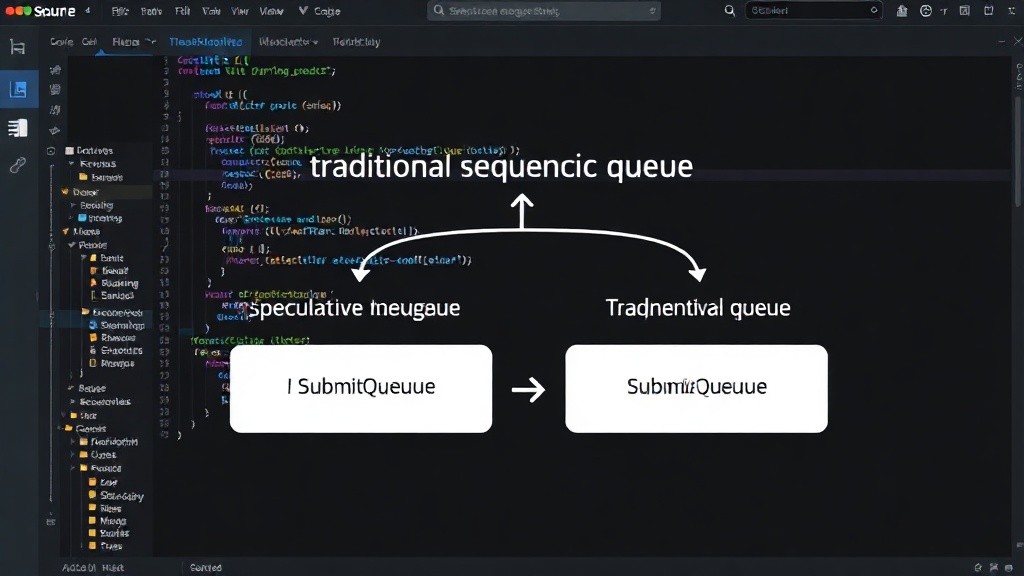
SubmitQueue operates on the principle of speculative execution, a concept more commonly associated with CPU architecture. Instead of waiting for all checks to complete on a given change, SubmitQueue intelligently predicts which changes are likely to be merged and proactively performs merge operations in the background. This allows the system to get ahead of the integration queue, significantly reducing the time from commit to mainline integration.
How SubmitQueue Works
The core innovation of SubmitQueue lies in its ability to predict the outcome of future merge operations. It analyzes incoming code changes, their dependencies, and the results of ongoing or recently completed checks (such as automated tests, static analysis, and security scans). Based on this analysis, it constructs a speculative merge graph. This graph represents a potential future state of the main branch, incorporating changes that are highly probable to pass all validation stages.
When a change is submitted, SubmitQueue doesn't just place it in a waiting line. It immediately attempts to merge it into the speculative branch. If this speculative merge succeeds and the associated checks pass, the change is essentially pre-merged and validated. When the actual main branch is ready for integration (after all preceding, non-speculative changes have been confirmed), SubmitQueue can then finalize the merge of the already-validated speculative change much faster. This bypasses the need to re-run all checks on the final merge, saving valuable time.
Key Components and Benefits
SubmitQueue is designed to be highly performant and scalable, suitable for large development organizations with high commit volumes. Its architecture emphasizes parallelism and efficient state management to handle the complexities of speculative merging.
The primary benefits include:
- Reduced Integration Latency: By performing merges and checks speculatively, the time it takes for a commit to land in the main branch is drastically reduced. This means developers see their changes integrated sooner, enabling faster iteration cycles.
- Improved Developer Productivity: Long waits for code integration can be frustrating and disruptive to a developer's workflow. SubmitQueue minimizes these delays, allowing developers to focus more on writing code and less on waiting for it to be merged.
- Handling High Throughput: The system is engineered to manage a large number of concurrent changes and checks, making it suitable for complex projects with many contributors.
- Intelligent Dependency Management: SubmitQueue understands the relationships between changes, ensuring that speculative merges respect code dependencies and avoid introducing conflicts that would invalidate the speculative work.
Speculative Merging: A Paradigm Shift
The concept of speculative merging is not entirely new in computer science, but its application to code integration pipelines is a significant advancement. Think of it less like a traditional, rigid assembly line and more like a highly sophisticated, predictive logistics network. Instead of waiting for a truck to arrive before preparing the next shipment, SubmitQueue is already packing and staging the next likely shipment, knowing with high confidence it will be needed soon.
This approach requires a sophisticated understanding of the codebase, the CI/CD pipeline, and the statistical likelihood of changes passing various quality gates. Uber has evidently invested considerable effort in developing the algorithms and infrastructure necessary to make this prediction accurate and reliable enough to be useful without introducing instability.
Challenges and Considerations
While SubmitQueue promises substantial improvements, implementing such a system is not without its challenges. The accuracy of its predictions is paramount. If the system speculatively merges changes that ultimately fail checks, it could lead to wasted computation or, worse, subtle bugs if not managed carefully. The overhead of managing the speculative state and ensuring consistency across multiple concurrent speculative merges also needs to be efficient.
Furthermore, integrating SubmitQueue into existing CI/CD workflows requires careful planning. It necessitates a robust testing and validation framework that can provide fast, reliable feedback to the speculative merge engine. Organizations adopting SubmitQueue will need to ensure their testing infrastructure is up to the task.
The Future of Code Integration
Uber's decision to open-source SubmitQueue makes this advanced integration technique available to the broader development community. As software projects grow in complexity and team sizes increase, the need for efficient and rapid code integration will only become more critical. SubmitQueue represents a step towards a future where the time lag between writing code and seeing it live in production is minimized, fostering faster innovation and more agile development practices.
The success of SubmitQueue will likely depend on its adoption and the community's ability to refine its predictive algorithms and integration strategies. As more organizations contribute and adapt it, we may see speculative merging become a standard component of modern CI/CD pipelines, fundamentally changing how code is integrated.