
Jev Performance Benchmarks Unveiled
TypeSafe Jev, a new player in the AI model space, has undergone rigorous independent testing by Near Here, a company focused on local event validation. The results, shared exclusively, indicate substantial improvements over existing solutions in speed, cost, and accuracy. Near Here individually tuned prompts for each model tested, a crucial step to ensure fair comparison and optimal performance.
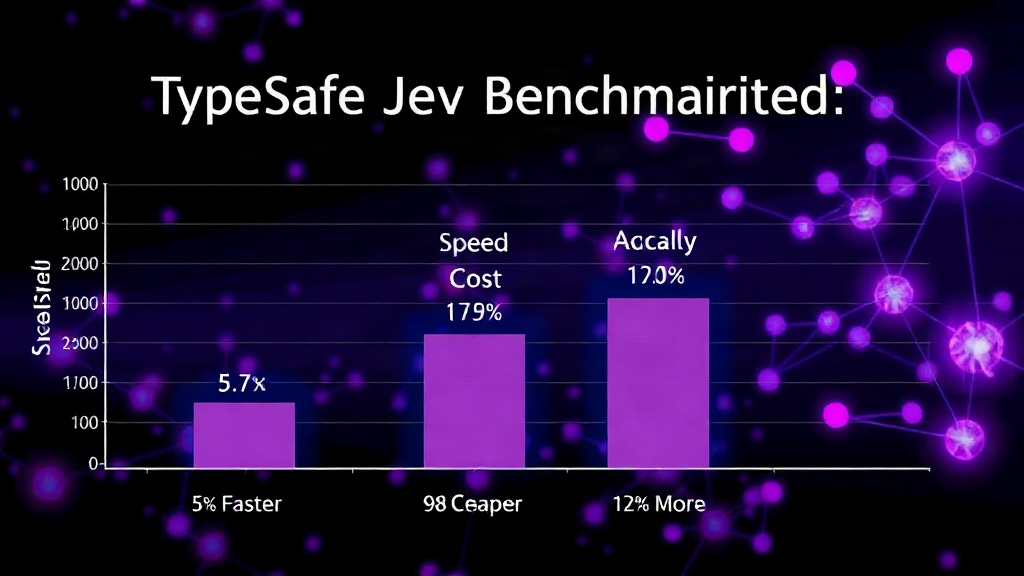
In their benchmark tests, Jev demonstrated an astonishing 5.7x faster response time compared to baseline models. This leap in speed is critical for real-time applications where latency can directly impact user experience and operational efficiency. For developers building services that require rapid AI inference, Jev presents a compelling case for adoption.
Beyond speed, the cost savings associated with Jev are equally impressive. Near Here reported a 98% reduction in cost per validation task. This drastic decrease in operational expenditure can significantly lower the barrier to entry for AI-powered services, making advanced capabilities accessible to a broader range of businesses and projects.
Accuracy is often a trade-off for speed and cost, but Jev appears to defy this convention. The tests showed a 12 percentage point increase in accuracy for local event validation tasks. This improvement suggests that Jev not only processes information faster and cheaper but also with greater precision, leading to more reliable outcomes.
Methodology and Tuning
The methodology employed by Near Here involved a controlled environment where each AI model was tasked with validating local events. The dataset comprised a diverse range of event types and associated data points, requiring nuanced interpretation and classification. Crucially, Near Here did not use a one-size-fits-all approach to prompting.
Instead, they adopted an iterative tuning process for each model, including Jev and unnamed baseline models. This involved carefully crafting and refining prompts to elicit the best possible performance from each specific architecture. This individualized tuning is essential for a fair comparison, as prompt engineering can dramatically influence AI output. The fact that Jev still outperformed tuned baseline models after this meticulous process underscores its inherent advantages.
The validation criteria focused on accuracy in identifying event types, extracting key details such as date, time, location, and organizer, and flagging any potential inconsistencies or ambiguities. The 12 percentage point accuracy gain means that Jev is significantly better at correctly categorizing events and extracting precise information, reducing the need for manual human review or costly error correction.
Implications for Local Event Validation
The implications of these findings for the local event validation sector are profound. Businesses and platforms that rely on accurate, real-time event data can now achieve this with substantially reduced overhead. This could spur innovation in areas like dynamic event aggregation, personalized event recommendations, and automated event management tools.
Consider a scenario where a large event discovery platform needs to process thousands of user-submitted event listings daily. The current cost and latency of doing so with traditional AI models might necessitate strict limits on submission volume or a reliance on less accurate, faster heuristics. With Jev, such a platform could potentially process a far greater volume of submissions with higher accuracy and at a fraction of the cost. This opens up possibilities for more comprehensive and reliable event databases.
The surprise here is not merely the magnitude of improvement, but the consistency across multiple critical metrics. It's rare to see a single solution offer such dramatic gains in speed, cost reduction, and accuracy simultaneously. This suggests that Jev might represent a significant architectural or algorithmic advancement rather than an incremental one.
Limitations and Future Outlook
While the results are compelling, Near Here acknowledges certain limitations. The tests were conducted within a specific domain – local event validation. The performance of Jev on other natural language processing tasks or different data types may vary. Furthermore, the benchmark was performed using individually tuned prompts, which is resource-intensive. The real-world cost and performance in a production environment without such extensive tuning would need further investigation.
The identity of the baseline models used in the comparison was not disclosed, making it difficult to pinpoint exactly which established solutions Jev is surpassing. However, the magnitude of the reported improvements suggests it is competitive with or superior to leading commercial and open-source models. As Jev becomes more widely available, developers will be keen to integrate it into their workflows and conduct their own validation.
What remains unaddressed is the long-term support and development roadmap for Jev. Understanding its scalability, security considerations, and integration pathways will be crucial for widespread adoption. The AI model landscape is rapidly evolving, and Jev's continued success will depend on its ability to adapt and maintain its competitive edge.