Two-Thirds of Europe's Top Sites Fail Basic WCAG 2.1 Accessibility
As WCAG 2.2 nears citation, a new scan reveals widespread failure on fundamental accessibility criteria for major European websites.
By NowRift Editorial|Updated 30 Aug 2026
Widespread Accessibility Failures on European Websites
The European Union is gearing up for the next iteration of its accessibility standard, EN 301 549 V4.1.1, which is slated for citation on November 30, 2026. This update will replace WCAG 2.1 with WCAG 2.2, introducing six new success criteria at Level A and AA. While a niche industry of readiness checklists has emerged, a recent analysis of Europe's most-visited websites reveals a stark reality: a significant majority are not even meeting the current accessibility requirements.
The analysis scanned the most popular websites across EU member states, assessing their compliance with the currently enforced version of EN 301 549. The results indicate that many organizations are far from prepared for the upcoming WCAG 2.2, let alone meeting existing obligations. The deadline people are preparing for is not the one they have missed; the current standard, in force since before the European Accessibility Act deadline passed in June 2025, is already proving too challenging for many.
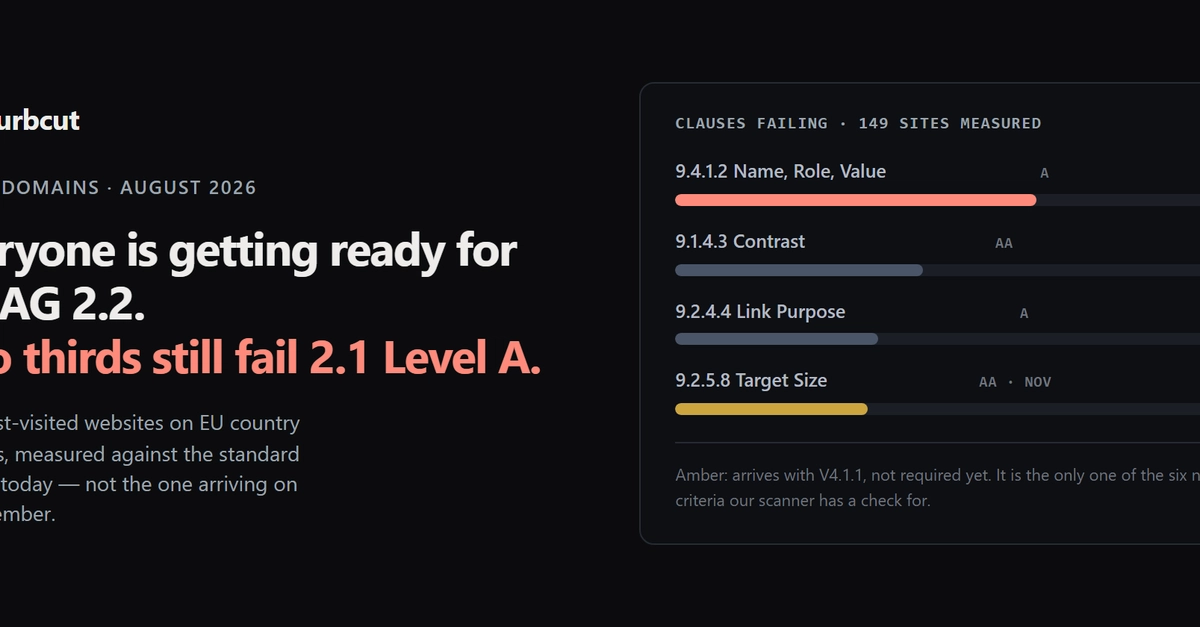
The most critical failure point is clause 9.4.1.2, "Name, Role, Value." A staggering 64% of the scanned websites fail this Level A criterion. This is not a new or complex requirement; it has been a foundational part of WCAG since 2008, forming the lowest accessibility bar. Its widespread failure suggests a systemic issue in how accessibility is being implemented, or perhaps ignored, across the digital landscape.
A pie chart illustrating the percentage of European websites failing WCAG 2.1 Level A criteria.
The "Name, Role, Value" Failure Explained
The "Name, Role, Value" (NRV) success criterion is fundamental to making web content accessible to users of assistive technologies, particularly screen readers. It mandates that user interface components (like buttons, links, form fields, and custom controls) must have programmatically determinable names, roles, and states/properties. This allows assistive technologies to convey the purpose and current status of these components to the user.
Name: This refers to the accessible name of an element, which is what a screen reader announces to the user. For a button, it might be the text inside it. For an icon button, it should be provided via an `aria-label` or similar mechanism. Without a proper name, a screen reader might announce "button" without any context, leaving the user confused.
Role: This defines the type of user interface element. For standard HTML elements like `