Understanding the Core Requirements
Designing a platform like Twitter, now X, involves balancing a vast array of user needs and technical constraints. At its heart, the system must allow users to post short messages (tweets), follow other users to curate their content feed, and view a real-time or near real-time stream of posts from those they follow. This basic functionality underpins a complex ecosystem that supports features like liking, retweeting, replying, user profiles with tweet history, and searching through millions of posts.
The requirements extend far beyond basic posting and viewing. Non-functional requirements are paramount for a service operating at Twitter's scale. High availability is non-negotiable; the platform is considered a utility by many, meaning downtime is unacceptable. Eventual consistency is a pragmatic choice, allowing the timeline to be slightly stale (perhaps by a few seconds) to achieve better performance and availability. Low latency is critical for user experience, with timeline loads expected to be under 200 milliseconds. The system is overwhelmingly read-heavy, with a read-to-write ratio estimated at 100:1. This dictates significant optimization for read operations. Finally, the sheer scale is staggering: hundreds of millions of Daily Active Users (DAU) generating hundreds of millions of tweets per day.
Estimating Scale and Capacity
To build such a system, a rigorous capacity estimation is the first step. For Twitter's scale, we're looking at roughly 300 million DAU and 500 million tweets per day. This translates to approximately 6,000 tweets per second (500M / 24h / 3600s). If we consider peak loads, this number could easily double or triple. For reads, with a 100:1 ratio, this means potentially 600,000 to 1.8 million read requests per second for timelines alone.
Storage is another massive consideration. If each tweet is, on average, 280 characters plus metadata, and assuming 1 byte per character, we're looking at roughly 0.5 KB per tweet. For 500 million tweets per day, that's 250 GB of new data daily. Over a year, this approaches 91 TB, not including user data, media, or indexes. This necessitates a distributed storage solution capable of handling petabytes of data.
Core System Components and Data Models
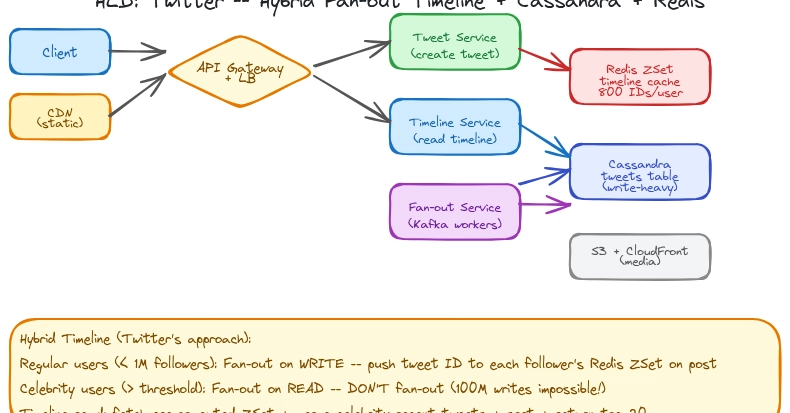
A high-level design for Twitter/X typically involves several key services:
User Service
Manages user profiles, authentication, and relationships (followers/following). A relational database might initially seem appropriate, but at scale, sharding by User ID is essential. To handle the read-heavy nature of follower graphs and efficient lookup of who follows whom, specialized graph databases or highly optimized distributed key-value stores are often employed.
Tweet Service
Responsible for creating, storing, and retrieving tweets. Tweets themselves can be stored in a distributed NoSQL database like Cassandra or a similar wide-column store, optimized for high write throughput and eventual consistency. Each tweet needs a unique ID, user ID, timestamp, content, and metadata (likes, retweets, replies). Tweet IDs are often time-based (like Snowflake IDs) to ensure chronological ordering and distribution.
Timeline Service
This is arguably the most complex component due to the read-heavy nature and latency requirements. Two primary approaches exist:
- Fan-out on Write: When a user posts a tweet, it's immediately pushed to the timelines of all their followers. This is highly efficient for reads but can be problematic for users with millions of followers (celebrities, news outlets), leading to massive write amplification.
- Fan-out on Read: When a user requests their timeline, the system fetches tweets from all the users they follow and merges them. This is simpler on the write side but can lead to high latency for users following many people.
Twitter likely employs a hybrid approach. For most users, a fan-out-on-write strategy is used, pushing tweets to follower timelines stored in a cache (like Redis) or a dedicated timeline store. For users with massive follower counts, their tweets might not be immediately pushed but rather fetched on demand during a timeline read, or a more sophisticated distributed system manages the fan-out at scale.
Referenced Sources
- verified