The Problem with JSON's Flexibility
JSON, in its ubiquity, has become the de facto standard for data interchange across web services, configuration files, and more. Its human-readable format and simple structure have driven widespread adoption. However, this flexibility is also its Achilles' heel. Without a defined schema, JSON documents can vary wildly in structure, leading to runtime errors, data corruption, and significant developer friction when integrating disparate systems. Developers often resort to custom validation logic, which is brittle and time-consuming to maintain. Think of it less like a structured database and more like a shared whiteboard where anyone can draw anything, leading to chaos when trying to extract specific information.
The lack of inherent schema enforcement means that data integrity is often an afterthought, handled at the application layer. This can manifest as unexpected `null` values, missing keys, or incorrect data types, all of which can cascade into subtle bugs that are difficult to trace. For large-scale systems or teams working collaboratively, this ambiguity poses a significant challenge to maintaining stability and predictability.
Introducing TSON: A Superset with Schema Enforcement
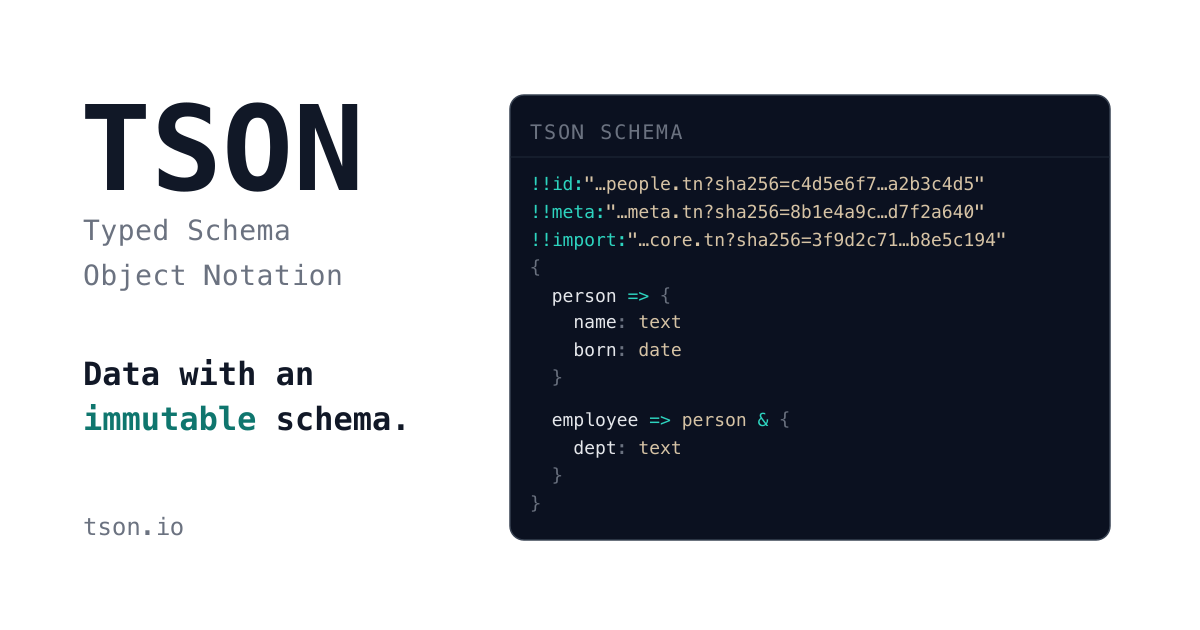
TSON (Typed Schema Object Notation) emerges as a proposed solution to these long-standing issues. It positions itself as a superset of JSON, meaning any valid JSON is also valid TSON. The key differentiator is its introduction of immutable, hash-pinned schemas. This means that TSON documents are not just data; they are data *with a contract*. This contract, the schema, is itself represented and pinned by a cryptographic hash, ensuring its integrity and immutability.
The core idea is that every TSON document is associated with a specific schema version, identified by its hash. When a TSON document is created or validated, it must conform to the schema it claims. This schema is not an external file that might drift or be modified independently; it is intrinsically linked to the data. This hash-pinning mechanism provides a strong guarantee: if the data is valid for schema X (identified by hash H), it will remain valid for schema X as long as that hash H is referenced.
Immutability and Versioning
A crucial aspect of TSON is its emphasis on immutability. Once a schema is defined and its hash is generated, that schema cannot be changed. If modifications are needed, a new schema must be created, resulting in a new hash. This approach inherently supports robust versioning. Instead of dealing with breaking changes, systems can simply reference different schema hashes for different data versions. This is particularly beneficial in distributed systems where components might update at different paces, or when maintaining backward compatibility is paramount.
This immutability of schemas offers a powerful mechanism for data governance and auditing. Since each schema version is uniquely identified and unalterable, tracking data evolution becomes straightforward. It’s akin to having an indelible ledger for your data’s structure, where every change is a new, distinct entry, rather than an edit to an existing one.
How TSON Works: Schemas and Data
At its heart, TSON involves two primary components: schemas and data. Schemas are defined using a TSON-specific schema language, which is designed to be expressive yet clear. These schemas specify the expected data types, structures, and constraints for JSON-like objects. Once a schema is defined, it is hashed. This hash acts as the schema's identifier. Data conforming to this schema is then encoded in TSON format, and crucially, includes a reference to the schema's hash.
Validation occurs by retrieving the schema associated with a given hash and verifying that the data adheres to its rules. The immutability ensures that the validation process is deterministic; the rules never change for a given schema hash. This is a significant departure from many existing schema validation systems where schemas can be updated, leading to potential inconsistencies if not managed carefully.
Potential Use Cases and Implications
The implications of TSON are far-reaching, particularly in domains where data integrity and predictable evolution are critical. For microservices architectures, TSON could provide a robust contract between services, reducing integration complexities and preventing runtime errors caused by malformed payloads. In configuration management, immutable schemas ensure that configurations remain consistent and auditable over time.
For data pipelines and ETL processes, TSON offers a way to enforce data quality at the ingestion point. Data that doesn't conform to the expected schema can be rejected or flagged early, preventing downstream issues. The ability to version schemas independently of data also simplifies long-term data archival and analysis, as the structure associated with historical data remains fixed and verifiable.
The concept of hash-pinning is not entirely new, appearing in systems like IPFS for content addressing. Applying it to data schemas brings a similar level of content-addressable integrity to data structure itself. This could fundamentally change how we think about data contracts and API evolution.
Challenges and The Road Ahead
While TSON presents a compelling vision, its adoption hinges on several factors. The development of robust, performant parsers and schema definition tools for various programming languages will be critical. The expressiveness of the schema language itself will also determine its suitability for complex data structures. Furthermore, convincing developers to adopt a new format, even one that offers significant advantages, is always an uphill battle.
The ecosystem around TSON will need to mature. This includes libraries for validation, serialization, and potentially tooling for schema management and migration assistance. The success of TSON will likely depend on its ability to integrate smoothly into existing workflows and demonstrate a clear, quantifiable benefit over current JSON practices. The question remains: will the developer community embrace this more rigorous approach to data interchange, or will JSON's inherent flexibility continue to reign supreme?