Automating Daily Standups with Troopr AI
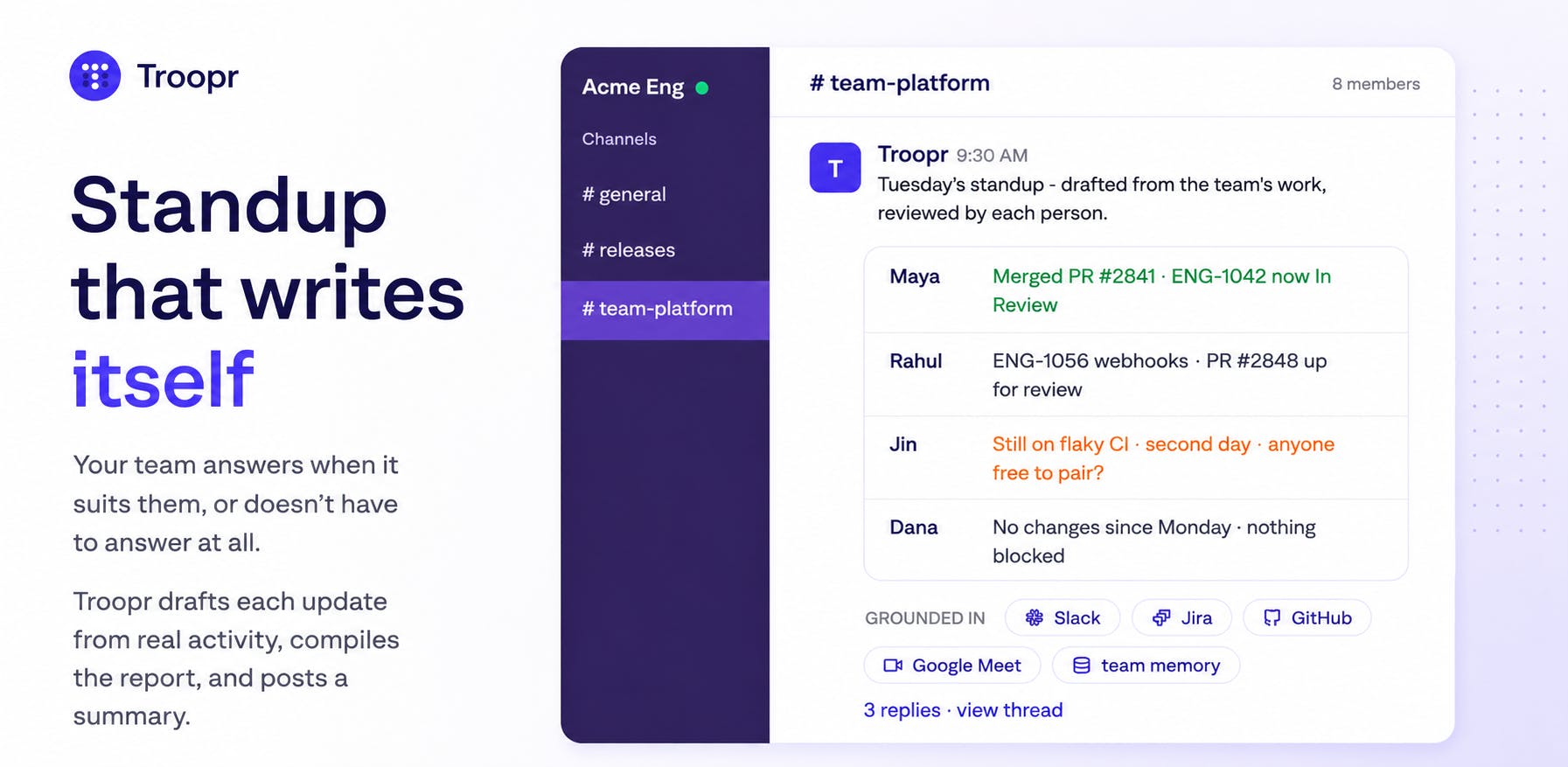
The daily standup, a cornerstone of agile development, often devolves into a ritual of time-wasting. Teams spend precious minutes reciting updates, often disconnected from the actual progress on tasks. Troopr AI Scrum Master emerges as a potential solution, promising to automate the generation of these crucial updates by directly observing and interpreting the work being done. This approach aims to free up developers and scrum masters from the repetitive task of compiling and delivering status reports, allowing them to focus on problem-solving and project advancement.
At its core, Troopr AI Scrum Master functions by integrating with existing development workflows and tools. It doesn't ask for manual input for the standup itself. Instead, it analyzes the real work being completed within the team's project management systems. This means it can parse updates, code commits, task status changes, and other relevant activities to construct a coherent narrative of progress. The system remembers the team's context, learning individual contributions and project specifics over time, which allows for more accurate and relevant summaries.
The value proposition is clear: reduce the time spent in standup meetings and increase their effectiveness. Instead of a verbal report, team members can review an AI-generated summary that reflects actual work accomplished. This shift could fundamentally alter how teams track progress, moving from a synchronous, often superficial, reporting mechanism to an asynchronous, data-driven overview. The promise is that by understanding what has truly been done, teams can identify blockers more quickly and plan their day with greater precision.
How Troopr AI Captures Real Work
The mechanism by which Troopr AI extracts information is key to its utility. The system is designed to connect with common development tools, such as project management platforms (like Jira, Asana, or Trello) and version control systems (like GitHub or GitLab). By tapping into these sources, Troopr AI can monitor:
- Task status updates (e.g., from 'In Progress' to 'Done').
- Code commits and pull requests, including associated commit messages and linked tasks.
- Comments and discussions on tasks and tickets.
- Completion of sub-tasks or checklists within larger tasks.
This continuous observation allows Troopr AI to build a dynamic understanding of project velocity and individual contributions. It's not just about ticking boxes; it's about understanding the narrative of development. For example, if a developer moves a task to 'In Review' and comments with specific details about a challenging implementation, Troopr AI can capture both the status change and the qualitative information, presenting it as part of the daily update. This level of detail is often lost in traditional standups, where the focus might be on simply stating that a task is 'in review'.
The AI's ability to 'remember' the team is also crucial. This implies a learning component, where the system becomes more adept at understanding the team's specific jargon, common workflows, and the typical lifecycle of their tasks. Over time, it can differentiate between a minor bug fix and a significant feature development, providing contextually appropriate summaries. This is a significant departure from generic reporting tools that might simply aggregate data without understanding its meaning within the team's specific agile framework.
Consider a scenario where a developer is working on a complex feature. Instead of saying, "I worked on feature X," in a standup, Troopr AI might generate: "Alice completed the backend integration for Feature X, resolving the authentication issue identified yesterday. She has now moved to implementing the frontend components. Bob finalized the UI mockups for Feature X and has handed them off to Alice." This detailed output, derived from commit messages and task updates, provides much richer information to the rest of the team than a simple verbal status.
The Impact on Team Dynamics and Productivity
The implications of such a tool extend beyond mere time savings. By providing an objective, data-driven summary of work, Troopr AI can foster greater transparency and accountability within teams. When the standup summary is generated directly from completed actions, it reduces the potential for misinterpretation or the omission of critical details. This can lead to more informed decision-making during sprint planning and daily task allocation.
Furthermore, the reduction in meeting time can have a cascading effect on productivity. Developers can reclaim minutes, or even tens of minutes, each day that were previously spent in standup. This time can be reinvested into coding, debugging, or collaborative problem-solving. For scrum masters, the burden of facilitating and documenting standups is significantly lightened, allowing them to focus on higher-value activities like coaching, impediment removal, and process improvement.
However, the success of Troopr AI Scrum Master hinges on the team's willingness to adopt it and ensure their workflows are consistently updated within the integrated tools. If tasks are not properly updated or commits lack descriptive messages, the AI will struggle to generate accurate summaries. It requires a disciplined approach to task management and version control, which is a prerequisite for effective agile practices anyway.
The surprising detail here is not the AI's ability to parse data, but its focus on replacing the *human* element of reporting with an *automated* one. Many AI tools augment human tasks; Troopr AI aims to replace a specific, recurring human communication task entirely. This bold approach could set a new precedent for how agile ceremonies are conducted, moving further towards an AI-assisted, asynchronous workflow.
What remains to be seen is how Troopr AI handles complex, ongoing tasks where progress isn't always a discrete 'done' state. For instance, a developer might spend an entire day researching a problem without a tangible code change. The AI's ability to interpret and report on such 'invisible' work will be a critical differentiator.