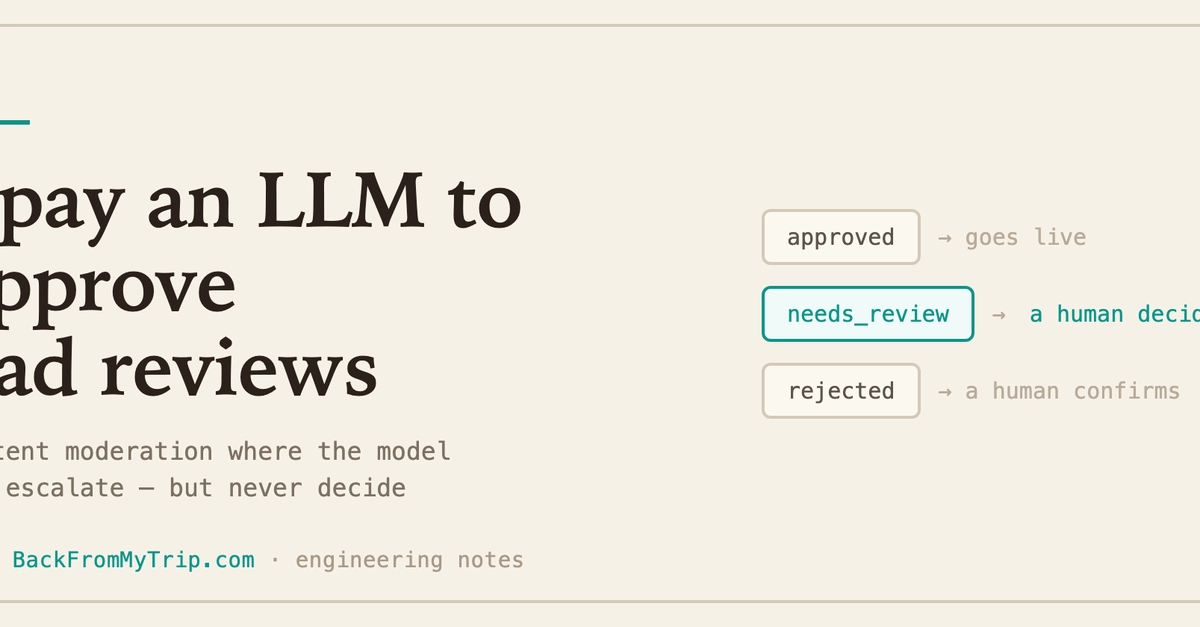
The Core Problem: Amplifying Honest Feedback
The internet is awash with travel reviews. Yet, finding genuinely useful, unvarnished feedback is a challenge. Many platforms, driven by business interests or user experience anxieties, inadvertently filter out or downplay negative experiences. This is precisely the problem Cornel Croi set out to solve with Back From My Trip. The site’s core premise is simple: “Would you go back?” No stars, no numerical scores. Just a direct answer and the story behind it.
Croi realized the most valuable content on such a site isn't the glowing endorsement, but the detailed account of a trip that fell short. These negative reviews offer crucial insights for potential travelers and hold businesses accountable. However, standard content moderation, whether human or automated, often struggles with nuance. Algorithms trained to detect spam, hate speech, or offensive language can inadvertently flag legitimate, albeit harsh, criticism as problematic. This is where an Large Language Model (LLM) became an unlikely but essential tool.
The critical insight is that negative reviews are not inherently bad content; they are often the most informative. Croi’s strategy isn't to suppress negative feedback but to actively ensure it gets published. This means paying for processing power not to filter out complaints, but to guarantee their passage. The LLM acts as a gatekeeper, but with a specific mandate: to protect and promote honest, critical perspectives.
The LLM Pipeline: A New Kind of Content Moderation
The entire pipeline for trip reports on Back From My Trip passes through an LLM. This model is tasked with reviewing each submission before it goes live. The prompt engineering is key, and Croi highlights one specific line as paramount: “- Negative reviews are ALWAYS allowed. A harsh critique of a hotel/destination is legitimate content.” This directive overrides any inclination the LLM might have to flag critical feedback as undesirable or problematic.
Think of it less like a traditional content filter designed to block anything that might upset someone, and more like an editor at a respected newspaper. This editor's job isn't to sanitise the news but to ensure accuracy and importance, even if the story is uncomfortable. The LLM, in this analogy, is that editor, specifically instructed to value honesty and critical reporting above all else. It's a deliberate choice to pay for the computational cost of LLM processing to achieve a specific editorial outcome: the unfiltered voice of the traveler.
The tradeoff is clear: Croi pays for LLM tokens to process every review, a cost incurred specifically to preserve the integrity of negative feedback. This is a departure from standard practice where AI is often employed to *reduce* the volume of undesirable content. Here, the AI's primary function is to *allow* content that might otherwise be challenged by simpler moderation systems.
Why This Approach Matters for Trust and Utility
In the crowded travel review space, trust is the ultimate currency. Users are increasingly skeptical of overly positive or suspiciously uniform reviews. When a platform actively champions negative feedback, it signals a commitment to authenticity. This can build a loyal user base that values the site for its candidness.
For travelers, negative reviews are often the most practical information. Knowing about a noisy hotel, a disappointing restaurant, or a poorly managed tour can save someone time, money, and frustration. By ensuring these voices are heard, Back From My Trip provides a service that goes beyond simple aggregation of opinions; it offers genuine utility.
This approach also presents an interesting model for other content platforms. Many struggle with the balance between maintaining a positive community image and allowing for robust, critical discussion. Using LLMs with carefully crafted prompts to *prioritize* certain types of content, rather than just block others, offers a sophisticated alternative to blunt-force moderation.
The Unanswered Question: Scalability and Nuance
While Croi’s strategy is innovative and effective for his current scale, a crucial question remains: how will this approach scale? As Back From My Trip grows, will the LLM remain adept at distinguishing between legitimate, constructive criticism and genuinely harmful content like hate speech or targeted harassment, especially as the volume of reviews increases? The prompt is explicit, but real-world data can be messy. The long-term success hinges on the LLM’s ability to consistently apply this nuanced editorial judgment without introducing new biases or failing to catch genuinely malicious content disguised as a review.
Furthermore, the cost of LLM processing, while accepted now, could become a significant operational hurdle for a rapidly scaling platform. Finding the optimal balance between AI-driven review and human oversight will be critical. The current model prioritizes ensuring negative reviews are allowed, but as the platform matures, the challenge will be to maintain this while also ensuring overall content quality and safety.