The Core of Modern NLP: Understanding Transformers
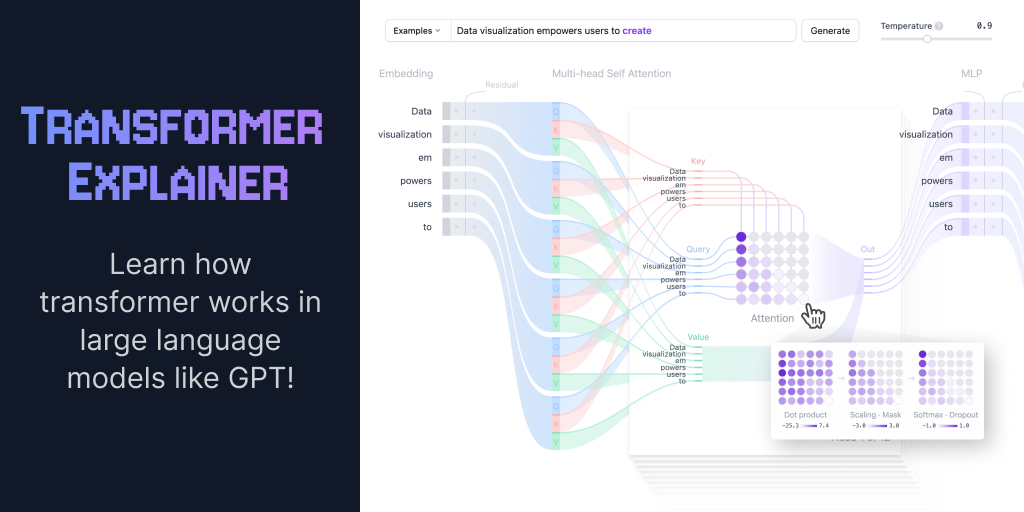
The Transformer architecture, first introduced in the 2017 paper "Attention Is All You Need," has fundamentally reshaped the landscape of Natural Language Processing (NLP) and, more broadly, artificial intelligence. While its impact is undeniable, the inner workings of this complex model can be opaque. A recent interactive explainer, gaining significant traction on Hacker News, breaks down these intricacies with remarkable clarity.
At its heart, the Transformer abandons traditional recurrent neural networks (RNNs) and convolutional neural networks (CNNs) in favor of a mechanism called self-attention. This allows the model to weigh the importance of different words in an input sequence when processing any given word. Unlike RNNs, which process sequences word-by-word, creating a bottleneck for long sequences, or CNNs, which have a limited receptive field, self-attention can consider all words simultaneously, regardless of their position. This parallel processing capability is a key reason for the Transformer's efficiency and effectiveness in handling long-range dependencies in text.

Decoding the Encoder-Decoder Structure
The original Transformer model consists of two main parts: an encoder and a decoder. The encoder's job is to process the input sequence and convert it into a rich, contextualized representation. It comprises a stack of identical layers, each containing two sub-layers: a multi-head self-attention mechanism and a position-wise fully connected feed-forward network. Crucially, a residual connection is employed around each of the two sub-layers, followed by layer normalization, which helps in training deep networks by mitigating vanishing gradient problems and stabilizing learning.
The decoder also has a stack of identical layers. In addition to the two sub-layers found in the encoder layers, the decoder layers include an additional multi-head attention layer that performs attention over the output of the encoder stack. This allows the decoder to focus on relevant parts of the input sequence while generating the output sequence. The feed-forward network is applied identically to each position, ensuring that the model learns to process each word's representation independently in the feed-forward step, but the attention mechanisms allow for cross-word contextualization.
The Power of Self-Attention
Self-attention is the critical innovation. For each word in the input sequence, the model calculates an attention score with every other word (including itself). These scores determine how much 'attention' or weight each word should receive when computing the representation of the current word. This is achieved by computing three vectors for each input word: a Query (Q), a Key (K), and a Value (V). The attention score between two words is computed by taking the dot product of the Query vector of the first word with the Key vector of the second word. These scores are then scaled and passed through a softmax function to obtain attention weights. Finally, the output representation for the word is a weighted sum of the Value vectors of all words in the sequence, where the weights are the computed attention weights.
Multi-head attention extends this by performing self-attention multiple times in parallel with different, learned linear projections of Q, K, and V. This allows the model to jointly attend to information from different representation subspaces at different positions. Essentially, it's like having multiple sets of eyes, each focusing on a different aspect of the word relationships, and then combining these perspectives.
Positional Encoding: Injecting Sequence Order
Since the Transformer architecture processes words in parallel and does not inherently capture sequential order like RNNs, positional information must be explicitly injected. This is done through positional encodings. These are vectors added to the input embeddings at the bottom of the encoder and decoder stacks. The original paper used sine and cosine functions of different frequencies to generate these positional encodings. This method allows the model to learn to attend based on the relative or absolute position of tokens in the sequence, as the encoding for each position is unique.
Why This Matters: Beyond NLP
While Transformers revolutionized NLP, enabling models like BERT, GPT, and T5, their influence has expanded. They are now being applied to computer vision (Vision Transformers or ViTs), audio processing, and even protein folding (AlphaFold 2 uses attention mechanisms). The ability to model long-range dependencies and capture complex relationships within data, combined with the parallelizability that allows for training on massive datasets, makes the Transformer architecture a cornerstone of modern AI research and development.
The visual explainer democratizes access to this knowledge, transforming a dense academic paper into an intuitive, interactive learning experience. For developers, understanding this architecture is no longer optional; it's essential for building state-of-the-art AI applications. The flexibility and power of the Transformer mean that new applications and research directions are continuously emerging, making it a vital area of study for anyone involved in AI.