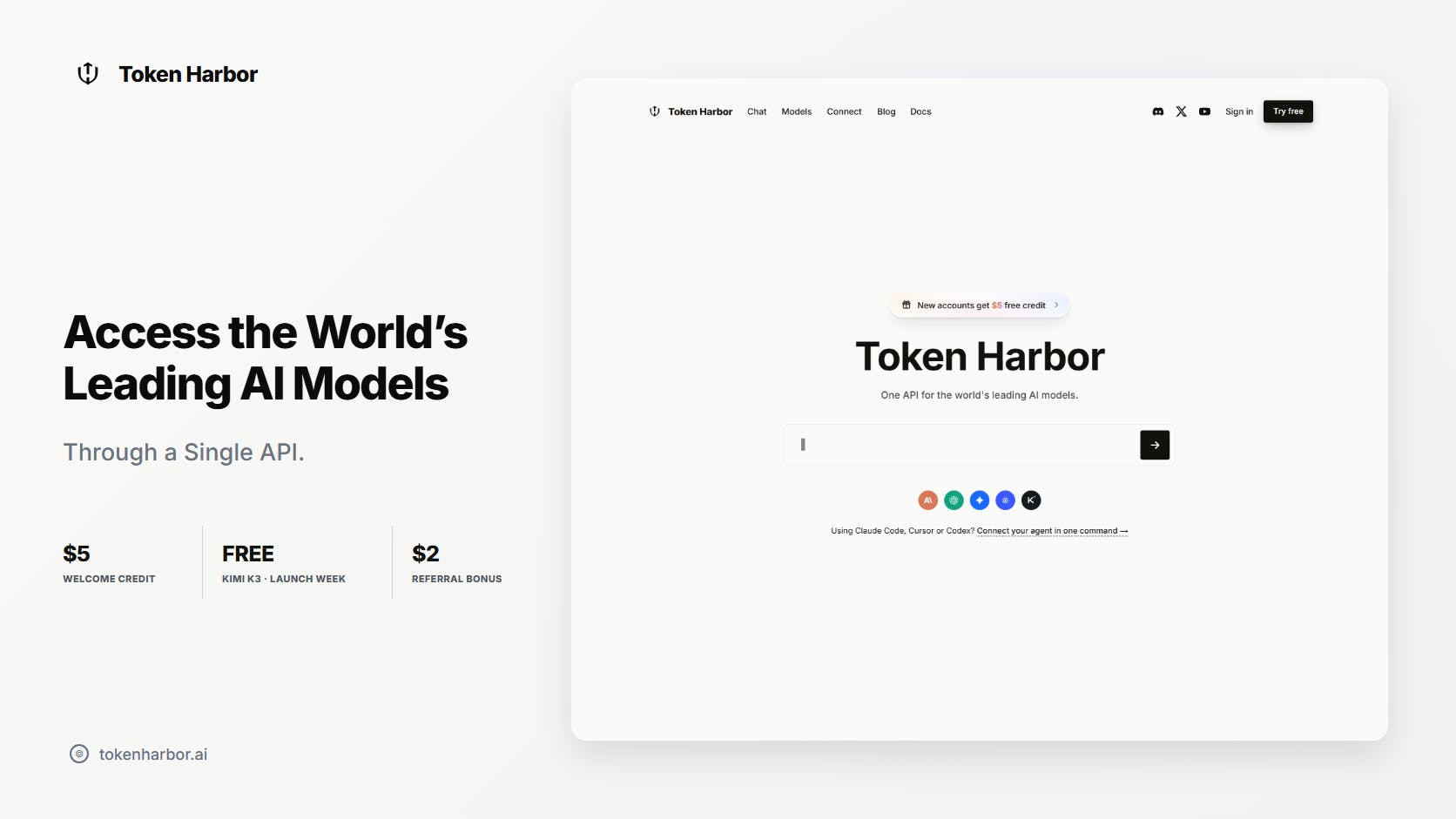
Democratizing Access to Frontier AI
Token Harbor has officially launched, positioning itself as the go-to platform for developers and researchers seeking simplified access to the latest frontier artificial intelligence models. The core mission of Token Harbor is to lower the barrier to entry for working with advanced AI, a space often characterized by complex setups, proprietary APIs, and significant computational overhead.
The current landscape for accessing state-of-the-art AI models is fragmented. Researchers might need to navigate through individual labs, negotiate access terms, or manage intricate deployment pipelines. For developers looking to integrate the newest AI capabilities into their applications, this often translates to long development cycles and high costs. Token Harbor aims to abstract away this complexity, offering a unified interface and managed infrastructure.
How Token Harbor Works
Token Harbor operates by providing a curated marketplace of AI models. Users can browse available models, understand their capabilities, and access them via a standardized API. This approach allows developers to experiment with and deploy models without needing to become experts in the underlying infrastructure or the specific requirements of each model provider. The platform handles the provisioning, scaling, and maintenance of the AI models, enabling users to focus on their applications and research.
Think of it less like a cloud provider with raw compute, and more like a highly organized library where every book is a powerful AI model, already cataloged and ready for immediate checkout via a single library card. This analogy highlights how Token Harbor simplifies the discovery and utilization process, making advanced AI as accessible as borrowing a book.

The platform is designed with developers in mind. It offers SDKs and clear documentation to facilitate quick integration. By providing a consistent API layer across diverse models, Token Harbor ensures that developers can switch between models or experiment with new ones with minimal code changes. This flexibility is crucial in the rapidly evolving AI field, where new models and techniques emerge constantly.
Target Audience and Use Cases
Token Harbor targets a broad spectrum of users, including:
- AI Researchers: Who need to test hypotheses with cutting-edge models without the burden of infrastructure management.
- Software Developers: Looking to embed advanced AI features like natural language processing, image generation, or complex data analysis into their applications.
- Startups and SMBs: Seeking to leverage AI capabilities without the significant upfront investment in hardware and specialized AI talent.
Potential use cases span numerous industries. For instance, a startup could use Token Harbor to power a sophisticated content generation tool, an e-commerce platform could integrate advanced recommendation engines, or a research institution could accelerate drug discovery by utilizing AI models for molecular analysis. The platform's ease of use and access to frontier models promise to unlock new applications and accelerate innovation across these sectors.
The Frontier AI Landscape
The field of AI is advancing at an unprecedented pace. Companies and research labs are continuously pushing the boundaries with larger, more capable models. However, these advancements often remain within the confines of their creators due to the immense resources required for their development and deployment. Token Harbor's initiative to make these models accessible can significantly democratize AI development, fostering a more competitive and innovative ecosystem. What remains to be seen is how Token Harbor will handle the ethical implications and potential misuse of these powerful frontier models as they become more widely available.
Future Implications
By simplifying access, Token Harbor could catalyze a new wave of AI-powered products and services. Developers who previously found advanced AI out of reach may now have the tools and models they need to build the next generation of intelligent applications. This could lead to increased competition for established AI providers and a more dynamic market overall. The platform's success will likely depend on its ability to maintain a diverse and up-to-date catalog of models, coupled with reliable performance and competitive pricing.