The Bare-Metal Approach to Language Models
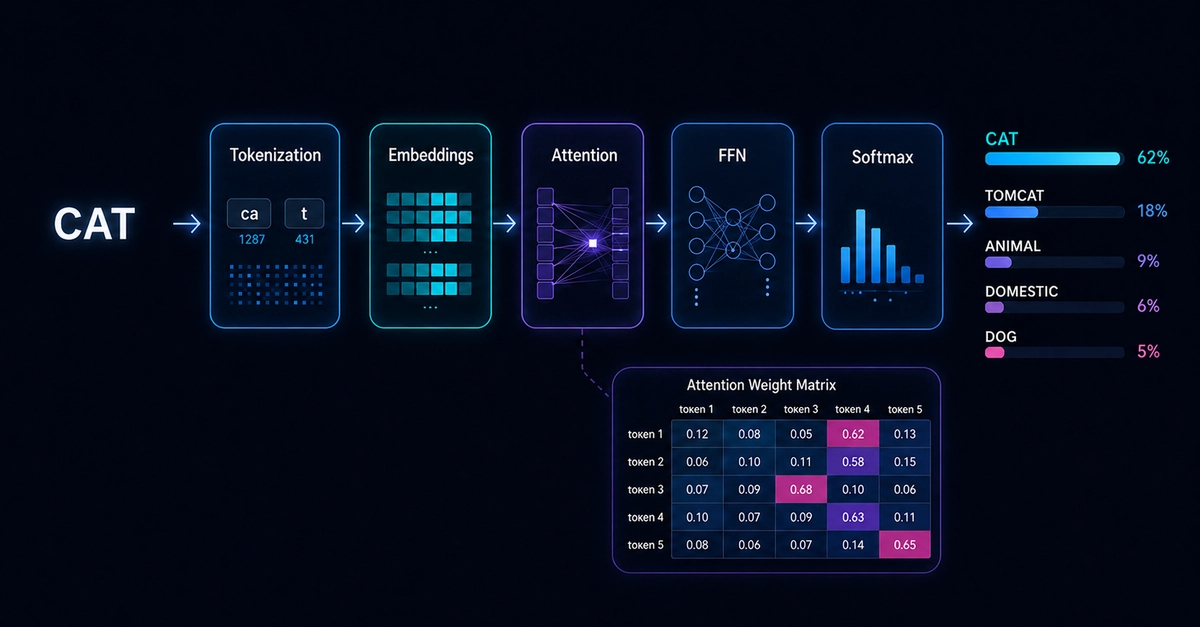
Understanding how large language models (LLMs) work often involves navigating complex frameworks like TensorFlow or PyTorch. These tools abstract away critical details, leaving developers with a "black box" understanding of the underlying mechanics. Maktordev’s project, ‘tiny-language-model-neuro-js,’ takes a deliberately opposite approach: building a functional, albeit small, language model entirely in pure Node.js, exposing every component and calculation. The goal is to make the machine learning process visible, from tokenization to the final softmax output, allowing anyone to see the transformation from incorrect predictions to accurate learning in real-time.
This project strips away the magic, offering a clear, step-by-step implementation of a causal Transformer model. It covers the entire pipeline: tokenization, embedding layers, the core Transformer blocks, a language modeling head, the softmax function for probability distribution, loss calculation, and crucially, backpropagation for weight updates. The absence of any external ML libraries means every line of code directly contributes to these fundamental ML operations, providing an unparalleled educational resource for those who want to truly grasp how these models learn.

From Raw Text to Learned Patterns
The journey begins with tokenization, where raw text is broken down into discrete units—tokens. These tokens are then converted into dense numerical vectors, known as embeddings, which capture semantic relationships. The core of the model is a causal Transformer architecture. “Causal” means that when predicting the next token, the model can only attend to preceding tokens, mimicking the sequential nature of language. This architecture is composed of multiple layers, each containing self-attention mechanisms and feed-forward networks, allowing the model to weigh the importance of different tokens in the input sequence and learn contextual dependencies.
Following the Transformer layers, a language modeling head transforms the learned representations into scores for each possible token in the vocabulary. A softmax function then converts these scores into probabilities, indicating the likelihood of each token being the next in the sequence. The model’s performance is measured by a loss function, which quantifies the difference between the predicted probabilities and the actual next token. This loss value is the signal used to adjust the model’s internal parameters—its weights and biases—through the process of backpropagation. This entire process, from input to loss calculation, is implemented without relying on automatic differentiation libraries, forcing the developer to manually derive and implement the gradients for every parameter.
Training and Observation
The project provides a single command to initiate the training process: node src/train.js --generalize --adaptive-teach. This command requires Node.js version 18.19 or newer and, notably, has zero external dependencies. This design choice is central to its educational value. Developers can run this script and observe the model’s learning curve directly. Initially, the model will produce nonsensical output, reflecting its untrained state and random weights. As training progresses, the weights are iteratively updated via backpropagation, and the terminal output will show a clear shift towards more coherent and contextually relevant predictions.
The ability to watch “every weight change” is a powerful concept. In traditional ML development, weight updates are hidden within optimized libraries. Here, the developer can, in principle, inspect or log these changes, gaining a granular understanding of how the model adapts and learns from the data. This direct observation is invaluable for debugging, understanding overfitting, and appreciating the subtle dynamics of neural network training. The project’s focus is not on achieving state-of-the-art performance but on providing a transparent, understandable implementation of the core machine learning principles that power much larger, more complex models.
The Node.js Advantage (and Challenge)
Building an ML model in Node.js presents unique challenges and advantages. The primary advantage is accessibility for a vast community of JavaScript developers who might otherwise be intimidated by Python-centric ML ecosystems. By using a familiar environment, the barrier to entry for understanding core ML concepts is significantly lowered. Furthermore, Node.js's event-driven, non-blocking I/O model, while not typically associated with heavy numerical computation, can be leveraged for managing the data flow and training loop efficiently, especially for smaller models.
The main challenge lies in performance. Node.js, being a single-threaded JavaScript runtime (with worker threads for concurrency), is generally slower for the intensive matrix operations that dominate ML computations compared to optimized C++ libraries used by Python frameworks. However, for a “tiny” language model, this performance difference is less critical than the clarity of implementation. The project demonstrates that fundamental ML concepts can be implemented and understood even in environments not traditionally considered primary for ML development. It proves that the “magic” isn’t in the framework, but in the mathematical principles and the data.
What’s Next for Transparent ML?
Maktordev’s project serves as a potent reminder that understanding the fundamentals is key in ML. While frameworks democratize the *use* of ML, projects like this democratize its *understanding*. The question remains: how many other complex ML concepts could be similarly distilled and implemented in common, accessible environments? Could this approach inspire more educational tools that peel back the layers of deep learning, making advanced AI more approachable for a wider audience? The success of this tiny Node.js model suggests a path forward for demystifying AI, one visible weight at a time.