Three.js: The Gateway to Web-Based 3D Experiences
Three.js is more than just a JavaScript library; it's a powerful, open-source tool that democratizes 3D graphics on the web. Built upon the WebGL API, it abstracts away the intricate, low-level details of GPU programming, allowing developers to craft visually stunning and interactive 3D environments directly within a web browser. Its ease of use, coupled with a rich feature set, makes it an ideal choice for a wide array of applications, from complex video games to novel professional portfolios.
The library's strength lies in its ability to simplify WebGL. Instead of wrestling with shader languages and buffer management, developers can leverage Three.js's high-level API to define geometries, materials, lights, and cameras with relative ease. This abstraction doesn't sacrifice power; it channels it into creative expression. Whether you're building a sprawling open-world game or a minimalist interactive resume, Three.js provides the building blocks.
Three.js as a Game Development Powerhouse
For game developers, Three.js represents a significant leap in creating engaging 3D experiences without the need for proprietary engines or heavy client-side installations. It allows for the development of browser-based games that are accessible to anyone with a modern web browser and an internet connection. This accessibility is a major advantage, lowering the barrier to entry for players and enabling developers to reach a broader audience.
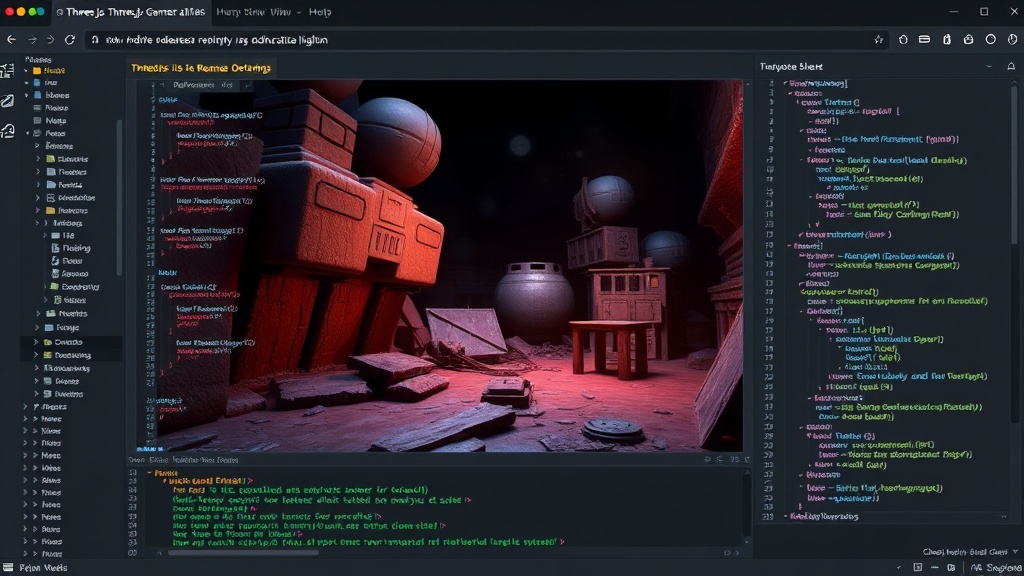
The library supports a wide range of graphical features essential for game development. This includes advanced lighting models (ambient, directional, point, spot), realistic material properties (like Phong and Physical-based Rendering), shadows, post-processing effects (bloom, depth of field, color correction), and sophisticated camera controls. Furthermore, Three.js can handle complex scene management, asset loading (models, textures, audio), and user input, all critical components for building interactive games.
Think of Three.js less like a full-fledged game engine with all the bells and whistles of Unity or Unreal, and more like an incredibly sophisticated set of LEGO bricks designed specifically for building 3D worlds within the browser. You have the core pieces (geometry, materials, lights), and you can assemble them precisely as you envision, with the added benefit of immediate web deployment. The community actively contributes extensions and shaders, further expanding its capabilities for specialized game mechanics or visual styles.
Beyond Games: The 3D Resume Concept
The application of Three.js extends far beyond traditional gaming. One of the most innovative use cases emerging is the interactive 3D resume. In a crowded job market, standing out is paramount, and a 3D resume offers a unique, memorable way to showcase skills, projects, and personality.
Imagine a personal website where your resume isn't just a static PDF but an interactive 3D space. You could navigate through different areas representing your experience, education, and portfolio. Each section could be a distinct module within the 3D environment. For instance, your work experience could be displayed on floating panels or within virtual rooms, each detailing a past role with interactive elements showcasing projects you contributed to. Your skills might be visualized as a dynamic graph or a constellation of interconnected nodes.
This concept allows for a more dynamic and engaging presentation of a candidate's qualifications. Instead of just listing technologies, a developer could embed interactive demos of their work directly into the resume. A designer could showcase their portfolio pieces as fully explorable 3D models. This approach not only demonstrates technical proficiency in web development and 3D graphics but also highlights creativity, initiative, and a forward-thinking mindset.
Technical Considerations and Community Support
Leveraging Three.js involves understanding core WebGL concepts, even with the library's abstractions. Developers will work with scenes, cameras, renderers, meshes, materials, and lights. Performance optimization is crucial, especially for complex scenes or games. Techniques like efficient geometry management, texture compression, level-of-detail (LOD) systems, and Web Workers for offloading tasks are vital.
The Three.js community is a significant asset. Active forums, extensive documentation, and a vibrant ecosystem of examples and tutorials mean that help is readily available. Influential figures within the Three.js community, active on platforms like X (formerly Twitter), frequently share new techniques, showcase impressive projects, and provide insights into best practices. As of July 2025, observing these accounts offers a real-time pulse on the library's evolving capabilities and emerging trends in web 3D development.
For developers considering a 3D resume, the choice of Three.js is particularly compelling. It allows for a high degree of customization, enabling a resume that truly reflects the individual's brand and skills. The ability to deploy it as a standalone web page means it's easily shareable via a URL, accessible from any device, and doesn't require special software installations. This makes it a practical, albeit ambitious, way to make a lasting impression on potential employers.