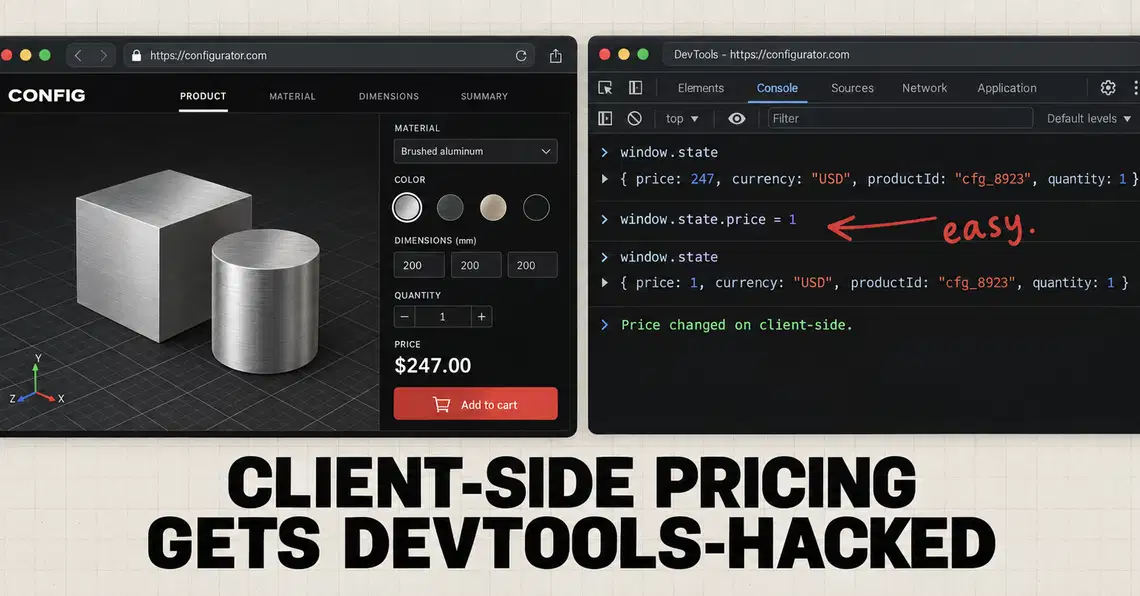
The Client-Side Pricing Trap
Building interactive 3D product configurators with Three.js is a common task. Developers often implement live pricing updates directly in the frontend. This approach calculates the price as users select options like materials, sizes, or finishes, updating a price display in real-time. The appeal is clear: it’s fast, provides immediate user feedback, and avoids the latency of network requests to a backend server.
A typical client-side pricing function might look something like this:
function calculatePrice(config) {
  let price = BASE_PRICE;
  price += MATERIAL_PRICING[config.material];
  price += SIZE_PRICING[config.size];
  // ... more options
  return price;
}
This seems straightforward. The `BASE_PRICE` and pricing tiers for materials and sizes are hardcoded or fetched once. However, this transparency is precisely its downfall. All the logic and pricing data reside within the user’s browser, accessible to anyone with basic developer tools.
Why Client-Side Pricing is Vulnerable
The primary vulnerability lies in the accessibility of frontend code and data. Modern browsers offer powerful developer tools (like Chrome DevTools or Firefox Developer Tools) that allow users to inspect HTML, CSS, JavaScript, network requests, and even modify code execution on the fly. For a developer implementing client-side pricing, this means the entire pricing calculation logic and all associated price constants (like `BASE_PRICE`, `MATERIAL_PRICING`, `SIZE_PRICING`) are exposed.
A malicious user, or even a curious one, can easily:
- Inspect the JavaScript code: Browse the source files to find the `calculatePrice` function and identify all pricing variables.
- Set breakpoints: Pause code execution at strategic points to inspect variable values.
- Modify variables: Change the values of `BASE_PRICE` or the multipliers for options before the `calculatePrice` function is executed.
- Rewrite the function: Directly alter the `calculatePrice` function to return a desired, lower price.
Imagine a furniture configurator. A user wants a custom sofa. They select a premium fabric and a larger size. On the client side, the price might jump to $2500. But with DevTools, they can simply change the `config.material` variable to the cheapest option, or even directly manipulate the `price` variable within the function to $500 before the final display. The website then shows the user a $500 sofa, while the company is still expecting to charge $2500. This is not just a theoretical risk; it's a direct invitation to price manipulation and fraud.
This is akin to a retail store leaving its entire inventory and pricing catalog open on the shop floor, with a pen readily available to cross out prices. It fundamentally breaks the trust and financial integrity of the transaction.
The Server-Side Solution
The robust solution is to move the pricing calculation to the server. When a user configures a product, the frontend sends the selected configuration (e.g., material, size, options) as data to a backend API endpoint. The server then performs the price calculation using its own secure, private logic and data, and returns the final price to the frontend.
Here’s how the workflow changes:
- User Interaction: The user selects options in the Three.js configurator.
- Data Transmission: Instead of calculating the price, the frontend packages the selected options into a JSON object and sends it via an HTTP request (e.g., POST) to a dedicated pricing API endpoint on the server.
- Server-Side Calculation: The server receives the configuration data. It uses its own securely stored pricing rules, base prices, and option costs to compute the final price. This logic is not exposed to the client.
- Price Response: The server sends the calculated, final price back to the frontend as a response to the API request.
- Frontend Display: The frontend receives the price and updates the display for the user.
This model ensures that the sensitive pricing logic and data never leave the server environment. Even if a user intercepts the network request, they only see the final price being transmitted, not the underlying calculation that derived it. Attempting to manipulate the price would require direct access to the server, which is significantly harder to achieve than manipulating client-side JavaScript.
Implementing Server-Side Pricing
Implementing this requires a backend service capable of handling API requests. This could be a dedicated microservice, or part of your existing web application’s backend. Common technologies include Node.js with frameworks like Express, Python with Flask or Django, or Go.
The frontend interaction would involve using `fetch` or `axios` to send the configuration:
async function getPriceFromServer(config) {
  try {
    const response = await fetch('/api/calculate-price', {
      method: 'POST',
      headers: {
        'Content-Type': 'application/json',
      },
      body: JSON.stringify(config),
    });

    if (!response.ok) {
      throw new Error(`HTTP error! status: ${response.status}`);
    }

    const data = await response.json();
    return data.price;
  } catch (error) {
    console.error('Error fetching price:', error);
    // Handle error appropriately in UI
    return null;
  }
}

// When user changes config:
const currentConfig = getCurrentConfigFromUI();
const finalPrice = await getPriceFromServer(currentConfig);
updatePriceDisplay(finalPrice);
On the server side (e.g., in Node.js/Express):
// server.js (simplified)
const express = require('express');
const app = express();
app.use(express.json());

const BASE_PRICE = 1000;
const MATERIAL_PRICING = { 'wood': 200, 'metal': 500 };
const SIZE_PRICING = { 'small': 0, 'large': 300 };

app.post('/api/calculate-price', (req, res) => {
  const config = req.body;
  let price = BASE_PRICE;
  price += MATERIAL_PRICING[config.material] || 0;
  price += SIZE_PRICING[config.size] || 0;
  // ... more options
  res.json({ price: price });
});

app.listen(3000, () => console.log('Pricing API listening on port 3000'));
While this adds network latency, it’s a necessary trade-off for security and integrity. The perceived responsiveness can often be managed with loading indicators and optimistic UI updates.
The Unanswered Question: Scalability and Cost of Server-Side Logic
The move to server-side pricing is a clear security win. However, it introduces new considerations. For high-traffic configurators, each user interaction now triggers a server request. This can significantly increase server load and operational costs, especially if the pricing logic is computationally intensive or requires database lookups for every request. What nobody has fully addressed yet is the optimal architecture for scaling these server-side pricing APIs—balancing the need for security with the demands of performance and cost-efficiency for millions of concurrent configurations.
Conclusion: Prioritizing Integrity Over Convenience
For any product configurator involving monetary value, client-side pricing is an unacceptable security risk. It’s a vulnerability that can be exploited with minimal effort, leading to direct financial losses and erosion of trust. Implementing server-side pricing, despite the added complexity and latency, is the only way to ensure the integrity of your pricing model. The security and financial soundness of your business must take precedence over the marginal convenience of eliminating a network trip.