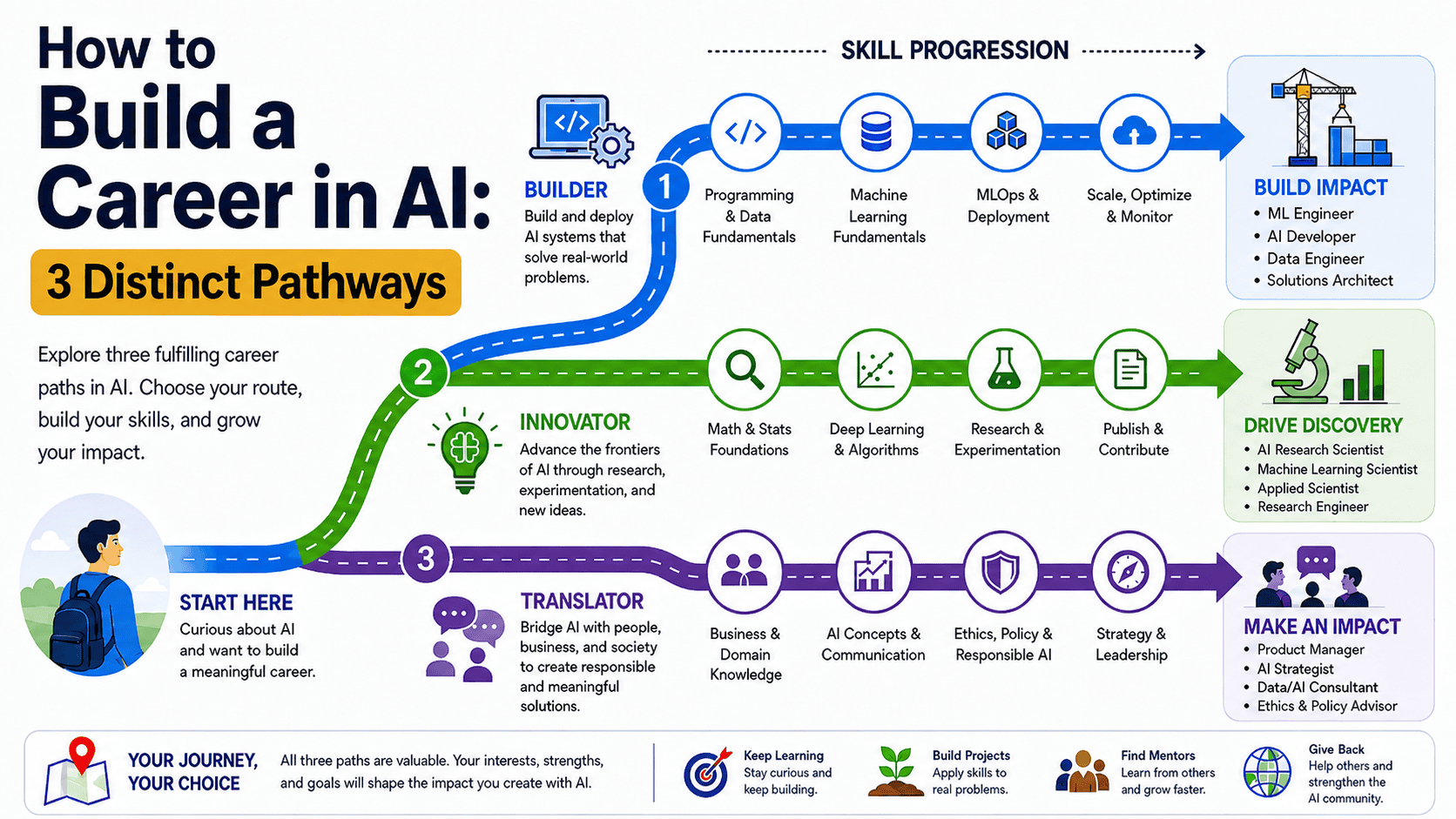
1. The AI Specialist: Deep Technical Mastery
This is the path for those who thrive on the theoretical underpinnings and cutting-edge research of AI. AI Specialists are typically found in research labs, academia, or R&D departments of large tech companies. Their focus is on pushing the boundaries of what AI can do, developing new algorithms, and advancing fundamental AI science. **Core Skillset:**- Mathematics & Statistics: A deep understanding of linear algebra, calculus, probability, and statistics is non-negotiable. This forms the bedrock of most machine learning algorithms.
- Computer Science Fundamentals: Expertise in data structures, algorithms, computational complexity, and software engineering principles is crucial for building efficient and scalable AI systems.
- Machine Learning Theory: In-depth knowledge of various ML paradigms (supervised, unsupervised, reinforcement learning), model architectures (neural networks, transformers, GANs), and optimization techniques.
- Programming Proficiency: Advanced skills in languages like Python, R, and potentially C++ or Julia, with a strong command of ML libraries (TensorFlow, PyTorch, scikit-learn).
- Research Acumen: Ability to read, understand, and critique academic papers, formulate hypotheses, design experiments, and publish findings.
2. The AI Implementer: Bringing AI to Life
AI Implementers are the engineers and developers who take the theoretical advancements of AI Specialists and translate them into practical, deployable solutions. They are the bridge between research and real-world application, focusing on building, integrating, and maintaining AI systems within existing products or workflows. **Core Skillset:**- Software Engineering: Strong programming skills (Python is dominant, but others like Java, Scala, or C++ can be relevant), version control (Git), CI/CD pipelines, and understanding of software architecture.
- Data Engineering: Proficiency in data pipelines, ETL processes, database management (SQL, NoSQL), and big data technologies (Spark, Hadoop).
- MLOps: Expertise in deploying, monitoring, scaling, and managing machine learning models in production environments. This includes containerization (Docker, Kubernetes), cloud platforms (AWS, Azure, GCP), and model monitoring tools.
- Applied Machine Learning: Practical understanding of common ML algorithms and libraries, with the ability to select, tune, and integrate them into applications. Focus is on *using* and *adapting* existing models rather than inventing new ones.
- API Integration: Ability to work with AI APIs, build microservices, and integrate ML models into larger software systems.
3. The AI Domain Expert: AI as a Tool for a Specific Field
This pathway is for individuals who possess deep expertise in a particular industry or domain (e.g., healthcare, finance, law, marketing, biology) and want to apply AI to solve problems within that field. They may not be deep AI researchers or hardcore software engineers, but they understand the problems, the data, and the potential of AI in their specific context. **Core Skillset:**- Domain Knowledge: Deep understanding of the industry, its challenges, data types, regulatory landscape, and business processes.
- Data Literacy: Ability to understand, interpret, and guide the collection and preparation of domain-specific data.
- AI Literacy: A solid conceptual understanding of AI capabilities and limitations. They know what AI *can* do and what questions to ask, even if they don't build the models themselves.
- Communication & Collaboration: Excellent ability to translate business needs into technical requirements and to explain AI concepts and results to non-technical stakeholders.
- Problem Formulation: Skill in identifying opportunities where AI can provide significant value and framing those opportunities as solvable AI problems.