The Hidden Data Collectors in Your Apps
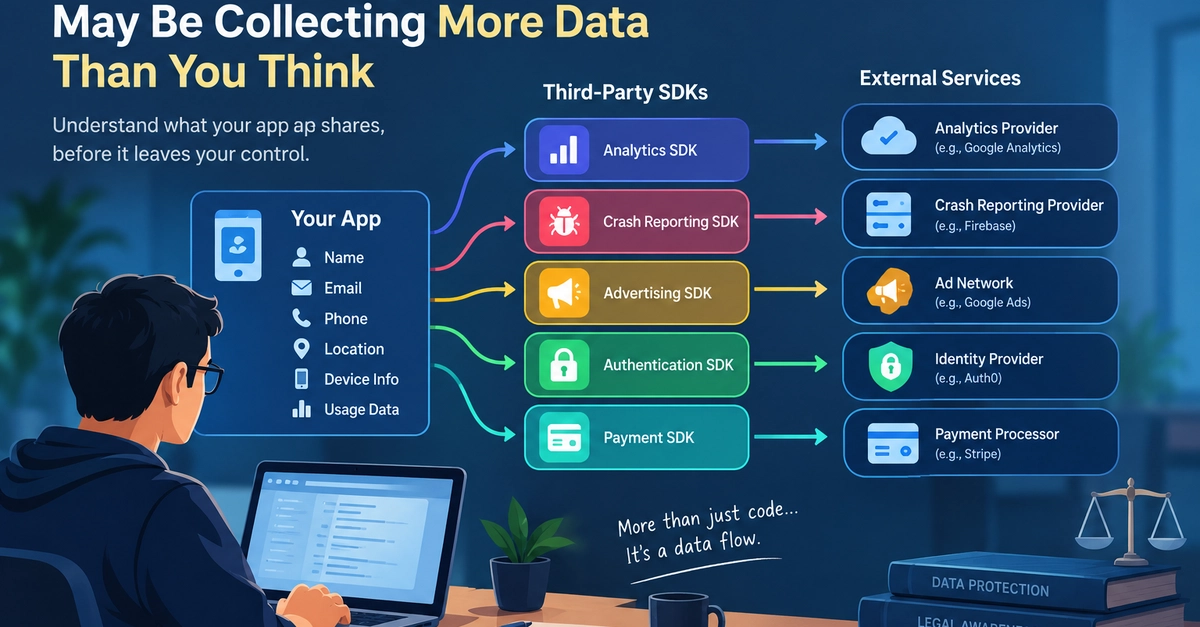
Modern applications rarely ship without a suite of third-party Software Development Kits (SDKs). These external libraries promise accelerated development cycles, offering pre-built functionality for analytics, crash reporting, payment processing, social logins, and advertising. A developer integrates an analytics SDK to track user engagement, adds a crash reporting SDK to catch bugs, and pulls in a payment library for transactions. Social login libraries streamline user authentication, while advertising SDKs help measure campaign effectiveness. The application functions, seemingly as intended.
But a critical question often goes unasked: What data is leaving the application because of these SDKs?
An SDK is far more than just a block of code. It can fundamentally alter an application's data flow, acting as an unseen conduit for information. This reality transforms the selection of an SDK from a purely technical decision into one with significant security, privacy, and legal ramifications. Developers must understand that each SDK integrated is a potential gateway for data to exit the application, often in ways not immediately apparent.
Understanding SDK Data Transmission
Consider a typical mobile application scenario. A user creates an account, providing their name, email address, and perhaps a phone number. This information is essential for account creation and personalized service. However, the integrated SDKs might operate with broader data collection mandates. An analytics SDK might log not only user interactions but also device identifiers, operating system versions, screen resolutions, and even network connection types. A social login SDK, while simplifying sign-in, could potentially access profile information beyond what is explicitly granted, depending on its implementation and the permissions requested from the social platform.
The payment library, beyond processing transactions, might log transaction details, user payment preferences, and potentially even partial card information if not handled with extreme care. Advertising SDKs, often the most aggressive data collectors, can track user behavior across multiple applications and websites, building detailed profiles for targeted advertising. Crash reporting SDKs, while invaluable for debugging, can sometimes inadvertently capture sensitive user data present in memory at the time of a crash, such as input fields or session tokens.
The cumulative effect is that an application, designed with user privacy in mind, can inadvertently become a significant data source for external entities. This data can be aggregated, anonymized, or even directly linked back to individual users, depending on the SDK provider's policies and practices. The ownership and control over this data become blurred, creating a complex web of responsibilities for the application developer.
The Developer's Responsibility
The responsibility for understanding and managing this data flow rests squarely with the application developer. Ignorance is not a defense when it comes to data privacy regulations like GDPR or CCPA. Developers must proactively vet every SDK they consider integrating. This vetting process should extend beyond checking for functionality and ease of integration. Key considerations include:
- Data Collection Policies: What specific data does the SDK collect? How is it collected? Is it anonymized or aggregated?
- Data Usage: How does the SDK provider use the collected data? Is it solely for the advertised purpose (e.g., analytics, crash reporting), or is it shared with third parties for marketing, advertising, or other purposes?
- Data Security: How is the collected data stored and protected by the SDK provider? What are their security practices and compliance certifications?
- Data Retention: How long is the data retained? Are there options for users to request data deletion?
- Permissions: What permissions does the SDK require from the operating system or the user? Are these permissions strictly necessary for the SDK's core function?
This due diligence can be time-consuming. Many developers, pressed for time and focused on feature delivery, may opt for convenience over caution. This is where the risk escalates. A seemingly innocuous analytics SDK could, in reality, be a sophisticated data harvesting tool, its true capabilities hidden behind layers of obfuscation or vague terms of service.
Navigating the Legal and Ethical Landscape
The legal landscape surrounding data privacy is increasingly stringent. Regulations like the GDPR in Europe and the CCPA in California impose strict requirements on how personal data is collected, processed, and stored. Developers are accountable for the data processed by their applications, including data handled by third-party SDKs. Failure to comply can result in substantial fines and reputational damage.
Ethically, developers have a duty to their users to protect their privacy. Users grant trust when they download and use an application, and that trust is violated when their data is collected and shared without their explicit, informed consent. The complexity of modern app development, with its reliance on external libraries, makes achieving this informed consent challenging. Users are rarely presented with a granular breakdown of what data each individual SDK is collecting and where it is being sent. Instead, they are typically presented with a single, often lengthy, privacy policy for the application as a whole.
This presents a significant challenge. How can developers ensure transparency when the data collection mechanisms are embedded within third-party code they do not fully control? The answer lies in rigorous selection, ongoing monitoring, and a commitment to privacy-by-design principles. Developers should favor SDKs from reputable providers with clear, transparent data policies. They should also explore tools and techniques for analyzing the network traffic generated by their applications to identify unexpected data transmissions. Furthermore, they must ensure that their own privacy policies accurately reflect the data collection practices of all integrated SDKs, even if those practices are not immediately obvious.
The choice of an SDK is therefore not just a technical implementation detail; it is a strategic decision with far-reaching consequences for user trust, legal compliance, and the overall security posture of the application. Developers must treat every SDK as a potential data conduit and conduct thorough investigations before integration, ensuring that the convenience offered by these tools does not come at the unacceptable cost of user privacy.