The Invisible Integration Tax
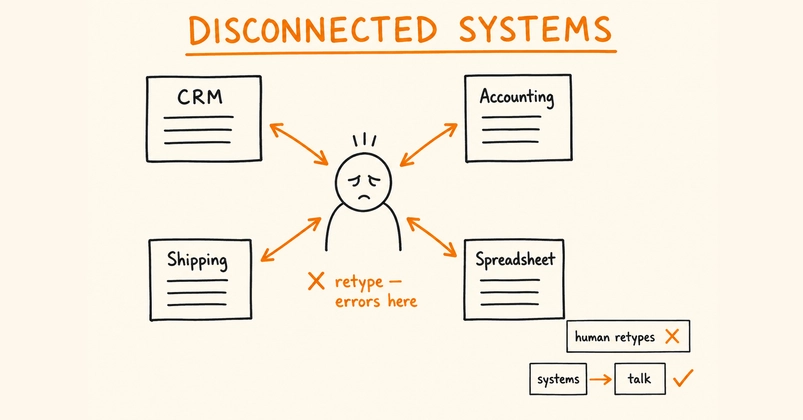
Businesses rarely intend to operate with disconnected systems. Instead, complexity creeps in incrementally. A simple spreadsheet for tracking sales evolves into a Customer Relationship Management (CRM) tool as the business scales. Accounting software becomes necessary to satisfy tax regulations, and a dedicated shipping portal is adopted when parcel volume increases. Each system is a logical choice at the time of its implementation, solving a specific, immediate problem.
The unintended consequence is a fragmented technology stack where these essential tools fail to communicate. The glue holding this disparate system together is frequently a person. This individual becomes the de facto integration layer, manually transferring data between applications. They read figures from one screen and meticulously type them into another. This human integration is a silent, daily operational cost that never appears on a balance sheet or an invoice, yet it drains resources and hinders efficiency.
This is the fundamental trap of manual integration. The cost isn't a direct expense like a software subscription or a support contract. Instead, it's embedded within an employee's salary and their time. Every hour spent on manual data entry, reconciliation, or cross-application validation represents a hidden tax on productivity. This cost is amortized across an entire team, making it difficult to quantify but significant in its cumulative impact.

The Operational Drag of Human Integration
Consider a typical workflow: an e-commerce business uses an online store platform, a separate inventory management system, and an accounting package. When an order is placed, the data must propagate across these systems. Without direct integration, a staff member logs into the e-commerce platform, notes the order details, then logs into the inventory system to update stock levels, and finally enters the sales data into the accounting software. This process, repeated for every order, is prone to human error. A mistyped product code, a forgotten quantity, or an overlooked order can lead to stockouts, incorrect financial reporting, and customer dissatisfaction.
The cognitive load on these employees is substantial. They are not only performing repetitive tasks but also constantly context-switching between different interfaces, each with its own logic and data fields. This mental overhead reduces their capacity for higher-value activities such as strategic planning, customer engagement, or process improvement. The very people hired for their expertise in sales, marketing, or operations are instead acting as manual data conduits.
This reliance on human integration also creates a bottleneck. As the business grows and order volume increases, the manual process cannot scale linearly. More staff may be required to handle the increased workload, or existing staff become overwhelmed, leading to delays and a decline in service quality. The system, which was designed for efficiency, now actively impedes growth and operational agility. The business becomes brittle, vulnerable to disruptions caused by staff absence, illness, or turnover. Replacing a human integration point requires training a new person, during which time errors can increase and efficiency plummets.
The Illusion of Affordability
The perceived affordability of human integration is a significant barrier to adopting automated solutions. Many small and medium-sized businesses operate with lean budgets. Investing in integration platforms, custom API development, or middleware solutions can seem like an extravagant expense when a seemingly free, human-powered alternative exists. The cost is not a line item; it's a portion of a salary, making it feel less like a direct expenditure and more like an inherent operational cost of doing business.
However, this view is myopic. The true cost encompasses several factors beyond the employee's direct wages. There are the costs associated with errors: incorrect shipments, lost sales due to stock inaccuracies, and the time spent correcting mistakes. There are the opportunity costs: the revenue that could have been generated if employees were focused on revenue-generating activities instead of manual data entry. There's also the cost of employee frustration and potential burnout, which can lead to higher turnover rates and recruitment expenses.
Furthermore, the lack of real-time data synchronization hampers decision-making. Management might be working with outdated information, leading to suboptimal strategic choices. For instance, an inventory manager might not see that a popular product is running low until it's too late, simply because the sales data hasn't been fully processed into the inventory system yet. This delay in visibility directly impacts the business's ability to react to market changes or customer demand.
The Path to Automation
The solution lies in recognizing the hidden costs of human integration and strategically investing in automated solutions. This doesn't necessarily mean a complete overhaul of every system. Often, modern software platforms offer robust APIs (Application Programming Interfaces) that allow for seamless data exchange. Integration platforms as a service (iPaaS) provide user-friendly tools to connect various applications without extensive coding knowledge, acting as digital plumbing for your business systems.
For businesses still relying heavily on manual processes, the first step is to identify the most critical and time-consuming integration points. Mapping these workflows can reveal where automation will yield the greatest return on investment. This might involve connecting the e-commerce platform directly to the inventory management system, or linking the CRM to the accounting software for automated invoicing. The goal is to eliminate repetitive, error-prone tasks and free up employee time for more valuable work.
The transition to automated integration is not just about efficiency; it's about building a more resilient, scalable, and competitive business. It allows for real-time data visibility, reduces operational errors, and empowers employees to focus on strategic initiatives. While the initial investment in automation may seem significant, the long-term benefits—reduced operational costs, increased accuracy, improved employee satisfaction, and enhanced decision-making—far outweigh the cost of continuing to pay the invisible integration tax.