%22%20%2F%3E%0A%20%20%3C%2Fsvg%3E)
The Underside of the Web: From Links to Meaning
Most internet users interact with the web as a series of discrete pages and hyperlinks. We search, we click, we read, we move on. This familiar architecture, the World Wide Web, is essentially a vast collection of documents linked together. But beneath this surface, something profound is happening. A new layer is being constructed, one that moves beyond simple document linkage to represent the underlying meaning and relationships within information. This is the emerging realm of advanced knowledge graphs and intelligent agents, weaving a semantic fabric that promises to change how we find, understand, and utilize digital information.
Imagine an internet not just of pages, but of interconnected concepts. Instead of merely finding a document about 'artificial intelligence,' you can now explore AI as a node in a vast network, connected to its subfields (machine learning, natural language processing), its key researchers, its historical milestones, and its practical applications. This is the essence of a knowledge graph: a structured representation of entities and their relationships. While knowledge graphs have existed in various forms for years, their integration with sophisticated AI agents is what is now creating a potent, emergent layer of the internet.
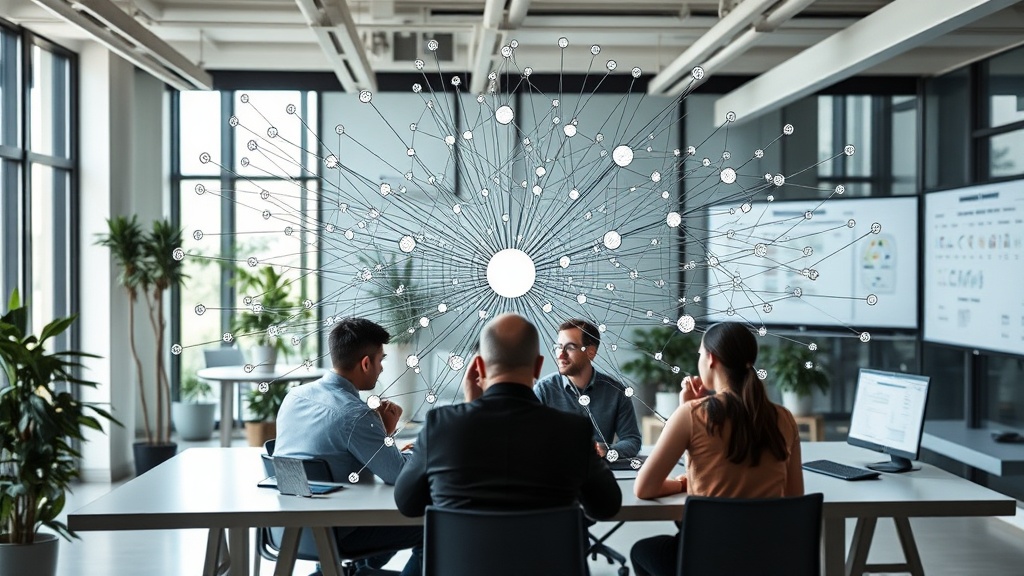
These advanced agents act as navigators and interpreters within this knowledge layer. They don't just fetch information; they understand context, infer relationships, and can even synthesize new insights by traversing the graph. Think of it less like a search engine returning a list of links and more like an expert research assistant who can connect disparate pieces of information, identify patterns, and answer complex, multi-faceted questions. This isn't science fiction; systems demonstrating these capabilities are already being developed and deployed, albeit often behind the scenes in specialized applications.
The Mechanics of Meaning: Knowledge Graphs and AI Agents
At the core of this new layer are two intertwined technologies: knowledge graphs and advanced AI agents. A knowledge graph is, in essence, a database structured as a network. It consists of nodes (entities like people, places, concepts, events) and edges (the relationships between these entities, such as 'born in,' 'invented,' 'is a type of'). Unlike traditional relational databases that store data in tables, knowledge graphs capture the semantic meaning and context of information, allowing for more nuanced querying and reasoning.
For instance, a knowledge graph might represent 'Alan Turing' as a node, connected to 'The Imitation Game' (an event he participated in) and 'Turing Machine' (a concept he invented), and categorized as a 'computer scientist' and 'mathematician.' This structured understanding enables machines to grasp the 'why' and 'how' behind data, not just the 'what.'
The true power emerges when these knowledge graphs are coupled with advanced AI agents. These agents are designed to interact with the knowledge graph, query it intelligently, and perform complex tasks. They can sift through vast amounts of interconnected data, identify subtle correlations that a human might miss, and present information in a synthesized, actionable format. For example, an agent could be tasked with identifying all the emerging AI research trends that are directly influenced by breakthroughs in quantum computing, a query that would be incredibly difficult to answer using traditional search methods.
Applications and Implications: Beyond the Surface Web
The implications of this emerging layer are far-reaching. For developers, it opens up new paradigms for building applications that can understand and reason about complex domains. Instead of manually encoding domain knowledge, developers can leverage vast, interconnected knowledge bases. This could lead to more intuitive user interfaces, sophisticated recommendation engines, and powerful analytical tools.
For researchers and analysts, this layer promises to accelerate discovery. Imagine a medical researcher being able to instantly query a knowledge graph of all known biological pathways, genetic markers, and drug interactions to identify potential new treatments. Or a financial analyst being able to map out the intricate supply chain dependencies of a global corporation to assess geopolitical risks. The ability to connect and reason over vast, semantically rich datasets fundamentally changes the speed and depth of insights possible.
However, building and maintaining these knowledge graphs is a monumental task. It requires sophisticated natural language processing to extract entities and relationships from unstructured text, robust data integration pipelines, and continuous curation to ensure accuracy and completeness. Furthermore, the development of AI agents capable of effectively navigating and reasoning over these complex structures is an ongoing area of research and engineering.
The Unseen Evolution: What Happens Next?
What remains to be seen is how this layer will become accessible to the average internet user. Currently, much of this technology operates in specialized enterprise solutions or research environments. Will search engines evolve to natively query and present information from these knowledge layers, moving beyond keyword matching to semantic understanding? Will new platforms emerge that are built entirely on this semantic web, offering experiences that are far more intelligent and context-aware than today's websites?
The construction of this new layer is not a single project but an ongoing, distributed evolution. It’s being built by companies developing enterprise knowledge management systems, by researchers pushing the boundaries of AI and graph databases, and by open-source communities contributing to knowledge graph initiatives. While most users may not consciously perceive this shift, they will increasingly benefit from its capabilities through more intelligent applications and services. The internet is becoming not just a network of documents, but a network of meaning, and that fundamental change is happening now.