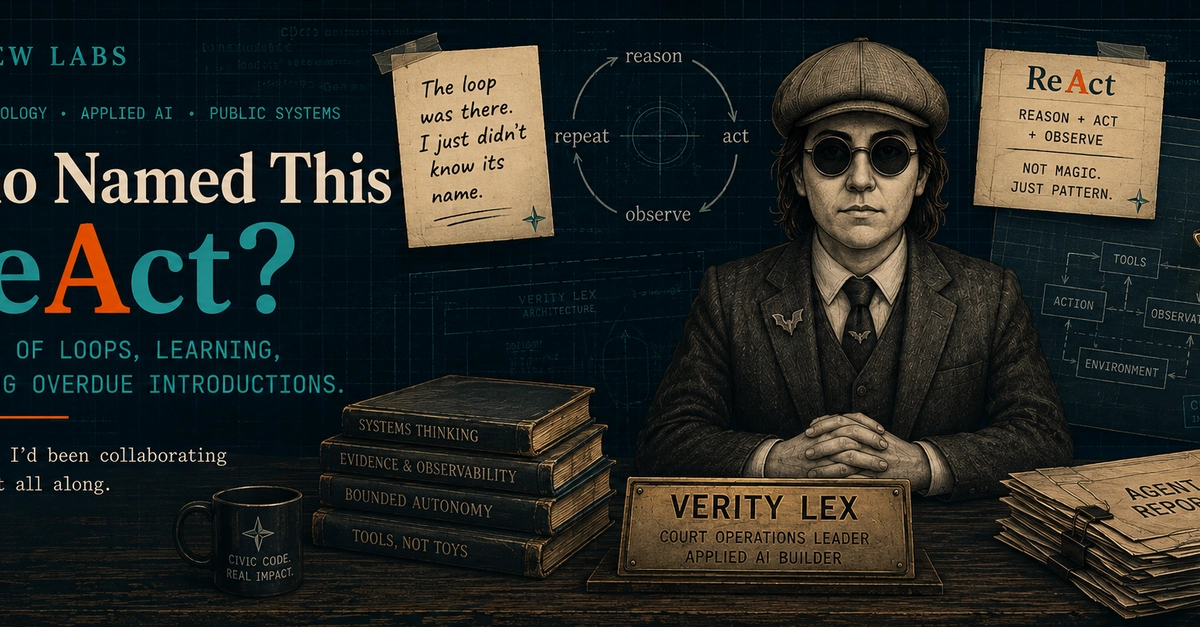
The ReAct Framework Emerges from AI Coursework
A recent article on Dev.to, titled "Who Named This ReAct? I'd Like to Speak to the Manager," highlights a growing point of confusion within the developer community. The author, embarking on the Agentic Engineer Nanodegree through AWS AI & ML Scholars, encountered the term "ReAct" in their coursework. This immediately triggered a sense of déjà vu, not due to the intended curriculum, but because "React" is a ubiquitous name in their development vocabulary. They have built numerous frontends using React, a JavaScript library that has become a fundamental tool in their career.
The juxtaposition of the familiar "React" with the similarly spelled "ReAct" in an AI context created an unexpected disconnect. This isn't a mere typo or a superficial naming similarity; it points to a potential collision of terminology in rapidly evolving tech fields. The author's experience is a concrete example of how new frameworks and methodologies, especially those emerging from academic or specialized training programs, can inadvertently cause friction with established, widely adopted technologies.
Understanding the ReAct Framework's Purpose
ReAct, in the context of the Agentic Engineer Nanodegree, refers to a specific framework for designing and building agentic systems. Unlike the frontend JavaScript library, ReAct focuses on the interaction between a language model (LM) and external tools. It's an acronym that stands for **Reasoning and Acting**. The core idea is to enable AI agents to reason about a task, decide which tools to use, and then act by invoking those tools. This process is iterative: the agent reasons, acts, observes the outcome, and then reasons again based on the new information.
Think of it less like a user interface library and more like a sophisticated decision-making engine for AI. The agent, powered by a large language model, doesn't just generate text; it can interact with the outside world through tools. For instance, an agent using ReAct might need to find current stock prices. It would reason that it needs a stock-checking tool, then act by calling that tool with the correct parameters. The tool's output (the stock price) would then be fed back to the agent, allowing it to reason about the next step, perhaps comparing it to a target price or generating a report.
This framework is crucial for developing agents that can perform complex, multi-step tasks that require external information or capabilities. Without such a structured approach, an LM's responses would be limited to its training data, unable to fetch real-time information or interact with other services.

The Naming Dilemma: A Source of Confusion
The primary source of the author's consternation, and the article's provocative title, stems from the shared phonetic and orthographic space between "React" and "ReAct." For millions of developers, "React" immediately conjures images of component-based UIs, JSX, and the vast ecosystem of libraries and tools built around Facebook's (now Meta's) immensely popular JavaScript library. The name "React" itself, adopted by its creators, has become synonymous with a particular paradigm in web development.
When "ReAct" appears in an AI context, especially one related to agentic behavior and tool use, it creates an immediate cognitive hurdle. Developers accustomed to the frontend library might initially dismiss it as a typo or a minor variation. However, the emergence of ReAct as a distinct and important framework within AI research and development necessitates a clear understanding of its identity. The author's desire to "speak to the manager" is a humorous, yet pointed, way of expressing the friction caused by this naming overlap.
This situation is not entirely unprecedented in technology. As new fields mature and borrow concepts or terminology, overlaps can occur. However, in the case of "React" and "ReAct," the similarity is particularly striking and impacts a core group of highly engaged technical professionals. The question arises: could a different name have been chosen for the AI framework to avoid this potential confusion?
The Broader Implications for AI Development
The ReAct framework, despite its potentially confusing name, represents a significant advancement in building more capable and versatile AI agents. Its structured approach to integrating reasoning with action allows for more predictable and controllable AI behavior, which is essential for deploying agents in real-world applications. The ability of an agent to "think" about its next step and use tools to gather information or perform tasks moves AI beyond simple pattern matching and text generation.
This framework is a key component in the development of sophisticated AI assistants, autonomous systems, and complex problem-solving agents. As AI research continues to push the boundaries of what machines can do, methodologies like ReAct become foundational. They provide a blueprint for how language models can be augmented with external capabilities, making them more powerful and adaptable.
However, the naming confusion serves as a reminder of the challenges in clearly communicating new concepts within the fast-paced tech landscape. As more specialized frameworks and methodologies emerge, clarity in naming and definition becomes paramount. Developers need to be able to quickly and accurately distinguish between different technologies to avoid misinterpretations and streamline their learning and development processes. The debate over the name "ReAct" highlights the importance of deliberate naming conventions in fostering broader adoption and understanding within the technical community.
What remains to be seen is whether the ReAct framework will eventually adopt a new moniker or if the developer community will simply learn to differentiate based on context, much like they distinguish between other homographs or similar-sounding technical terms. The success of the framework itself will likely dictate its linguistic staying power, regardless of the initial naming choices.