
The Gap Between Benchmarks and Reality
The promise of natural language interfaces for data analysis hinges on the ability of text-to-SQL models to accurately translate human questions into database queries. While significant progress has been made, a critical disconnect persists: current benchmarks often fail to represent the messy, complex reality of production data stores. This oversight means that even models performing well on academic datasets may falter when deployed in real-world scenarios, leading to incorrect insights and frustrated users.
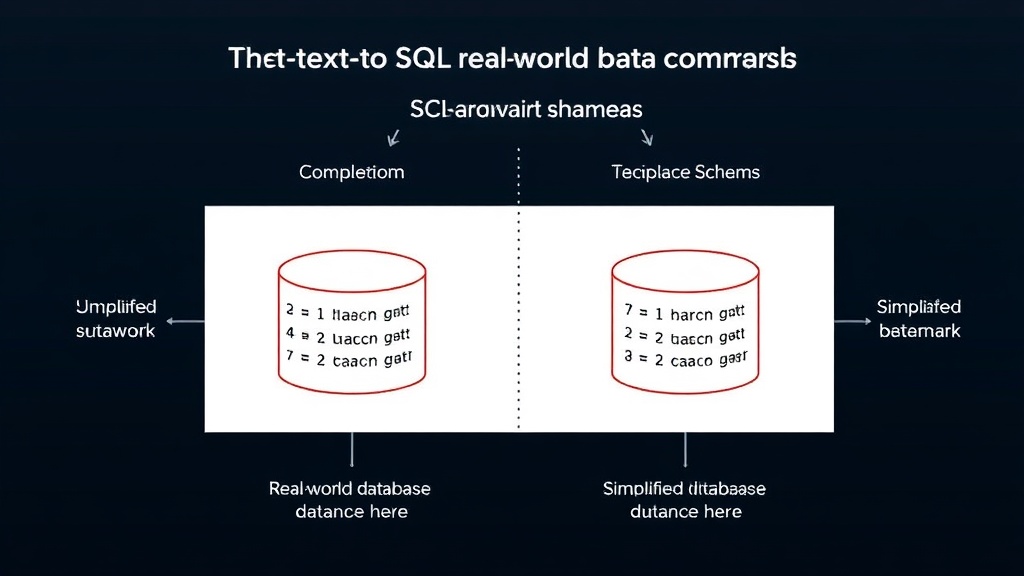
The core issue lies in the artificial simplicity of most benchmark datasets. These datasets are typically curated, clean, and relatively small, lacking the inherent challenges that characterize enterprise databases. Real-world data is rarely so accommodating. It is often plagued by inconsistencies, missing values, complex data types, intricate relationships between tables, and a sheer volume that dwarfs academic examples. Benchmarks that do not account for these factors provide a misleading picture of a text-to-SQL model's actual utility.
Consider the typical benchmark dataset: a few well-defined tables, clear column names, and straightforward relationships. A model trained on this can easily learn to map phrases like "total sales" to a `SUM(sales_amount)` aggregation on a `sales` table. However, in a production environment, the "sales" table might have multiple columns for sales figures (e.g., `gross_sales`, `net_sales`, `returned_sales`), requiring the model to understand context and disambiguate. Furthermore, the required information might be spread across dozens of tables, each with cryptic naming conventions and foreign key relationships that are not immediately obvious. The model must not only understand the query but also navigate a complex schema, inferring relationships and correctly joining tables.
Challenges Ignored by Current Benchmarks
Several key difficulties inherent in real-world data stores are systematically overlooked by existing text-to-SQL benchmarks:
- Schema Complexity and Ambiguity: Production databases often feature hundreds or even thousands of tables and columns. Column names can be abbreviated, use inconsistent casing, or overlap in meaning. Schemas evolve over time, leading to legacy tables and complex, non-obvious relationships. Benchmarks usually feature schemas with a dozen or so tables, often with human-readable names.
- Data Sparsity and Missing Values: Real-world data frequently contains missing values (NULLs) or placeholder values (e.g., 0, -1, 'N/A') that require careful handling. A model that assumes complete data will produce incorrect results when encountering these situations, failing to correctly apply aggregations or filters.
- Complex Data Types and Formats: Dates might be stored as strings in various formats, numerical data might include currency symbols or commas, and text fields could contain unstructured information. A robust text-to-SQL system must parse and interpret these variations, a task often simplified or ignored in benchmark datasets.
- Multi-Turn Conversations and Context: Many real-world data exploration tasks involve a series of follow-up questions where context from previous turns is crucial. For example, a user might first ask for "all customers in California" and then, in a subsequent turn, ask "show me their recent orders." Models need to maintain conversational state and refer back to previous query results or context, a capability rarely tested in single-shot benchmark questions.
- Data Volume and Performance: While not strictly a semantic challenge, the sheer volume of data in production databases means that inefficiently generated SQL queries can lead to timeouts or excessive resource consumption. Benchmarks typically use small datasets where query performance is not a significant differentiator.
- Domain-Specific Knowledge: Many industries have specialized terminology and implicit business rules that are not captured in generic benchmarks. Understanding a query like "What were our Q3 earnings before tax impact?" requires domain knowledge about what constitutes "earnings" and how "tax impact" is calculated, information not present in the schema alone.
The Need for More Realistic Evaluation
To truly advance the field of text-to-SQL, benchmark creators must prioritize realism. This involves several key shifts:
Firstly, benchmarks should incorporate datasets that mimic the scale and complexity of enterprise databases. This could involve using anonymized, but structurally representative, subsets of production databases or generating synthetic data that explicitly models common data quality issues like sparsity, inconsistent formatting, and complex relationships. Developers of these benchmarks should focus on creating schemas with hundreds of tables and thousands of columns, populated with data that reflects real-world imperfections.
Secondly, evaluation metrics need to evolve. Beyond simple exact match accuracy on the generated SQL, benchmarks should include metrics that assess the semantic correctness of the query results, the efficiency of the generated SQL, and the model's ability to handle ambiguity and follow-up questions. This might involve running the generated SQL against the database and comparing the results to ground truth, or evaluating the model's performance in a simulated conversational setting.
Thirdly, there needs to be a greater emphasis on evaluating models in their intended operational context. This means moving beyond static question-answer pairs to more dynamic, interactive evaluations. Researchers could develop frameworks that simulate user interactions with a live or near-live database, allowing for the assessment of conversational capabilities, error handling, and the impact of schema evolution.
The implications of this gap are significant. Companies investing in natural language interfaces for data access risk deploying systems that appear functional on paper but fail in practice. This can lead to a loss of trust in AI capabilities, wasted development resources, and missed opportunities for data-driven decision-making. For developers building these systems, it means that optimizing for current benchmarks may not translate to real-world success. The challenge is to bridge this gap, ensuring that text-to-SQL technology can reliably unlock the vast potential of enterprise data.