Understanding the Quantum Threat to Encryption
Quantum computers, when fully realized, will possess the computational power to break many of the encryption algorithms currently securing our online communications. This isn't a distant sci-fi scenario; the development of quantum computing is accelerating, and the internet needs to prepare. The primary threat comes from Shor's algorithm, which can efficiently factor large numbers and compute discrete logarithms. These are the mathematical foundations of widely used public-key cryptosystems like RSA and Elliptic Curve Cryptography (ECC). If these systems are compromised, secure connections, digital signatures, and data confidentiality are at risk.
Post-quantum cryptography (PQC) is the defense. These are new cryptographic algorithms designed to be resistant to attacks from both classical and quantum computers. Organizations like the National Institute of Standards and Technology (NIST) are standardizing these new algorithms. The transition to PQC is a complex, multi-year process, and many websites and services are still operating with vulnerable classical encryption methods.
This guide provides a practical, hands-on approach to assessing a website's current encryption posture and identifying potential vulnerabilities to quantum attacks. You don't need to be a cryptography expert. With basic computer skills and free tools, you can gain a solid understanding of where a website might be susceptible and communicate these findings effectively.

Assessing Website Encryption with Browser Tools
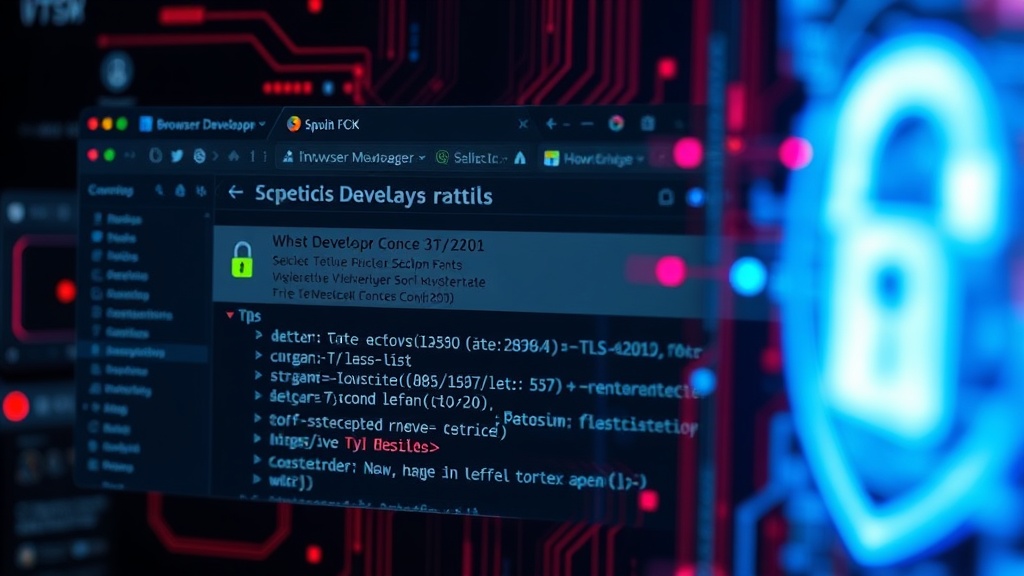
The first step in evaluating a website's quantum-readiness involves examining its current transport layer security. Most modern websites use TLS/SSL to encrypt data in transit. We can use built-in browser developer tools to inspect the cryptographic protocols and cipher suites a website is employing.
Steps for Analysis:
- Open the Website: Navigate to the website you want to analyze in your web browser (Chrome, Firefox, Edge, etc.).
- Open Developer Tools: Right-click anywhere on the page and select "Inspect" or "Inspect Element." Alternatively, use keyboard shortcuts (F12 on Windows/Linux, Option+Command+I on macOS).
- Navigate to the Security Tab: In Chrome and Edge, this is usually under the "Security" tab. In Firefox, it might be under the "Network" tab, where you can inspect individual requests and their security details. Look for details related to the connection's security.
- Examine the Connection Details: Once in the Security or Network tab, refresh the page. Click on the main document request (usually the first one). You will see details about the connection, including:
- Protocol: Look for TLS versions. TLS 1.2 is common, but TLS 1.3 is preferred for its enhanced security and performance. Older versions like TLS 1.0 and 1.1 are deprecated and should not be used.
- Cipher Suite: This is the most critical part for quantum threat assessment. A cipher suite is a set of algorithms that establish a secure connection. It typically includes a key exchange algorithm, an authentication algorithm, and a bulk encryption algorithm.
What to look for regarding cipher suites:
- Key Exchange: Algorithms like RSA key exchange are vulnerable because RSA itself is breakable by quantum computers. Look for cipher suites that use Diffie-Hellman (DH) or Elliptic Curve Diffie-Hellman (ECDH) for key exchange. Even better are suites that support ephemeral key exchange (DHE or ECDHE), which generate a new key for each session, providing forward secrecy.
- Bulk Encryption: Algorithms like AES (Advanced Encryption Standard) with a key size of 128 bits or more are currently considered quantum-resistant. Quantum computers do not offer a significant speedup for symmetric encryption algorithms like AES, unlike asymmetric algorithms. Grover's algorithm can theoretically reduce the effective key strength by half, meaning AES-128 would be roughly equivalent to 64-bit security. Therefore, AES-256 is recommended.
- Signature Algorithm: The server's digital certificate is signed using an algorithm. If this is RSA or ECDSA, it could be vulnerable. Look for certificates signed with SHA-256 or SHA-384. NIST has also approved new signature algorithms as part of PQC, but these are not yet widely deployed.
If a website is still using cipher suites that rely heavily on vulnerable RSA key exchange or older hashing algorithms, it's a strong indicator that it has not yet been updated for quantum resilience.
Using Online Scanners for Deeper Analysis
While browser tools provide a good on-the-spot check, dedicated online SSL/TLS scanners offer more comprehensive analysis and often flag specific vulnerabilities. These tools connect to the website's server and perform a battery of tests, reporting on protocol versions, cipher suite support, certificate validity, and known weaknesses.
Recommended Tools:
- Qualys SSL Labs Server Test: This is arguably the most thorough free tool available. Simply enter the website's domain name, and it will perform an in-depth analysis of its SSL/TLS configuration. It provides a letter grade (A+ to F) and detailed reports on the protocols, key exchange, encryption strength, and certificate status. It specifically flags cipher suites that are vulnerable to known attacks, including those that would be susceptible to quantum computers.
- ImmuniWeb SSLScan: Another excellent free tool that provides a detailed security report, including checks for TLS configuration, supported ciphers, and potential vulnerabilities.
Interpreting Scanner Results:
When using these scanners, pay close attention to the following sections:
- Protocol Support: Ensure the server supports TLS 1.2 and, ideally, TLS 1.3. Disable support for older, insecure protocols (SSLv2, SSLv3, TLS 1.0, TLS 1.1).
- Key Exchange: The scanner will list the supported key exchange methods. Prioritize those that offer strong forward secrecy (e.g., ECDHE). Avoid configurations that heavily rely on static DH or RSA key exchange.
- Cipher Suites: The scanner will list all supported cipher suites, ordered by preference. Look for suites that use AES-256 for encryption and strong key exchange mechanisms. Tools like Qualys SSL Labs will explicitly flag suites that are weak or vulnerable.
- Certificate Details: Check the certificate's signature algorithm. While SHA-256 is currently strong, future-proofing might involve looking at certificates signed with newer, quantum-resistant algorithms as they become available and are adopted by CAs.
A website that scores an A+ on Qualys SSL Labs and passes checks on other scanners, while still using classical cryptography, is likely configured optimally for the current threat landscape. However, this does not mean it is 'quantum-proof' in the long term. It means its current implementation of classical encryption is robust and uses best practices that minimize immediate risk and are a good stepping stone for PQC migration.
The Long Road to Post-Quantum Cryptography
The tools discussed above help assess a website's current security posture against *existing* threats and identify configurations that are *less vulnerable* to future quantum attacks. However, they cannot definitively tell you if a website is 'quantum-proof' in the sense of using actual post-quantum cryptographic algorithms. The widespread deployment of NIST-standardized PQC algorithms (like CRYSTALS-Kyber for key encapsulation and CRYSTALS-Dilithium for digital signatures) is still in its early stages.
Determining if a website is truly quantum-proof requires checking if its server is configured to use these new PQC algorithms for key exchange and digital signatures. This is a more advanced check, often requiring access to the server's configuration files or specialized network analysis tools that can inspect PQC handshake parameters. As of now, very few websites have fully transitioned to PQC.
The critical takeaway is that while we wait for universal PQC adoption, the best we can do is ensure our current encryption is as robust as possible. This means using TLS 1.3 with strong, ephemeral key exchange mechanisms, AES-256 encryption, and SHA-256 or SHA-384 signatures. This approach maximizes resilience against current threats and provides a solid foundation for the eventual transition to post-quantum cryptography.
If you manage a website, the immediate action is to audit your TLS configuration. Ensure you are using the strongest available classical ciphers and protocols. If your server software and hardware support it, begin exploring and testing PQC implementations. The transition will be gradual, but proactive assessment and preparation are key.