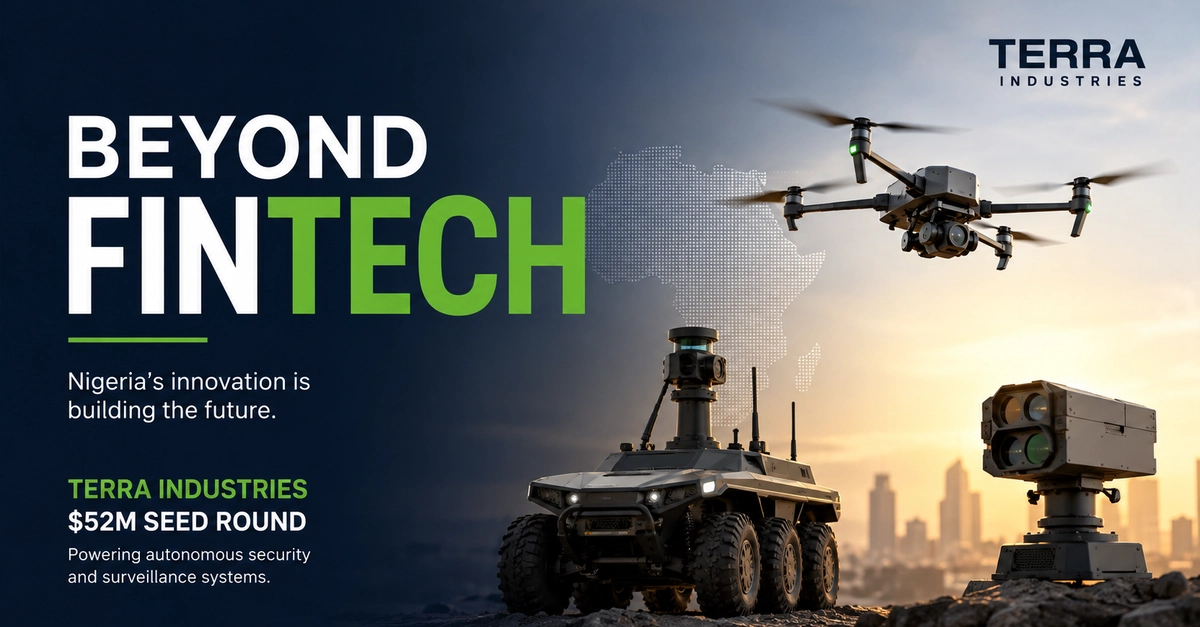
Beyond the Fintech Frenzy: Terra Industries' Autonomous Systems Ambition
Nigeria's startup scene often conjures images of fintech innovation – payments, digital banking, and sophisticated APIs dominate the conversation. Yet, beneath this well-established surface, a new wave of technically-driven ventures is emerging, signaling a broadening of the nation's developer ecosystem. Terra Industries stands at the forefront of this shift, a defense-tech startup that has quietly secured a substantial $52 million in seed funding. This capital infusion is not for a new payment gateway or a challenger bank, but for the development of sophisticated autonomous security systems aimed at safeguarding critical infrastructure.
The significance of this funding extends beyond its impressive scale. It represents a strategic bet on a future where artificial intelligence and robotics play a crucial role in national security and infrastructure protection. Terra Industries is not merely building drones; it is architecting a comprehensive ecosystem of interconnected autonomous systems designed for robust surveillance, threat detection, and operational planning. This multi-faceted approach positions the company as a key player in a burgeoning, yet often overlooked, sector of technological development.
A Suite of Autonomous Capabilities
Terra Industries' technological portfolio is diverse and designed for integrated operation. At its core are autonomous aerial systems, capable of providing persistent surveillance and rapid response over large areas. Complementing these are advanced surveillance systems that leverage AI for real-time analysis of visual data, identifying anomalies and potential threats with high precision.
The company is also developing unmanned ground vehicles (UGVs), which can be deployed for ground patrols, reconnaissance in hazardous environments, or direct intervention. These UGVs work in concert with AI-powered sentry systems, which act as intelligent guardians for fixed installations, capable of autonomous decision-making and threat neutralization within defined parameters. This combination of aerial and ground assets creates a layered security network, far more dynamic than static defenses.
Underpinning these hardware capabilities is a sophisticated software backbone. Terra's mission-planning software allows operators to define complex operational zones, flight paths, and engagement rules, tailored to specific mission requirements. This software is crucial for coordinating the actions of multiple autonomous units, ensuring seamless operation and maximizing efficiency. Furthermore, dedicated threat-detection systems employ machine learning algorithms to analyze sensor data from all deployed assets, identifying potential security breaches or hostile activities with a low false-positive rate.
ArtemisOS: The Unifying Intelligence Layer
The true innovation at Terra Industries lies in its proprietary software platform, ArtemisOS. This AI-powered operating system serves as the central nervous system for the entire suite of autonomous systems. ArtemisOS is designed to achieve a level of operational synergy that is difficult to attain with disparate, independently controlled systems. It integrates data streams from aerial drones, ground vehicles, and static sensors, creating a unified operational picture for human commanders.
Think of ArtemisOS less like a simple command-and-control interface and more like a highly intelligent air traffic controller for a fleet of autonomous agents. It not only directs their movements and tasks but also learns from their collective experiences, optimizing future missions and threat responses. This AI-driven orchestration allows for adaptive defense strategies, where the system can dynamically reallocate resources and adjust tactics in response to evolving threats in real-time. The platform's AI capabilities are central to its promise of autonomous decision-making and predictive threat assessment, moving beyond reactive security measures to proactive defense.

Implications for Critical Infrastructure Security
The application of Terra Industries' technology is primarily focused on protecting critical infrastructure – power grids, oil and gas facilities, water treatment plants, and major transportation hubs. These assets are often vast, difficult to secure with traditional methods, and represent high-value targets for state and non-state actors. Autonomous systems offer a scalable and cost-effective solution for continuous monitoring and rapid response, far surpassing the capabilities of human patrols alone.
The integration of AI in threat detection is particularly noteworthy. Instead of relying on human operators to sift through hours of surveillance footage or analyze sensor logs, ArtemisOS can perform these tasks autonomously, identifying subtle patterns indicative of intrusion or sabotage. This not only speeds up response times but also reduces the cognitive load on security personnel, allowing them to focus on strategic decision-making rather than routine monitoring.
What remains to be seen is how these systems will be integrated into existing defense and security frameworks. The operationalization of such advanced autonomous technology requires significant changes in training, doctrine, and regulatory oversight. The successful deployment of Terra Industries' systems will depend not only on their technical prowess but also on their ability to seamlessly interface with human command structures and comply with evolving legal and ethical guidelines surrounding autonomous operations.
A New Frontier for Nigerian Tech
Terra Industries' significant funding round and its focus on defense technology signal a maturation of Nigeria's tech ecosystem. While fintech has been the dominant narrative, this investment highlights the growing capacity and ambition in other high-tech sectors. It demonstrates that Nigerian startups can compete on a global stage not just in software services, but also in hardware development, advanced robotics, and AI-driven defense solutions.
This diversification is crucial for the long-term health and innovation potential of the region's technology sector. It attracts a different kind of talent, fosters interdisciplinary research, and opens up new avenues for economic growth. For developers, it means more opportunities in complex, cutting-edge fields that extend far beyond consumer-facing applications. The challenges of building robust, reliable autonomous systems for critical infrastructure security require deep expertise in areas like embedded systems, real-time operating systems, advanced AI/ML, and complex integration testing – skills that are in high demand globally.
The $52 million seed funding for Terra Industries is more than just a financial transaction; it's a statement of intent. It underscores a commitment to developing advanced technological solutions for some of the most pressing security challenges facing nations worldwide, all while pushing the boundaries of what's possible within the African tech landscape.