Sandboxing Untrusted Code: Meet CubeSandbox
As artificial intelligence agents evolve to perform increasingly complex tasks, their ability to write, compile, and execute code dynamically presents a significant security challenge. The core problem lies in how to safely run this untrusted code. A malicious script or even a simple coding error executed by an AI agent could lead to unauthorized access to host files or system instability. Traditional software containerization solutions, while robust, are not always sufficient to prevent sophisticated escape attempts.
Tencent Cloud has addressed this critical need by open-sourcing CubeSandbox, a new security sandbox designed specifically for the execution of untrusted code, particularly in the context of AI agents. The project aims to provide a highly secure and performant environment that isolates code execution, preventing potential damage to the host system.
The Architecture of Security and Speed
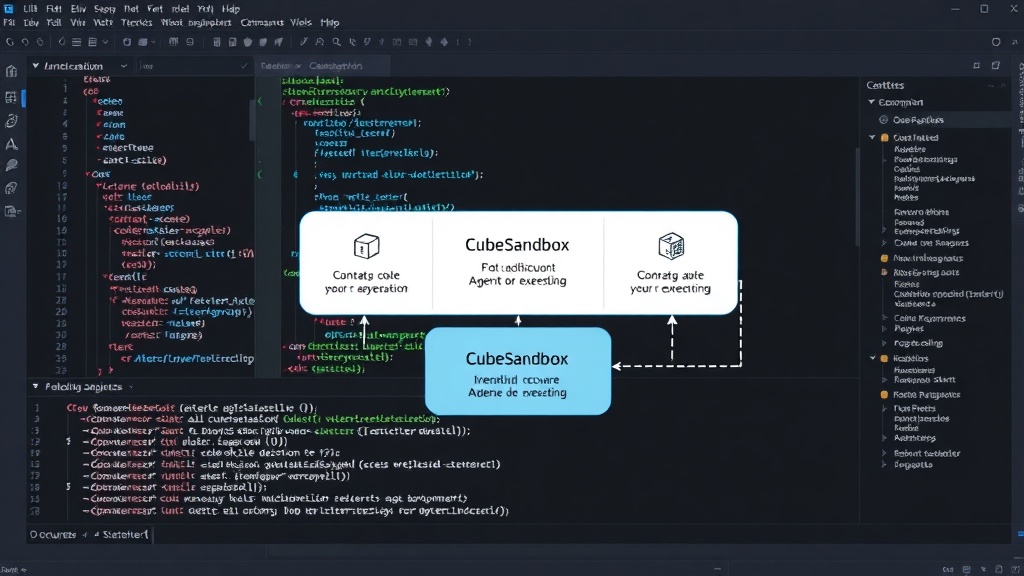
CubeSandbox distinguishes itself through its lightweight and efficient design. Unlike traditional virtual machines or heavier container solutions, CubeSandbox leverages advanced isolation techniques to create a secure execution environment with minimal overhead. This approach is crucial for AI agents, which often require rapid execution of code snippets for tasks like data analysis, algorithm testing, or even self-debugging.
The sandbox is built upon a foundation of robust isolation mechanisms. It operates by creating a confined environment where the AI agent's code runs. This environment is strictly controlled, limiting the agent's access to system resources, network interfaces, and file systems. Any attempt by the executed code to breach these boundaries is intercepted and blocked by the sandbox's security layer.
One of the key design principles behind CubeSandbox is its speed. The overhead introduced by the sandbox is minimized, ensuring that the performance of code execution is not significantly degraded. This is achieved through careful engineering and the selection of efficient isolation technologies. The goal is to provide a security layer that is both strong and practically invisible in terms of performance impact, enabling AI agents to operate efficiently without compromising system security.
Addressing the AI Agent Code Execution Problem
The proliferation of AI agents capable of generating and executing code has created a new attack surface. These agents, often developed by third parties or operating in dynamic environments, cannot be implicitly trusted. Scenarios like a coding assistant generating code for a user, or an AI agent testing new algorithms, necessitate a secure execution environment. Without it, the risks are substantial:
- Data Leakage: Malicious code could exfiltrate sensitive data from the host system.
- System Compromise: An agent could execute commands that lead to full system takeover.
- Denial of Service: Erroneous or malicious code could crash the host system or consume all its resources.
- Supply Chain Risks: If AI agents integrate third-party libraries or code, vulnerabilities in those components could be exploited.
CubeSandbox is engineered to directly counter these threats. By providing a secure, isolated space for code execution, it acts as a critical safeguard. Developers can integrate CubeSandbox into their AI agent platforms to ensure that even if an agent encounters or generates harmful code, the underlying infrastructure remains protected. This allows for the development and deployment of more sophisticated and capable AI agents with greater confidence.
Performance Benchmarks and Use Cases
While specific benchmark figures are still emerging from early adopters and the open-source community, initial reports suggest that CubeSandbox offers competitive performance compared to existing solutions. The project emphasizes its ability to handle a high volume of code execution requests with low latency, making it suitable for real-time applications and large-scale AI deployments.
Potential use cases for CubeSandbox are broad:
- AI Development Platforms: Securely running and testing AI-generated code during development.
- Code Generation Services: Providing a safe environment for users to test code generated by AI assistants.
- Automated Security Testing: Using AI agents to probe systems for vulnerabilities within a controlled sandbox.
- Educational Tools: Allowing students to experiment with code execution in a safe, isolated environment without risking their local machines.
- AI Agent Orchestration: Managing and executing tasks for fleets of AI agents that require code execution capabilities.
The open-source nature of CubeSandbox is a significant advantage. It allows the security community to scrutinize the code, contribute improvements, and adapt it to specific needs. This collaborative approach is vital for building trust and ensuring the ongoing security and effectiveness of the sandbox.
The Future of Secure AI Execution
CubeSandbox represents a proactive step by Tencent Cloud to address the evolving security landscape of AI. As AI agents become more autonomous and integrated into critical systems, the need for robust, high-performance security solutions will only intensify. By open-sourcing this technology, Tencent Cloud is enabling broader adoption and fostering innovation in the field of secure AI execution.
The project's focus on speed and security provides a compelling solution for developers and organizations building AI-powered applications. It lowers the barrier to entry for implementing strong security measures, encouraging the development of more powerful and trustworthy AI agents. The community's engagement will be key to its long-term success, driving further enhancements and ensuring it remains at the forefront of AI security technology.