
The Long Wait for Tail-Call Optimization in C
For decades, C developers have operated without a crucial compiler optimization: tail-call optimization (TCO). This absence meant that recursive functions, even those elegantly structured to be tail-recursive, would consume stack space with each call, eventually leading to stack overflows for deep recursions. This limitation forced C programmers to often rewrite recursive algorithms iteratively, sacrificing clarity for the sake of memory management. Now, that paradigm is beginning to shift, with C compilers gradually adopting TCO, a move that signals a significant evolution for the language, particularly in performance-sensitive domains.
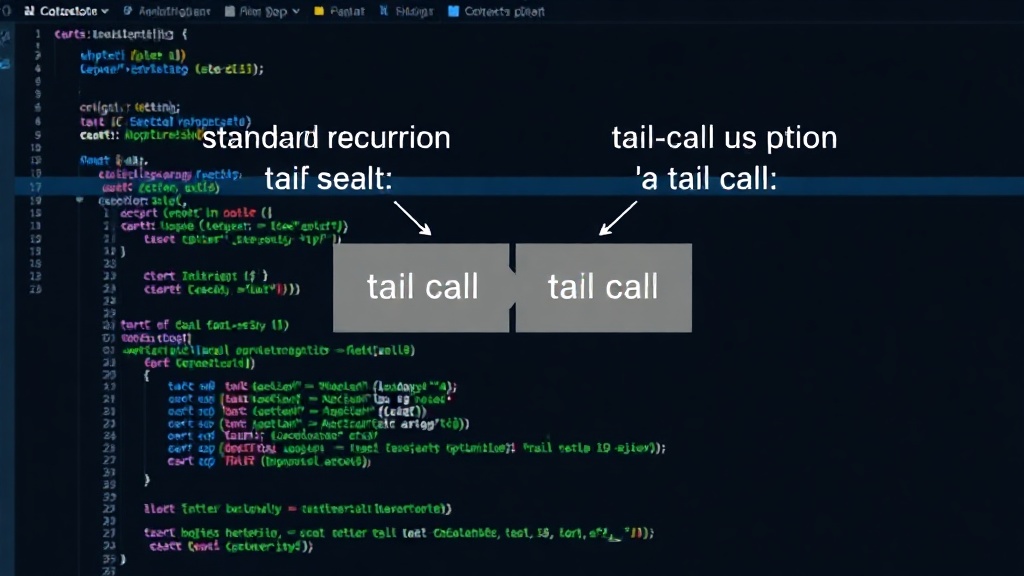
Tail-call optimization is a compiler technique that transforms a function call occurring as the very last operation in another function (a tail call) into a jump. Instead of pushing a new stack frame for the called function, the compiler reuses the existing stack frame. This effectively turns recursion into iteration at the machine code level, eliminating the risk of stack overflow and improving performance. Languages like Scheme, Haskell, and even modern JavaScript engines have supported TCO for years, recognizing its importance for functional programming paradigms and efficient recursion.
The recent emergence of TCO support in C compilers is not a sudden development but rather a culmination of ongoing discussions and proposals within the C standards committee and compiler development communities. While the C standard itself has not historically mandated TCO, compiler implementers have now begun to integrate it. This is a substantial, albeit late, arrival for a feature that has been a staple in many other programming languages for a considerable time. The implications are far-reaching, especially for systems programming, embedded systems, and any area where C's performance and low-level control are paramount.
Why Now? The Technical and Practical Drivers
Several factors likely contribute to the timing of TCO's integration into C compilers. Firstly, the increasing complexity of software and the desire for more expressive, maintainable code are pushing developers to explore more elegant solutions, including recursion. As C continues to be a foundational language for operating systems, game engines, and high-performance computing, enabling efficient recursion directly within the language itself becomes increasingly valuable. Developers no longer have to resort to manual stack management or iterative rewrites for every deep recursive pattern.
Secondly, advancements in compiler technology and analysis have made implementing TCO more feasible and reliable. Modern compilers are sophisticated tools capable of intricate code analysis. The ability to accurately identify tail calls and perform the necessary transformations without introducing regressions or subtle bugs has matured. This technical readiness, combined with a growing recognition of the practical benefits, has likely spurred compiler vendors to prioritize this feature.
The initial support for TCO in C compilers might be optional or controlled by specific compiler flags. This approach allows developers to opt into the optimization, providing a gradual adoption path and enabling testing and validation. As the feature becomes more robust and widely adopted, it could eventually become a more standard offering, fundamentally changing how certain classes of problems are approached in C.
Implications for C Development
The most immediate impact of TCO in C will be on how developers write recursive functions. Code that was previously prone to stack overflows can now be written more directly and readably. This could lead to a resurgence in the use of recursive patterns for algorithms where they offer superior clarity, such as tree traversals, certain parsing algorithms, and state machine implementations. The cognitive load on developers will decrease as they can focus more on the algorithmic logic rather than the mechanics of stack management.
For embedded systems and environments with highly constrained memory, TCO offers a significant advantage. By preventing stack growth, it allows for deeper recursion without exhausting limited RAM. This is critical for firmware, real-time operating systems, and deeply embedded applications where every byte of memory counts. The ability to write more declarative, recursive code without the penalty of stack consumption opens up new possibilities for efficient resource utilization.
Furthermore, the presence of TCO could influence C's role in emerging fields. In areas like high-performance computing (HPC) and scientific simulation, where complex recursive algorithms are common, TCO can provide a performance boost and simplify code maintenance. As C++ continues to evolve with features like `constexpr` and concepts, the integration of TCO into standard C compilers might also encourage more modern programming practices within the C ecosystem, bridging the gap with languages that have long offered such optimizations.
The Road Ahead: Standardization and Adoption
While TCO is starting to appear in C compilers, its widespread and standardized adoption will be a gradual process. The C Standards Committee will likely need to formally address TCO to ensure consistent behavior across different compilers and platforms. This standardization will be crucial for portable codebases that rely on this optimization.
Developers will need to become familiar with the specific compiler flags and settings required to enable TCO. Understanding how their chosen compiler implements TCO, and any potential side effects or limitations, will be important. Benchmarking recursive functions with and without TCO will be essential to quantify the performance and memory benefits in real-world scenarios.
The arrival of tail-call optimization in C is more than just a new compiler feature; it represents a maturation of the language and its tooling. It acknowledges the evolving needs of modern software development and brings C more in line with other high-performance languages. For developers who have long yearned for more expressive and efficient recursive capabilities, this is a welcome, if belated, development that promises to refine how C code is written and optimized for years to come.