The Challenge of Domain Gaps in Synthetic Data
Synthetic data generation has become a powerful tool for training artificial intelligence models, particularly in computer vision. The promise is clear: create vast, labeled datasets without the cost, time, and privacy concerns associated with collecting real-world data. However, a significant hurdle remains, especially when models encounter real-world scenarios that deviate from the synthetic training environment. This phenomenon, known as the "domain gap," often leads to AI systems performing poorly in production, even after extensive training.
One of the most persistent and challenging aspects of this domain gap involves transparent objects. Unlike opaque objects with distinct edges and surfaces that are relatively straightforward to model and render, transparent materials like glass, water, or certain plastics present complex optical challenges. These include refraction, reflection, and subtle distortions that can drastically alter the appearance of objects behind or within them. Standard synthetic data pipelines often struggle to accurately capture these nuances, resulting in models that fail to recognize or correctly interpret these objects in real-world images. This is particularly problematic for industrial applications where precise object detection and manipulation are critical.
Consider a self-driving car's perception system trained on synthetic data. If that data doesn't accurately represent the way light bends through a rain-streaked windshield or reflects off a wet road surface, the system's ability to perceive obstacles or lane markings under adverse weather conditions will be severely compromised. Similarly, a robotic arm designed for automated manufacturing might fail if its training data doesn't account for the subtle visual cues of handling glass bottles or liquid-filled containers.
Advancing to High-Fidelity Validation Assets
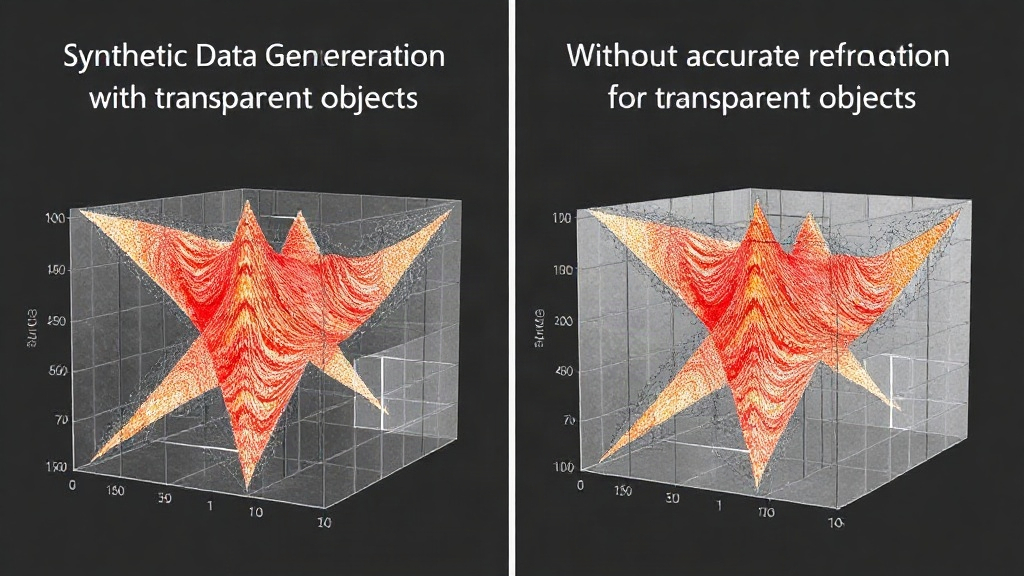
Recognizing these limitations, the focus is shifting from simply generating "pretty" images to creating industrial-grade evaluation assets. The goal is to move beyond superficial visual fidelity and achieve true "geometric truth." This means that not only should the rendered images look realistic, but the underlying geometric and physical properties must be precisely modeled. For transparent objects, this involves accurately simulating how light rays interact with surfaces, bend as they pass through different media, and reflect back to the virtual camera.
The development of solutions specifically addressing these challenges aims to stress-test AI models against the most complex visual phenomena. This includes dynamic lighting conditions that change the appearance of reflections and refractions, as well as intricate object interactions where one transparent object might distort the view of another. By ensuring 100% geometric truth, these advanced synthetic data generation techniques provide a more robust training and validation pipeline. This allows developers to identify and rectify model weaknesses that would otherwise only surface in costly and potentially dangerous production failures.
The methodology often involves sophisticated rendering engines that support advanced optical simulation. These engines can model phenomena like caustics (the patterns of light formed when light is focused or dispersed by a surface or lens), subsurface scattering (how light penetrates and reflects within translucent materials), and complex Fresnel effects (which describe how the reflectivity of a surface changes with the angle of incidence). The data generated not only includes the rendered image but also precise ground truth annotations, such as depth maps, surface normals, and semantic segmentation masks, all of which are geometrically consistent with the rendered scene.
The Path Forward: Bridging the Gap for Real-World AI
The development of high-fidelity synthetic data is crucial for unlocking the full potential of AI in domains where visual perception is paramount and complex optical effects are common. Industries such as robotics, augmented reality, autonomous systems, and industrial inspection stand to benefit immensely. By providing AI models with training and validation data that accurately reflects the complexities of the real world, developers can build more reliable, robust, and safe AI systems.
The availability of open-source projects, such as the one linked for synthetic glass and transparent packaging generation, signifies a growing community effort to tackle these difficult problems. While these efforts are promising, the challenge of comprehensively covering all possible real-world variations and optical phenomena remains. Future work will likely involve further advancements in rendering technology, more sophisticated simulation of physical properties, and perhaps even hybrid approaches that combine synthetic data with targeted real-world data collection to fine-tune models.
Ultimately, the goal is to create synthetic data that is not just a proxy for real data, but a superior tool for building AI that can reliably perform in the wild. This requires a deep understanding of both computer graphics and the specific domain challenges AI models will face. The ongoing innovation in synthetic data generation suggests that the industry is moving towards this goal, promising more capable and trustworthy AI applications across a wider range of industries.