The Core Challenge: Bridging Document and Relational Worlds
Migrating data from MongoDB, a flexible NoSQL document database, to PostgreSQL, a rigid relational database, presents a fundamental challenge: reconciling their vastly different data structures. MongoDB documents can contain a heterogeneous mix of data types, including strings, dates, nested objects, and arrays, all within a single record. PostgreSQL, conversely, demands a predefined schema with fixed columns, strict data types, and explicit primary keys. This disparity means that simply copying data is insufficient; a deliberate transformation process is required.
The primary hurdle is not the synchronization mechanism itself, but rather ensuring that PostgreSQL can correctly interpret and store the shape of MongoDB documents. Before any data transfer can occur, developers must meticulously define the target PostgreSQL table structure. This involves deciding how to represent MongoDB's dynamic fields, nested objects, and arrays within PostgreSQL's columnar, typed environment. For instance, a common MongoDB document might include a 'user_profile' object containing 'address' (another object) and 'interests' (an array of strings). Translating this requires flattening nested objects into separate columns or perhaps JSONB columns in PostgreSQL, and deciding whether to store arrays as text, JSONB, or in separate related tables.
This was precisely the experience when testing a synchronization process with a visits collection from MongoDB to PostgreSQL. The initial assumption was that the sync tool would handle the heavy lifting. However, the real work involved pre-emptively designing the PostgreSQL table schema to accommodate the varied data present in the MongoDB source documents. This upfront schema design phase is critical for a successful and reliable data migration.
Choosing a Synchronization Tool
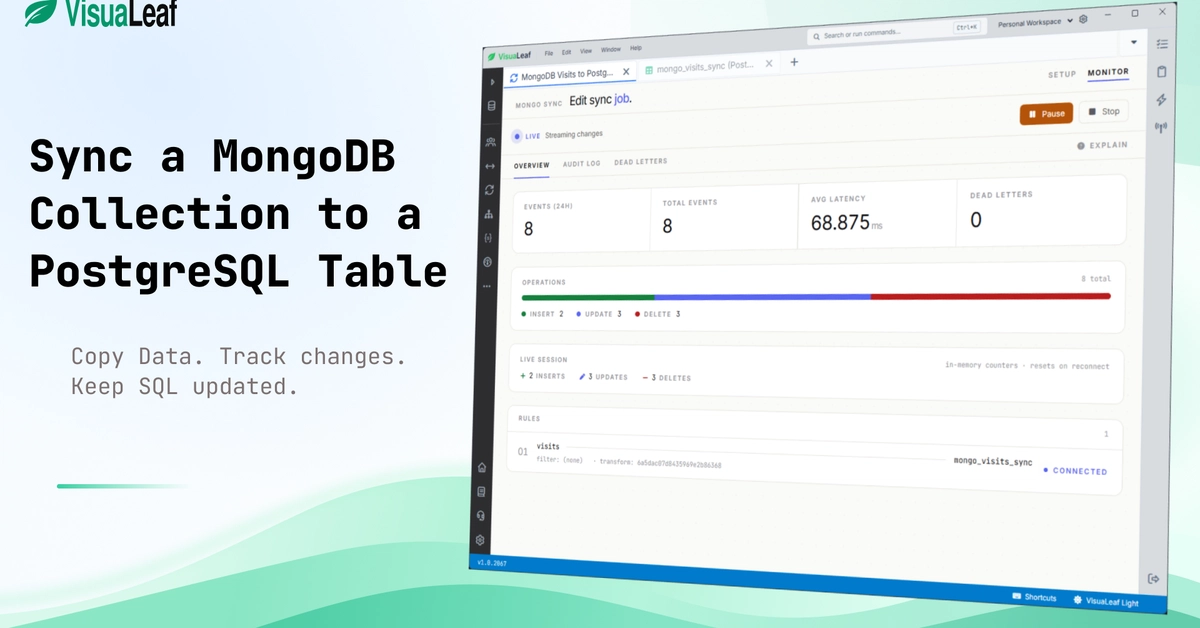
While custom scripting is an option for complex or highly specific migration needs, leveraging existing tools can significantly accelerate the process, especially for initial testing and workflow setup. For this particular test, VisuaLeaf Mongo Sync was employed. The appeal of such a tool lies in its visual interface, which simplifies the setup of the data pipeline. It allows users to define the source MongoDB collection, the target PostgreSQL table, map fields between the two, and monitor sync status. Although the tool automates much of the connection and transfer logic, it does not eliminate the need for manual intervention. Developers still need to create the target PostgreSQL table structure beforehand and carefully verify the field mappings to ensure data integrity and correctness during synchronization.
Designing the PostgreSQL Target Schema
The process of defining the PostgreSQL table schema is iterative and depends heavily on the structure of the source MongoDB collection. For the visits collection example, the MongoDB documents might look something like this:
{
  _id: ObjectId("60d5ecf1b4e6f8a3f4d3f8a3"),
  timestamp: ISODate("2023-10-27T10:00:00.000Z"),
  userId: "user123",
  page: "/home",
  referrer: "google.com",
  device: {
    type: "desktop",
    os: "Windows"
  },
  tags: ["new", "featured"]
}
To represent this in PostgreSQL, one might create a table with columns like:
id(SERIAL PRIMARY KEY) - mapping from MongoDB's_id, though often a UUID or BIGINT is preferred for production.timestamp(TIMESTAMP WITH TIME ZONE) - directly maps from MongoDB'stimestamp.user_id(VARCHAR) - maps fromuserId.page(VARCHAR) - maps frompage.referrer(VARCHAR) - maps fromreferrer.device_type(VARCHAR) - flattened from the nesteddevice.typeobject.device_os(VARCHAR) - flattened from the nesteddevice.osobject.tags(TEXT[]) - representing the array of strings directly as a PostgreSQL array type. Alternatively, this could be a JSONB column or a separate linked table.
The decision on how to handle nested objects and arrays is crucial. Flattening is straightforward but can lead to very wide tables and potential naming conflicts if sub-object keys are not unique. Using PostgreSQL's JSONB data type is a more direct way to preserve the nested structure but can make querying specific nested fields less performant and more verbose than querying native columns. Creating separate tables for arrays or nested objects with foreign key relationships is the most normalized approach, offering performance benefits for specific queries but increasing complexity.
The Synchronization Process
Once the PostgreSQL table schema is defined and created, the synchronization tool can be configured. This typically involves:
- Connecting to MongoDB: Providing connection details (URI, database, collection).
- Connecting to PostgreSQL: Providing connection details (host, port, database, user, password).
- Field Mapping: Explicitly linking MongoDB fields to PostgreSQL columns. This is where the flattening or JSONB conversion logic is applied. For example, mapping
device.typefrom MongoDB to thedevice_typecolumn in PostgreSQL. - Data Type Coercion: Ensuring that data types are compatible or that the tool handles necessary conversions (e.g., MongoDB's ISODate to PostgreSQL's TIMESTAMP WITH TIME ZONE).
- Running the Sync: Initiating the one-time copy or setting up ongoing synchronization.
The 'sync' aspect implies more than just a one-time copy. For continuous synchronization, the tool needs to handle changes in the MongoDB collection. This could involve periodic polling, using MongoDB's change streams, or other mechanisms to detect and apply inserts, updates, and deletes to the PostgreSQL table. The effectiveness and efficiency of these change detection and application methods are key to maintaining data consistency between the two databases.
Post-Synchronization Considerations
After the initial sync, ongoing data consistency is paramount. The choice between a one-time migration and continuous synchronization depends on the application's requirements. If the PostgreSQL database is intended as a read replica for analytics or reporting, continuous sync might be necessary. If it's a one-off data export, the process ends after the initial copy.
Developers must also consider performance implications. Querying data that has been flattened from nested structures might be faster than querying JSONB fields, but the schema design heavily influences this. Indexing strategies in PostgreSQL become critical for efficient data retrieval, especially as the dataset grows. Furthermore, handling potential data conflicts or errors during synchronization requires robust error logging and retry mechanisms.
The surprising detail here is not the complexity of the sync tools themselves, but the significant effort required in schema design and mapping, which is often underestimated. This process demands a deep understanding of both MongoDB's flexible document model and PostgreSQL's structured relational model, making it a task that requires careful planning and execution rather than just technical execution of a tool.