Unified AI Infrastructure in Rust
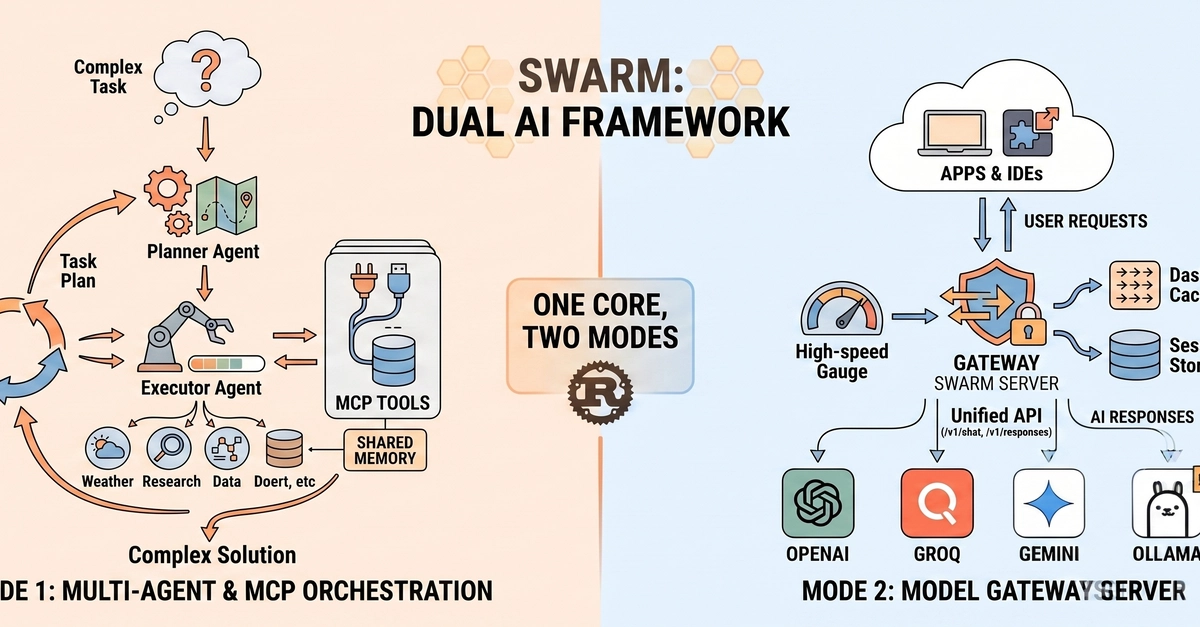
Developing complex AI systems often involves managing two distinct, yet related, components: an orchestration layer for coordinating agents and tools, and a gateway for routing requests to Large Language Models (LLMs). This separation typically necessitates managing separate infrastructure, leading to duplicated abstractions for runtimes, provider configurations, state management, and protocol definitions. Recognizing this inefficiency, a new open-source project named Swarm has emerged, built entirely in Rust. Swarm aims to unify these two critical pieces of infrastructure into a single, high-performance framework.
Swarm's core innovation lies in its dual-mode architecture. Instead of maintaining separate systems for agent orchestration and LLM gateway functionalities, Swarm integrates them around a single, high-performance Tokio runtime. This consolidation promises a more streamlined development experience and improved operational efficiency for AI applications. The project's author, focusing on a unified approach, sought to eliminate the overhead associated with managing disparate systems for agent coordination and model access.
Core Components and Design Philosophy
At its heart, Swarm is an AI orchestration framework and a model gateway. The framework provides the necessary tools and abstractions to define, manage, and execute multi-agent systems. This includes capabilities for agent lifecycle management, inter-agent communication, tool integration, and complex reasoning workflows. The model gateway component, on the other hand, handles the routing of requests to various LLM providers. This could involve managing API keys, selecting optimal models based on cost or performance, and abstracting away provider-specific nuances.
The decision to build Swarm in Rust is significant. Rust is renowned for its performance, memory safety, and concurrency primitives, making it an excellent choice for demanding, real-time applications like AI orchestration and model serving. The Tokio runtime, a popular asynchronous I/O framework for Rust, underpins Swarm's ability to handle numerous concurrent operations efficiently. This combination suggests that Swarm is designed for scalability and robustness, capable of managing a high volume of agent interactions and LLM requests without compromising performance.
The project's open-source nature, available on GitHub, invites community contribution and allows developers to inspect, modify, and integrate Swarm into their own projects. The repository provides the codebase, documentation, and examples necessary to get started. The author's motivation stemmed from a recurring need for shared runtime, provider abstractions, state management, and protocol contracts across agent orchestration and LLM routing, a problem Swarm directly addresses.
Addressing the Dual-Mode Challenge
Many existing AI stacks present a challenge where lightweight routing proxies are separate from more complex reasoning orchestrators. Swarm tackles this by bringing both functionalities under one roof. This unified approach means that agents can seamlessly interact with the LLM gateway, and vice-versa, without the complexities of inter-process communication or data serialization between separate services. This can lead to reduced latency, simpler deployment pipelines, and easier debugging.
For developers building AI applications, this unification offers several advantages. Instead of configuring and maintaining a separate API gateway and an orchestration engine, they can leverage Swarm's integrated system. This simplifies the overall architecture, reduces the attack surface, and potentially lowers operational costs. The shared state management and protocol contracts ensure consistency across the entire AI pipeline, from agent decision-making to LLM inference.
The project's GitHub repository, linked from the Dev.to post, serves as the central hub for Swarm. It contains the source code, issue tracker, and potentially contribution guidelines. Developers interested in exploring Swarm can clone the repository, examine the code, and experiment with its capabilities. The explicit mention of Tokio suggests a modern, asynchronous design, which is crucial for handling the I/O-bound nature of LLM interactions and agent communication.
Implications and Future Potential
Swarm's introduction signifies a move towards more integrated and performant AI infrastructure. By offering a unified solution for multi-agent orchestration and LLM gateway functionality in a high-performance language like Rust, it addresses a clear pain point for developers in the AI space. The project's potential lies in its ability to simplify the development and deployment of sophisticated AI agents and applications that rely heavily on LLM interactions.
What remains to be seen is how Swarm scales with very large numbers of agents or extremely high LLM request volumes. While Rust and Tokio provide a strong foundation, real-world performance under heavy load will be the ultimate test. Furthermore, the breadth of LLM provider integrations and the flexibility of its agent definition language will be key factors in its adoption by the broader developer community.
The project is positioned to attract developers who prioritize performance, safety, and control in their AI systems. Its open-source nature also makes it an attractive option for startups and research teams looking to build custom AI solutions without the constraints of proprietary platforms. The dual-mode architecture is a clever design choice that could set a new standard for how AI orchestration and model access are managed.