Introduction to Machine Learning Categories
Machine learning problems are broadly categorized based on the nature of the input data and the desired output. This classification is crucial for selecting appropriate algorithms and evaluation metrics. The primary categories include Supervised Learning, Unsupervised Learning, and Reinforcement Learning.
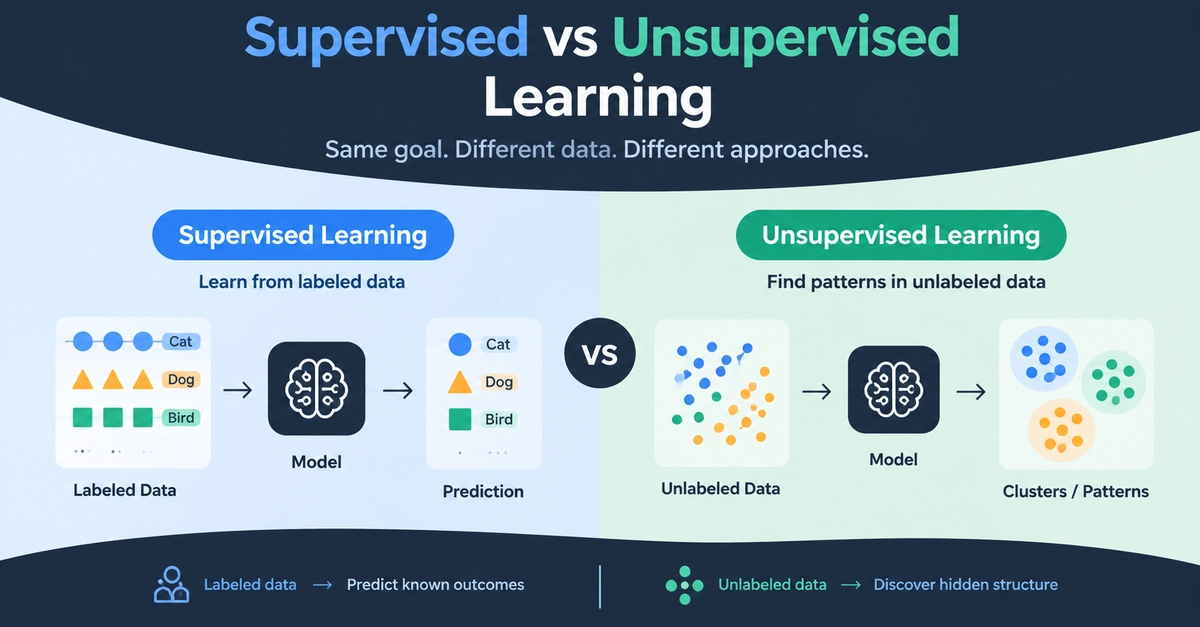
Supervised Learning: In this paradigm, models are trained on a dataset where each data point is paired with a correct output or label. The model learns to map input features to these known targets, essentially learning from examples with known answers. The goal is to predict outcomes for new, unseen data based on this learned mapping.
Unsupervised Learning: This approach deals with unlabeled data. The model's task is to explore the data and discover inherent patterns, structures, or relationships without any predefined targets. It's about finding hidden insights within the data itself.
Reinforcement Learning: Here, an agent learns by interacting with an environment. Through trial and error, the agent receives feedback in the form of rewards or penalties, aiming to maximize its cumulative reward over time. This is common in robotics and game AI.
Supervised Learning Explained
Supervised learning is akin to learning with a teacher. The training data consists of input-output pairs. For instance, in image classification, you would feed the model images of cats and dogs, each explicitly labeled as 'cat' or 'dog'. The algorithm's objective is to learn a function that can accurately predict the label ('cat' or 'dog') for new, unseen images. This type of learning is further divided into two sub-types:
Classification
Classification problems involve predicting a discrete category or class. The output is a label from a predefined set of categories. Examples include:
- Spam detection: Classifying an email as 'spam' or 'not spam'.
- Image recognition: Identifying objects in an image as belonging to specific classes (e.g., 'car', 'tree', 'person').
- Medical diagnosis: Predicting whether a patient has a particular disease based on their symptoms.
Algorithms commonly used for classification include Logistic Regression, Support Vector Machines (SVMs), Decision Trees, Random Forests, and Naive Bayes.
Regression
Regression problems, on the other hand, predict a continuous numerical value. The output is a real number. Examples include:
- House price prediction: Estimating the market value of a house based on features like size, location, and number of bedrooms.
- Stock price forecasting: Predicting the future price of a stock.
- Weather forecasting: Estimating temperature or rainfall amounts.
Popular regression algorithms include Linear Regression, Polynomial Regression, Ridge Regression, Lasso Regression, and Gradient Boosting Regressors.
Unsupervised Learning Explained
Unsupervised learning is like learning without a teacher, where the model must find structure in data on its own. The training data consists only of input features, with no corresponding output labels. The goal is to uncover hidden patterns, group similar data points, or reduce the dimensionality of the data. This approach is particularly useful when labeled data is scarce or when you want to explore data for novel insights.
Clustering
Clustering is the process of grouping similar data points together into clusters. Data points within the same cluster share common characteristics, while points in different clusters are dissimilar. Applications include:
- Customer segmentation: Grouping customers based on their purchasing behavior for targeted marketing.
- Document analysis: Grouping similar articles or documents by topic.
- Anomaly detection: Identifying data points that do not belong to any cluster, which might indicate fraudulent activity or system errors.
Common clustering algorithms include K-Means, DBSCAN, Hierarchical Clustering, and Gaussian Mixture Models (GMMs).
Dimensionality Reduction
Dimensionality reduction aims to reduce the number of features (variables) in a dataset while retaining as much of the important information as possible. This is useful for simplifying models, speeding up training, and visualizing high-dimensional data. Techniques include:
- Principal Component Analysis (PCA): A linear technique that transforms data into a new coordinate system where the greatest variance lies on the first few components.
- t-Distributed Stochastic Neighbor Embedding (t-SNE): A non-linear technique often used for visualizing high-dimensional data in 2 or 3 dimensions.
- Autoencoders: Neural networks trained to reconstruct their input, with a bottleneck layer that forces compression of the data.
These methods help in making complex datasets more manageable and interpretable.
Key Differences Summarized
The core distinctions between supervised and unsupervised learning lie in their data requirements, objectives, and evaluation methods:
- Data: Supervised learning requires labeled data (input-output pairs), while unsupervised learning uses unlabeled data.
- Objective: Supervised learning aims to predict a specific target variable, whereas unsupervised learning seeks to discover inherent patterns or structures within the data.
- Evaluation: Supervised models are typically evaluated using metrics like accuracy, precision, recall, F1-score (for classification), or Mean Squared Error (MSE), R-squared (for regression). Unsupervised models are evaluated using metrics that assess the quality of clusters (e.g., silhouette score) or the effectiveness of dimensionality reduction, which can be more subjective.
- Use Cases: Supervised learning is ideal for prediction and classification tasks where historical data with known outcomes is available. Unsupervised learning excels at exploratory data analysis, pattern discovery, and data preprocessing.
Choosing between supervised and unsupervised learning depends entirely on the problem you are trying to solve and the nature of the data available. For instance, if you want to predict customer churn based on past customer behavior, you would use supervised learning with historical data labeled as 'churned' or 'not churned'. If you want to group similar customers for marketing campaigns without a predefined outcome, unsupervised clustering would be more appropriate.
What nobody has addressed yet is the optimal hybrid approach when dealing with partially labeled datasets, where traditional supervised methods might be insufficient and purely unsupervised methods might miss critical predictive signals. Exploring semi-supervised learning techniques becomes paramount in such scenarios.