The Challenge of Employment Verification
Employment verification is a cornerstone of modern business operations, essential for everything from tenant screening and loan applications to background checks for new hires. Traditionally, this process has been a laborious, manual undertaking. It often involves HR departments or third-party services spending significant time on the phone, composing emails, or even sending faxes to former employers to confirm details like dates of employment, job titles, and salary. This manual approach is not only time-consuming but also prone to human error, delays, and potential security risks associated with sharing sensitive information over less secure channels.
The inherent inefficiencies of manual verification create bottlenecks. For landlords, this can mean vacant units for longer periods. For lenders, it can delay loan approvals. For employers, it can slow down the onboarding process for critical new talent. In an era where speed and accuracy are paramount, the reliance on outdated, manual methods for such a fundamental task represents a significant point of friction.
Superunit's AI-Powered Solution
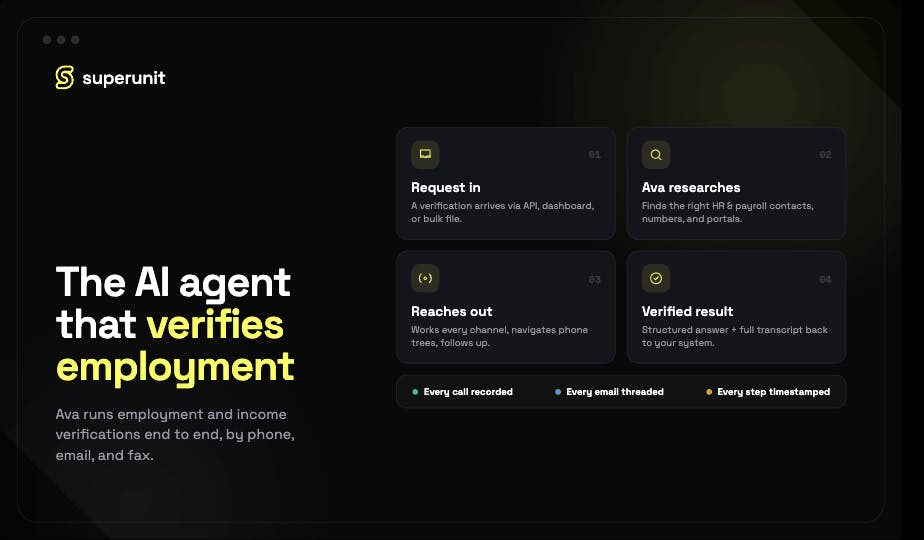
Superunit aims to eliminate this friction by deploying AI agents designed to automate the entire employment verification process. These agents act as digital employees, capable of initiating and managing verification requests across multiple communication channels simultaneously. Instead of a human spending minutes or hours on a single verification, Superunit's agents can handle a high volume of requests with speed and consistency.
The core functionality revolves around these AI agents interacting with former employers through phone calls, emails, and even the legacy fax system. This multi-channel approach is crucial. While many organizations have adopted email and digital communication, a significant number, particularly in certain industries or geographical regions, still rely on phone calls or fax for official communications. Superunit's ability to navigate this diverse communication landscape ensures broader applicability and higher success rates.

By leveraging artificial intelligence, Superunit's agents can understand the nuances of human conversation (in phone calls), interpret email content, and process information from faxes. This allows them to gather the necessary data points—such as employment dates, positions held, and sometimes salary information—without direct human intervention. The AI is trained to handle common responses, ask clarifying questions, and extract relevant data, effectively mimicking the actions of a human verifier but at a vastly accelerated pace.
Benefits for Businesses and Consumers
The implications of automating employment verification are far-reaching. For businesses that require these verifications (e.g., property management companies, lenders, background check services), Superunit offers a significant reduction in operational costs and turnaround times. What might have taken days can now be completed in minutes or hours, freeing up human resources for more strategic tasks.
For end-users, such as prospective tenants or loan applicants, this translates to a faster, smoother experience. The anxiety and uncertainty associated with waiting for verification to be completed are minimized. This can be particularly impactful in time-sensitive situations, like securing a rental property in a competitive market or obtaining financing for a major purchase.
The system's ability to handle multiple verification types—phone, email, and fax—makes it a versatile tool. This is a moment of genuine surprise, as many modern automation tools overlook the continued prevalence of fax in official business communications, a channel many assumed was on its way out. Superunit's inclusion of fax demonstrates a pragmatic approach to real-world business processes, ensuring that no avenue is left unexplored in the pursuit of comprehensive verification.
The Future of Verification
Superunit's entry into the market signals a broader trend towards AI-driven automation in traditionally manual administrative tasks. As AI capabilities advance, we can expect more sophisticated agents to tackle complex workflows. The accuracy and efficiency gains offered by Superunit could set a new standard for employment verification, potentially pressuring existing service providers to adopt similar technologies or risk becoming obsolete.
The core value proposition is clear: reduce time, reduce cost, and reduce errors. By abstracting the human element from a repetitive and often frustrating task, Superunit allows businesses to operate more efficiently and provide a better experience for their customers. This is not just about speed; it's about fundamentally rethinking how essential, yet often overlooked, administrative processes can be transformed by intelligent automation.