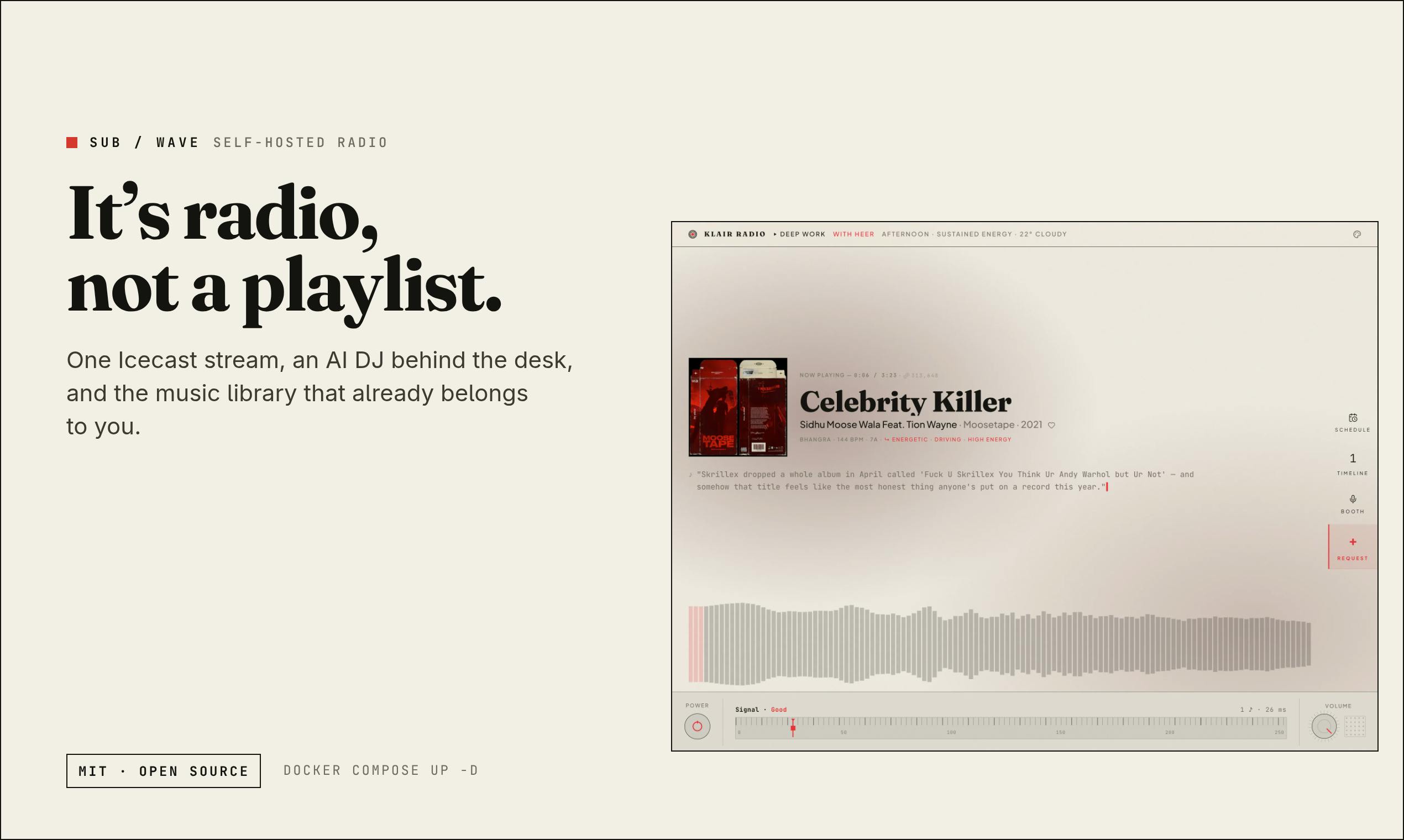
The Vision: Personalised Radio Reimagined
SUB/WAVE enters the digital audio landscape with a compelling proposition: to bring the intimacy and control of self-hosted radio back to users, augmented by artificial intelligence. Unlike traditional streaming services that offer curated playlists or algorithmically generated stations, SUB/WAVE aims to provide a deeply personal listening experience. The core concept revolves around users hosting their own radio stations, managing their music libraries, and even leveraging an AI-powered DJ to curate and present the music. This approach taps into a desire for ownership and customization that has been somewhat lost in the era of monolithic streaming platforms.
The platform's self-hosted nature means users have direct control over their audio content. This isn't just about selecting songs; it implies a level of flexibility that could extend to managing the audio quality, the metadata, and even the playback logic. For audiophiles and hobbyists, this offers a playground to experiment with their music collections in a way that's not typically possible with commercial services. The AI DJ component adds a layer of sophistication, promising to provide a dynamic and engaging listening experience that goes beyond simple track sequencing.
AI DJ: The Intelligent Curator
At the heart of SUB/WAVE's innovation is its AI DJ. This isn't merely a playlist generator; it's designed to act as a virtual radio host. The AI is intended to understand user preferences, the nuances of music genres, and potentially even contextual information to create a seamless and enjoyable listening flow. Imagine an AI that can introduce tracks, provide brief commentary, transition between songs smoothly, and adapt its style based on user feedback or the time of day. This level of intelligence transforms passive listening into a more interactive and curated event.
The development of such an AI DJ would likely involve sophisticated machine learning models. These models would need to be trained on vast datasets of music, DJ commentary, and listener behavior. Key challenges would include natural language generation for commentary, sophisticated recommendation engines that understand musical harmony and mood, and real-time adaptation to user input. The promise is a radio experience that feels both familiar, like listening to a human DJ, and novel, due to its AI-driven personalization and capabilities. The AI could potentially learn to mimic specific DJ styles or create entirely new ones, offering a unique sonic identity for each user's station.
Shared Streams: Community and Discovery
Beyond personal curation, SUB/WAVE introduces the concept of shared streams. This feature allows users to broadcast their personal radio stations to a wider audience, fostering a sense of community and enabling music discovery. It bridges the gap between a private listening experience and public broadcasting, akin to the early days of internet radio or independent music platforms. Users can tune into stations hosted by friends, family, or even strangers who share similar musical tastes. This social dimension is crucial, transforming a solitary activity into a shared cultural experience.
The shared stream functionality opens up avenues for niche communities to form around specific genres, artists, or even moods. It provides a platform for aspiring DJs, music enthusiasts, and independent artists to reach new listeners. The ability to share a curated experience means that the AI DJ's output, combined with the host's music selection, can be enjoyed by others. This creates opportunities for collaborative curation, where listeners might influence the playlist or even suggest new music for a host's station. The discovery aspect is particularly potent, allowing users to stumble upon music and personalities they might never have encountered through mainstream platforms.
Self-Hosting: Ownership and Control
The self-hosted aspect of SUB/WAVE is a significant differentiator. In an age where most digital services are cloud-based and proprietary, offering a self-hosted solution appeals to users who value data privacy, control over their digital assets, and a desire to escape the limitations of walled-garden platforms. Self-hosting implies that users run the SUB/WAVE software on their own hardware, whether it's a home server, a virtual private server (VPS), or even a dedicated machine. This grants them complete ownership of their music library and the operational data of their radio station.
This model requires a certain technical proficiency from the user, positioning SUB/WAVE as a tool for enthusiasts and developers. It's less of a plug-and-play consumer product and more of a customizable platform. The benefits of self-hosting include the potential for unlimited storage (bound only by the user's hardware), no subscription fees for the core service (beyond hosting costs), and freedom from external censorship or platform policy changes that could affect content availability. It's a return to a more decentralized model of digital content consumption and creation, reminiscent of early internet culture.
Technical Considerations and Future Potential
Implementing SUB/WAVE involves several technical considerations. The self-hosted server needs to be robust enough to handle music streaming, AI processing, and potentially multiple concurrent listeners. Efficient audio encoding and streaming protocols are essential for a smooth user experience. The AI DJ component requires significant computational resources and sophisticated algorithms for effective operation. For shared streams, network infrastructure and bandwidth management become critical to ensure reliable delivery to listeners.
Looking ahead, SUB/WAVE could evolve in several directions. Integration with existing music libraries (like local MP3 collections or even cloud-based services, if APIs permit) would broaden its appeal. Advanced AI features could include sentiment analysis of listener feedback to dynamically adjust the music and commentary. The platform could also develop tools for collaborative station management, allowing groups of friends to co-host a radio stream. The success of SUB/WAVE will likely hinge on its ability to balance technical complexity with user-friendliness, making the power of self-hosted, AI-driven radio accessible to a broader audience of music lovers and creators.